

Hardware is a commodity. Architecture is the asset. In mission-critical environments, system failure is rarely a product of faulty components. It's a failure of the foundational framework. You've likely managed the fallout of fragmented systems that don't scale or hardware-first planning that ignores ICT constraints. These inefficiencies compromise structural integrity and complicate long-term oversight. This article provides a disciplined, vendor-neutral lens to master technical AV system architecture. It's the only way to ensure long-term reliability in high-stakes infrastructure.
Core pillars. Scalable design. Unified infrastructure. We'll move beyond brand-specific features to focus on core engineering principles. You'll gain a clear roadmap for aligning complex AV requirements with existing ICT infrastructure through a structured framework. We'll examine the essential phases of the system lifecycle: conceptualization, rigorous documentation, and technical commissioning. The goal is a resilient system that functions as a unified, manageable endpoint on your network. We'll replace ad-hoc installation with methodical, standards-based engineering, utilizing frameworks such as ANSI/AVIXA D401.01:2023. This is the blueprint for infrastructure that doesn't just work, but endures under pressure.
Key Takeaways
- Define the logical framework of a system by distinguishing between functional requirements and technical specifications.
- Map the signal lifecycle and manage latency to ensure performance in real-time collaboration and broadcast environments.
- Master the principles of technical AV system architecture to integrate audio-visual endpoints into converged enterprise ICT networks.
- Standardize technical documentation and naming conventions to ensure clarity and reliability throughout the system lifecycle.
- Utilize independent engineering oversight and commissioning to verify that final execution aligns with the original architectural intent.
Foundations of Technical AV System Architecture
Effective technical AV system architecture is not a collection of hardware. It is a logical arrangement of hardware, software, and network protocols organized into a cohesive framework. Modern engineering requires a shift from point-to-point hardware connections to software-defined AV environments. This transition demands a rigorous distinction between functional requirements and technical specifications. Functional requirements define the user experience. Technical specifications define the infrastructure required to support it. Architecture bridges the gap between these two domains.
Vendor-neutrality is a prerequisite for long-term system scalability. Proprietary silos restrict modular expansion and create lifecycle vulnerabilities. By prioritizing open standards, engineers ensure that the Foundations of Audiovisual Systems remain robust even as individual components reach end-of-life. A disciplined architectural approach treats the AV system as a permanent asset rather than a disposable appliance. It's about structural integrity over brand loyalty.
The Structural Hierarchy of Modern AV Systems
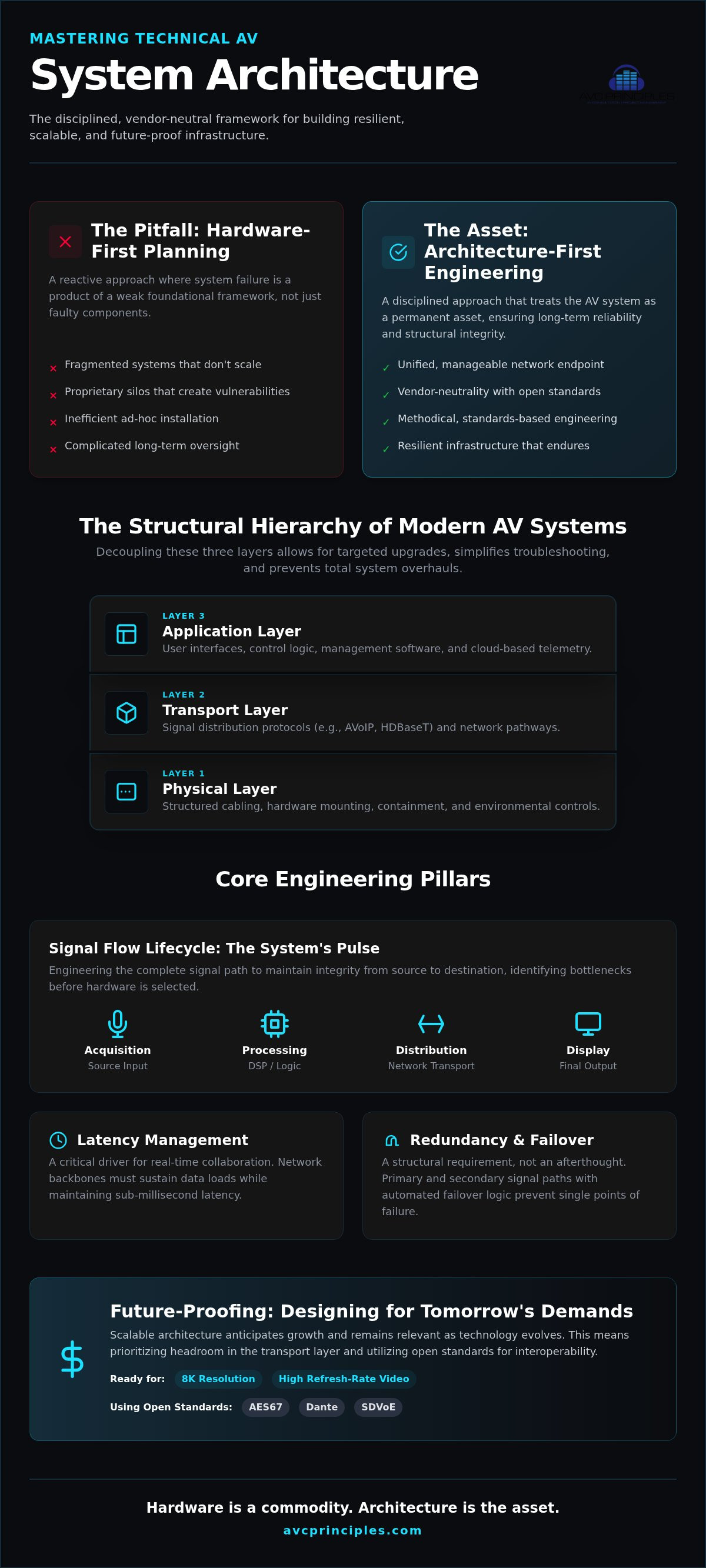
A structured hierarchy ensures technical reliability and simplifies troubleshooting. This model categorizes system components into three distinct layers:
- Physical layer: Structured cabling. Containment. Hardware mounting. Environmental considerations.
- Transport layer: Signal distribution protocols. HDBaseT. AVoIP. Legacy analog pathways.
- Application layer: User interfaces. Control logic. Management software. Cloud-based telemetry.
Decoupling these layers allows for targeted upgrades. You can modernize the application layer without disturbing the underlying physical infrastructure. It doesn't require a total system overhaul to update a user interface.
Architectural Scalability and Future-Proofing
Scalable technical AV system architecture anticipates growth. It utilizes modular expansion to accommodate new endpoints without core infrastructure overhauls. This requires a focus on high-bandwidth capacity and standardized communication protocols. Open standards such as AES67, Dante, and SDVoE provide the interoperability needed for multi-vendor environments.
Current engineering must account for 2026-era demands. This includes 8K resolution and high-refresh-rate video. Network backbones must sustain these data loads while maintaining sub-millisecond latency. A forward-looking architecture prioritizes headroom in the transport layer, ensuring the system remains relevant as display technologies evolve. Precision in design today prevents obsolescence tomorrow.
Core Engineering Pillars: Signal Flow and Processing
Signal flow is the fundamental pulse of any technical AV system architecture. It follows a rigid lifecycle. Acquisition. Processing. Distribution. Display. Engineering this path requires more than just connecting ports; it involves calculating the total path length and identifying potential bottlenecks before hardware is selected. In mission-critical environments, every millisecond matters. Signal integrity must be maintained from the source to the final output to avoid data degradation. A failure at any point in this chain compromises the entire system's utility.
Latency management is a critical driver for real-time collaboration. Systems must adhere to AVIXA industry standards to ensure performance reliability. Redundancy isn't an afterthought. It's a structural requirement. We implement primary and secondary signal paths with automated failover logic. This prevents single points of failure. This level of disciplined AV systems design ensures the signal chain remains intact during high-stakes operations. Acoustic and visual metrics act as primary architectural drivers. They dictate the necessary processing power and distribution bandwidth. For example, ANSI/AVIXA A103.01:2023 provides the procedure to measure spectral balance, ensuring audio systems meet specific performance benchmarks before they're handed over to the client.
Audio Signal Processing and Distribution
Audio integrity depends on Digital Signal Processing (DSP) architectures. In complex acoustic environments, DSP manages gain structure and echo cancellation. Network stability is paramount. Jitter and packet loss can disrupt clock synchronization. This leads to audible artifacts and timing errors. Modern designs integrate beamforming microphone arrays and spatial audio. These technologies require high-precision processing. Phase alignment must be maintained across the network. Directional accuracy is essential for natural communication in large-scale staged environments or command centers.
Video Path Integrity and Switching Logic
Video distribution involves complex digital handshakes. Managing EDID and HDCP across multi-node architectures prevents blank screens and resolution mismatches. Compression choice involves a technical trade-off. ProAV algorithms prioritize low latency, while standard IT codecs might sacrifice image detail to save bandwidth. For command center visualization, 4:4:4 chroma subsampling is mandatory to ensure the legibility of fine text and critical data overlays. Every pixel must be rendered with absolute fidelity to support rapid decision-making. We prioritize uncompressed or mathematically lossless paths for environments where visual accuracy is non-negotiable.
Converged Infrastructure: AV and ICT Network Integration
Convergence is an operational reality. Dedicated silos are obsolete. Modern technical AV system architecture exists within the enterprise ICT network. This integration demands a move beyond general IT management. Standard office traffic is bursty. AV traffic is continuous and high-bandwidth. Treating them as identical leads to packet loss and system instability. High-stakes environments require a disciplined approach to converged infrastructure. Every packet must be accounted for to maintain real-time performance.
A common objection suggests that IT teams can manage AV endpoints without specialized input. This is a risk. Multicast video streams behave differently than standard TCP traffic. Without precise engineering oversight, these streams can saturate uplinks and trigger network-wide failures. Independent design ensures that AV requirements align with ICT limits. It protects the integrity of both systems. This alignment prevents the "noisy neighbor" effect where AV traffic degrades core business applications. It's about maintaining structural balance across the entire enterprise network.
Network Topologies for AV over IP
Spine-leaf architectures are superior for large-scale AV distribution. They provide consistent, low-latency pathways between any two points. In contrast, traditional star topologies often create bottlenecks at the core switch. Critical engineering requirements include:
- IGMP snooping: Managing multicast traffic distribution to prevent network flooding.
- VLAN segmentation: Isolating AV signals from general data to ensure security and performance.
- PoE budget planning: Calculating power requirements for high-density hardware deployments.
Meticulous calculation prevents power-related hardware failures during peak operation. It ensures the physical layer can support the logical distribution without overheating or voltage drops. We design for the worst-case scenario to ensure uptime. It doesn't matter how advanced the software is if the power budget fails under load.
Security and Governance in AV Architecture
Security is a core design pillar. Every AV endpoint is a potential entry point for external threats. We implement 802.1X authentication to secure the network edge. This ensures only verified hardware can communicate. Encryption standards are non-negotiable for sensitive sectors. Government and healthcare environments require AES-256 or similar protocols for all signal transmissions. Independent engineering oversight provides the necessary verification for NIST and SOC 2 compliance. It ensures that the technical AV system architecture meets the highest standards of enterprise governance. This methodical approach minimizes risk in high-stakes infrastructure.
Standardising Technical Documentation and Specifications
Documentation is the definitive record of technical AV system architecture. It is not a secondary deliverable. It is the core asset required for lifecycle management and system maintenance. A fragmented documentation package leads to operational downtime and increased service costs. We prioritize a complete technical package that ensures every component is traceable. This requires standardizing symbols and naming conventions across all project stakeholders. Consistency prevents errors during the transition from conceptual schematics to detailed as-built documentation.
Rigorous documentation facilitates independent project oversight. It provides the baseline against which all installation work is measured. Without a clear technical narrative, commissioning becomes subjective. We eliminate ambiguity through precise engineering records. This methodical approach ensures that the original architectural intent is preserved throughout the build phase. Professional AV systems design requires this level of documentation to guarantee long-term reliability.
Essential Documentation Components
A comprehensive documentation package includes several critical elements. These files provide the technical foundation for the entire system lifecycle:
- Signal flow diagrams: The logical map of every audio, video, and control path. These are essential for rapid troubleshooting.
- Rack elevations and floor plans: Detailed drawings of physical hardware placement. These account for thermal management and service access.
- Cable schedules: A complete database of every cable run. This ensures traceability and simplifies future infrastructure audits.
These components work together to create a unified technical record. They allow facility managers to understand the system without relying on the original installer's memory. It's about data integrity over anecdotal knowledge.
Technical Specifications and Procurement
Technical specifications define the performance benchmarks. They must remain vendor-neutral to ensure competitive and compliant bidding. This approach prevents proprietary lock-in and encourages high-quality hardware selection based on merit. We define specific metrics for signal-to-noise ratios, image contrast, and network throughput. These benchmarks are non-negotiable requirements. They form the basis of the final commissioning process. When specifications are clear, the gap between owner expectations and contractor delivery disappears. A well-written spec is the most effective tool for risk mitigation in high-stakes infrastructure projects.
Independent Engineering Oversight and Commissioning
Commissioning represents the final verification of architectural intent. It is the phase where theoretical design meets physical reality. In high-stakes environments, commissioning is a rigorous engineering process rather than a cursory functional check. We verify that every component of the technical AV system architecture performs according to established specifications. This stage provides the necessary assurance that the investment in infrastructure will deliver the required operational outcomes. It is the definitive boundary between construction and operation.
Independent engineering oversight serves as a critical mediation layer. It bridges the gap between owners and installers. An independent consultant prioritizes performance benchmarks over equipment sales targets. This objective perspective ensures that the system meets multi-disciplinary requirements without compromise. We manage the transition from technical commissioning to operational handover. This includes validating broadcast levels, acoustic performance, and network reliability. Handover isn't complete until the system is fully documented and the operations team is trained to manage the new infrastructure.
The Commissioning Checklist
A systematic approach to testing prevents post-installation failures. Our methodology utilizes a structured checklist to verify every aspect of the build:
- Physical inspection: Verification of structured cabling, termination quality, and hardware mounting security.
- Functional testing: Validating every signal path, control logic sequence, and user interface response.
- Calibration: Adjusting audio and video systems to meet industry standards, including ANSI/AVIXA V201.01:2021 for contrast ratios and A103.01:2023 for spectral balance.
Calibration ensures the system operates at peak efficiency. It removes subjectivity from performance evaluation. We use calibrated measurement tools to prove compliance with the design intent. This data-driven approach provides a clear record of system health at the point of handover. It establishes the performance baseline for the entire system lifecycle.
Independent Oversight: Protecting the Investment
Equipment vendors often face a conflict of interest during the testing phase. Their primary goal is project closure. In contrast, an independent consultant focuses on long-term lifecycle stability. We provide more rigorous testing protocols that challenge the system's limits. This ensures compliance with stringent government and corporate engineering standards, such as NIST or SOC 2. Our role is to act as a trusted strategist for the owner, ensuring the final delivery matches the high-level conceptualization. To ensure your infrastructure meets these rigorous standards, consult with AVC Principles for independent AV engineering oversight. This disciplined oversight is the final safeguard for complex, mission-critical systems.
Engineering Resilience into Modern AV Infrastructure
Precision in technical AV system architecture is the only defense against infrastructure obsolescence. Success requires a transition from hardware-centric procurement to a logic-driven engineering framework. Signal flow integrity, converged ICT integration, and standardized documentation aren't optional. They're the prerequisites for stability in mission-critical environments. Independent oversight ensures these standards are met without the bias of equipment sales.
Enterprise systems demand a steady hand and a methodical approach to design. By prioritizing vendor-neutrality and rigorous commissioning, you protect the long-term value of your technical assets. This disciplined methodology transforms fragmented components into a unified, resilient ecosystem. Partner with AVC Principles for Technical AV Engineering Excellence. Our firm provides independent engineering oversight and a vendor-neutral design methodology. We offer proven expertise in mission-critical command centers to ensure your infrastructure performs under pressure. Your roadmap to technical reliability starts with a commitment to these foundational principles.
Frequently Asked Questions
What is the difference between AV design and AV architecture?
AV architecture defines the logical arrangement and structural hierarchy of a system. AV design focuses on the specific hardware selection and spatial implementation. Architecture establishes the rules for signal flow and network integration before hardware is considered. It's the engineering blueprint that ensures long-term scalability. Design is the tactical execution of that blueprint. Effective technical AV system architecture provides a vendor-neutral framework that remains stable even as specific products reach end-of-life.
Why is vendor-neutral AV architecture important for enterprise projects?
Vendor-neutrality prevents proprietary lock-in and protects your infrastructure investment. It allows for modular expansion without requiring a total system overhaul when one component fails. You gain the flexibility to select best-of-breed hardware based on performance benchmarks rather than brand loyalty. This approach is essential for large-scale enterprise projects where lifecycle management is a priority. It ensures the system remains adaptable to emerging standards like 8K or new AVoIP protocols.
How does AVoIP change the requirements for technical AV architecture?
AVoIP transforms AV devices into standard network endpoints. This shift requires a focus on network-centric engineering, including spine-leaf topologies and IGMP snooping. You must manage multicast traffic to prevent network saturation. Security becomes a primary architectural pillar, necessitating 802.1X authentication and VLAN segmentation. The architecture must account for continuous high-bandwidth streams that differ from bursty IT data traffic. It demands a convergence of traditional AV engineering and modern ICT infrastructure design.
What documents are included in a professional AV technical package?
A complete technical package includes signal flow diagrams, rack elevations, floor plans, and cable schedules. These documents provide the definitive record of every logical path and physical connection. You also require technical narratives that define performance benchmarks and operational logic. This documentation is not a secondary deliverable. It is the core asset for troubleshooting and future system audits. It allows independent project oversight and ensures that the as-built reality matches the original architectural intent.
Can an existing IT network support high-end technical AV systems?
An existing network can support high-end AV only if it is properly engineered for multicast traffic. Standard IT configurations often fail under the continuous load of high-resolution video streams. You must implement IGMP snooping and dedicated VLANs to isolate AV traffic from general data. A thorough PoE budget analysis is also required to prevent power failures in high-density deployments. Without specialized engineering oversight, AV traffic can degrade core business applications and compromise network stability.
What is the role of commissioning in AV system architecture?
Commissioning is the final verification of architectural intent. It proves that the physical installation meets the technical specifications defined in the design phase. The process involves rigorous functional testing and the calibration of audio and video systems. We utilize industry standards like ANSI/AVIXA A103.01:2023 for sound system spectral balance. This ensures the system is operational and optimized before handover. It provides the owner with data-driven proof of system performance and reliability.
How do you ensure security in a networked AV architecture?
Security requires a multi-layered approach at the architectural level. We isolate AV traffic on dedicated VLANs and implement 802.1X authentication for all hardware endpoints. Sensitive data transmissions, especially in government or healthcare sectors, require AES-256 encryption. Control systems must be protected from external vulnerabilities through rigorous firewall configurations. Independent engineering oversight ensures that the technical AV system architecture complies with enterprise governance standards like NIST or SOC 2. It minimizes the risk of unauthorized network access.
Why should I hire an independent AV consultant instead of a hardware vendor?
Independent consultants provide objective oversight without the conflict of hardware sales quotas. Their priority is the structural integrity and performance of the system rather than moving inventory. You receive a vendor-neutral design that focuses on lifecycle stability and cost-efficiency. Consultants act as trusted strategists who mediate between owners and installers. They provide the rigorous, independent commissioning needed to verify that the final delivery matches your high-stakes infrastructure requirements.


