

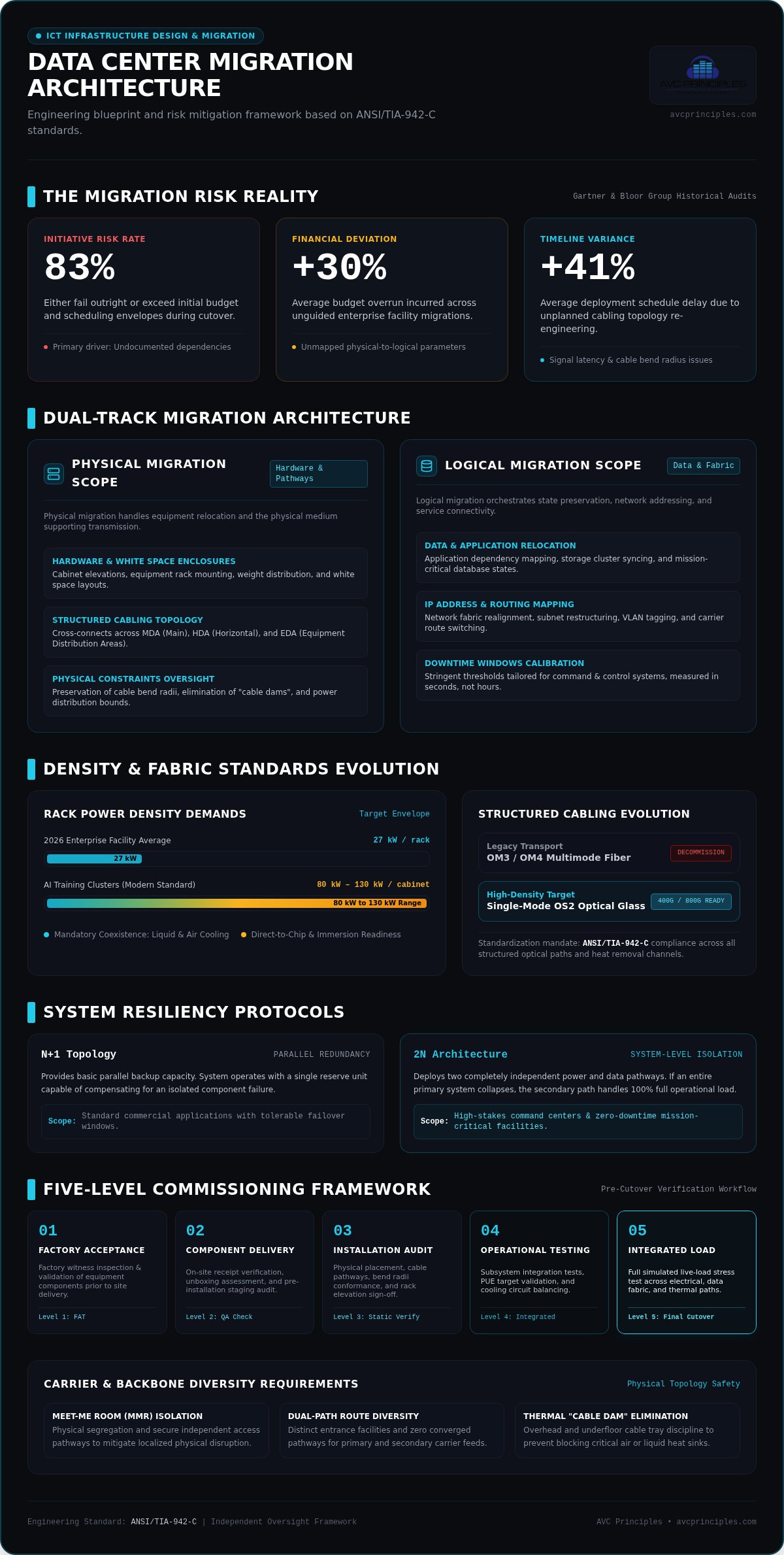
According to historical audits from Gartner and Bloor Group, 83% of data center migration initiatives either fail or exceed their initial budget and scheduling envelopes. Cost overruns average 30% while schedule delays average 41%. These failures often stem from undocumented application dependencies and unverified physical cable mapping. You likely recognize the high stakes involved. The fear of prolonged downtime during a physical relocation is a rational response to the complexities of mapping legacy connectivity to high-density modern architectures. Without technical oversight, vendor-driven inefficiencies often compromise the structural integrity of the new facility.
Engaging professional data center ICT infrastructure design consultants shifts the focus from simple logistics to rigorous engineering. You'll master the complexities of data center migration through a framework focused on ICT infrastructure integrity. This guide provides a methodical roadmap for a seamless transition to a modern ICT environment. We'll examine the transition from multimode fiber to single-mode OS2 plants and the mandatory coexistence of liquid and air cooling. You'll learn how to implement strict adherence to global engineering standards like ANSI/TIA-942-C and ensure validated system performance post-migration.
Key Takeaways
- Define the critical distinction between physical and logical migration parameters through the lens of data center ICT infrastructure design consultants to ensure structural integrity.
- Master the transition from legacy copper and multimode glass to high-density, single-mode fiber architectures capable of supporting 400G and 800G fabrics.
- Execute a phased migration workflow centered on rigorous pre-migration staging and meticulous asset mapping to prevent Day-1 operational failures.
- Implement a five-level technical commissioning framework to verify performance metrics for structured cabling and environmental systems prior to the final cutover.
- Leverage independent, vendor-neutral engineering oversight to bridge the gap between high-level architectural design and granular technical execution.
Strategic Planning for Data Center ICT Migration
Strategic planning is the primary safeguard against the 83% failure rate common in large-scale migrations. It requires a clear distinction between physical and logical migration parameters. Physical migration involves the relocation of hardware, racks, and structured cabling systems. Logical migration focuses on data, IP address mapping, and application dependencies. Professional data center ICT infrastructure design consultants act as the technical lead in this phase. They ensure that high-level project milestones account for technical constraints such as signal latency, cable bend radii, and power distribution limits.
The Comprehensive Infrastructure Audit
Success depends on a granular understanding of the current state. The audit phase catalogs legacy hardware and maps every connectivity dependency within the existing fabric. Identifying single points of failure in the ICT layers prevents legacy vulnerabilities from being replicated in the new environment. This process includes verifying port availability and documenting end-to-end signal paths across the MDA, HDA, and EDA. The comprehensive infrastructure audit serves as the essential foundation for structural integrity throughout the migration lifecycle.
Defining Migration Objectives and KPIs
Technical requirements must align with business continuity plans to minimize operational disruption. Establishing acceptable downtime windows is a critical metric for the migration team. For high-stakes environments, such as command and control centers, these windows are often measured in seconds rather than hours. Key Performance Indicators (KPIs) should include:
- Latency thresholds for mission-critical applications.
- Power Usage Effectiveness (PUE) targets for the new facility.
- Verification of 400G or 800G fabric readiness using single-mode fiber.
- Strict adherence to ANSI/TIA-942-C standards for heat removal and cabling topology.
Migration is an opportunity for architectural redesign. Experienced data center ICT infrastructure design consultants ensure the new environment supports long-term enterprise scalability. This includes designing for increased rack power densities, which have jumped to an average of 27 kW per rack in 2026. Future-proofing the architecture ensures the facility can accommodate AI training clusters that push densities between 80 kW and 130 kW per cabinet. Methodical planning transforms a logistical hurdle into a strategic infrastructure upgrade that lasts for years.
Engineering ICT Infrastructure Design Standards
Modern data center migrations demand a total departure from legacy copper-heavy topologies. High-density fiber architectures are now the baseline for any facility targeting 400G or 800G fabric readiness. Engaging data center ICT infrastructure design consultants ensures these transitions follow a rigorous engineering framework rather than vendor-driven convenience. Standardizing technical documentation for structured cabling systems is the first step toward long-term operational stability. This includes detailed rack elevation engineering. Every cabinet must be mapped for optimal airflow and power distribution to handle the 2026 average rack density of 27 kW.
Redundancy models define the facility's resilience. An N+1 model provides basic parallel redundancy, but high-stakes environments often require a 2N architecture. A 2N design ensures two completely independent power and data paths. If one system fails, the other maintains full load capacity. This architectural discipline extends to space planning. White space layouts must prioritize heat removal and cable pathway accessibility to prevent thermal bottlenecks and "cable dams" that restrict airflow.
Connectivity and Redundancy Protocols
Structural integrity depends on carrier and backbone diversity. Engineering diverse pathing prevents a single localized incident from severing external connectivity. Meet-Me Room (MMR) design must follow best practices for physical separation and secure access. All low-voltage systems should maintain strict compliance with the ANSI/TIA-942-C standard. This includes specific heat removal specifications for direct-to-chip and liquid immersion cooling architectures. Professional ICT infrastructure design ensures these protocols are embedded in the initial blueprints.
High-Density Cabling Architectures
The transition to 100G+ speeds necessitates a shift from multimode OM3/OM4 glass to single-mode OS2 fiber. Consultants must evaluate MPO-16 and MPO-24 connectors against traditional LC interfaces. MPO/MTP connectivity supports the ultra-high-density requirements of modern fabrics but requires precision cleaning and testing. Cable management strategies must prioritize bend-radius mitigation and modularity. Designing for future ICT capacity expansion allows for seamless upgrades to 1.6T fabrics without ripping out existing pathways. This modular approach ensures the infrastructure remains relevant as hardware cycles evolve.
The Methodical Migration Workflow: A Step-by-Step Guide
Execution follows a strictly sequenced protocol. Phase 1 involves pre-migration staging. This includes environment preparation and the deployment of swing infrastructure to maintain uptime. Phase 2 focuses on technical documentation and asset mapping validation. Every port and patch lead must match the master architectural plan. Phase 3 is the physical relocation. It encompasses the decommissioning, transport, and re-installation of hardware into the newly commissioned environment. Phase 4 covers post-migration connectivity testing and performance verification. Professional data center ICT infrastructure design consultants oversee every transition point to ensure signal integrity across the new 400G or 800G fabric.
Phased Execution and Risk Mitigation
A "Big Bang" migration involves moving all systems in a single window. This approach carries extreme risk for mission-critical facilities. Most enterprise environments favor a phased migration strategy instead. This allows for isolated testing and minimizes the impact of unforeseen technical friction. Establishing clear rollback triggers is essential. If a specific milestone isn't met within the allocated window, the team executes a predefined fallback procedure. Coordination between multidisciplinary teams ensures that facilities engineering and IT infrastructure remain synchronized throughout the cutover.
Integrating Specialized Systems
Migration complexity increases when relocating specialized environments. Command center visualization and control systems require precise calibration post-move. These systems often rely on proprietary low-latency fabrics that demand specific handling. Maintaining broadcast infrastructure continuity is equally demanding. Signal paths for real-time operations centers must remain robust to avoid data loss during the transition. Data center ICT infrastructure design consultants provide the technical oversight needed to manage these high-stakes integrations. They ensure that the staged environment engineering matches the final operational requirements of the target hall.
Rigorous adherence to this workflow reduces Day-1 operational incidents. By the time equipment arrives at the target facility, the environment is already validated. This preparation includes the verification of secondary fluid networks for direct-to-chip cooling and the certification of ultra-high-density structured cabling. A methodical approach transforms the migration from a chaotic logistics exercise into a controlled engineering deployment.
Mitigating Risk through Technical Commissioning
Technical commissioning serves as the final barrier between a successful migration and operational failure. It is an exhaustive process of independent verification and calibration. This phase ensures the as-built environment mirrors the original design specifications exactly. Implementing formal pre-migration Level 1 through 5 technical commissioning reduces post-cutover Day-1 operational incidents by up to 73%. Professional data center ICT infrastructure design consultants utilize this framework to validate every component before the first packet of live data is transmitted. This clinical approach eliminates the vendor-driven shortcuts that often compromise high-stakes infrastructure.
Verification and Calibration Metrics
Precision testing defines the commissioning phase. Optical Time-Domain Reflectometer (OTDR) testing provides a granular view of fiber link integrity; it identifies micro-bends and splice losses that basic light meters miss. This is critical for 400G and 800G fabrics where the power budget for signal loss is minimal. Calibrating AV and broadcast controls in the new hall ensures that visualization systems in command centers operate without latency. Testing protocols must strictly adhere to the ANSI/TIA-942-C standard, which was approved on May 7, 2024, to ensure physical infrastructure compliance. Performance metrics must also include acoustic analysis and thermal mapping to confirm that high-density racks operate within the 18°C to 27°C ASHRAE TC 9.9 recommended envelope.
Avoiding Common Technical Pitfalls
The transition to a modern facility often reveals unrecorded legacy cabling errors. Identifying and correcting these discrepancies before go-live is mandatory. Environmental factors require equal attention. Integrated Systems Testing (IST), or the "Black Building" test, simulates total utility power drops to verify that UPS and generator synchronizations occur within the IT equipment hold-up time. This level of rigor ensures that cooling loops and power distribution units handle the projected load without thermal runaway. For comprehensive oversight, engage our specialists for professional ICT infrastructure design and commissioning to secure your environment. Finalizing the technical commissioning report provides a baseline for all future Day-2 operations.
Architecture validation. Performance calibration. Compliance verification. These pillars of technical commissioning ensure that the complex migration from legacy to modern architectures survives the critical first 24 hours. Without independent engineering oversight, the risk of undocumented application dependencies causing an outage remains unacceptably high. Methodical testing transforms uncertainty into verified reliability.
Navigating Complexity with Independent Engineering Oversight
High-stakes infrastructure relocation isn't a task for generalists. It demands the clinical precision of independent engineering oversight. Vendor-neutrality is the cornerstone of this approach. It ensures that technical specifications drive equipment selection rather than sales quotas or regional availability. Professional data center ICT infrastructure design consultants bridge the critical gap between high-level architectural intent and granular technical execution. This oversight prevents the dilution of engineering standards during the high-pressure migration window. By maintaining a vendor-neutral stance, consultants protect the enterprise from proprietary lock-in and ensure the long-term flexibility of the ICT fabric.
Bridging the gap between design and execution requires a trusted strategist. The consultant translates complex engineering blueprints into actionable workflows for installation teams. This process includes staged environment engineering to verify system interoperability before the final move. Without this layer of discipline, the risk of technical friction during the cutover increases. AVC Principles manages this complexity through a focus on structural integrity and comprehensive oversight. We ensure the "how" of the migration is as rigorous as the "what."
The Consultant as a Strategic Partner
Managing vendor relationships requires a rigorous technical framework. Consultants act as the owner's representative, enforcing compliance with established design standards such as ANSI/BICSI 002-2024. Objective oversight is essential for mission-critical systems where undocumented dependencies create long-term operational risks. The transition to operations and maintenance marks the final phase of the strategic partnership. It involves the handover of validated systems and the verification of all redundancy protocols. This ensures the facility isn't just functional but resilient from the first hour of live operation.
Finalizing the ICT Lifecycle
Lifecycle reliability depends on accurate post-migration documentation. This documentation establishes a baseline for all future infrastructure audits and capacity planning. It must include updated cable schedules, port mapping, and thermal profiles that account for the 2026 average rack density of 27 kW. Architecture validation. Performance calibration. Compliance verification. These pillars define the successful conclusion of a migration project. AVC Principles specializes in this end-to-end oversight, managing the integration of broadcast design and command center infrastructure. We provide the technical gravity required for high-stakes environments. To secure your transition, contact AVC Principles for professional migration oversight.
Securing Your Infrastructure Legacy
Data center migration is a high-stakes engineering challenge. It is not a simple logistics exercise. Success depends on architectural clarity. Rigorous technical documentation. Methodical five-level commissioning. Transitioning to high-density modern architectures requires a disciplined shift to single-mode fiber and hybrid cooling systems. These complex environments demand the steady hand of seasoned experts who prioritize structural integrity over vendor-driven convenience. Every patch lead and power distribution unit must align with the master design to ensure zero-day performance and long-term lifecycle reliability.
Engaging professional data center ICT infrastructure design consultants ensures your facility meets global standards like ANSI/TIA-942-C. AVC Principles provides independent engineering and commissioning expertise with a specialized focus on mission-critical command and control environments. Our vendor-neutral approach to technical system architecture guarantees that your infrastructure remains flexible and resilient. We bridge the gap between high-level theory and granular execution. Engage AVC Principles for Expert ICT Infrastructure Design Oversight. You've defined the strategy. Now execute with the clinical precision your infrastructure deserves.
Frequently Asked Questions
What is the role of an ICT infrastructure design consultant in a migration?
Professional data center ICT infrastructure design consultants serve as the technical lead and owner's representative during a migration. They bridge the gap between high-level architectural design and granular execution. Their primary responsibility includes developing vendor-neutral technical specifications and overseeing the installation of structured cabling. This independent oversight ensures that the project adheres to global engineering standards rather than vendor-driven shortcuts. They mitigate risk through meticulous asset mapping and technical commissioning.
How long does a typical enterprise data center migration take?
The duration of a migration depends on the complexity of the ICT environment and the volume of physical hardware. Planning phases typically span six to twelve months, while the execution window varies from a single weekend to several months for phased rollouts. Large-scale enterprise migrations often require eighteen months for complete lifecycle execution. This includes initial auditing, design validation, and post-migration commissioning. Strategic planning helps prevent the 41% average schedule delays recorded in recent industry audits.
What are the biggest risks during a data center physical relocation?
The primary risks include undocumented application dependencies and unverified physical cable mapping. These factors contribute to high failure or budget overrun rates reported in industry audits. Physical equipment damage during transport and thermal bottlenecks in the new facility also pose significant threats. Without independent engineering oversight, these vulnerabilities often remain hidden until the final cutover. Methodical risk mitigation requires a comprehensive infrastructure audit and the use of swing hardware to maintain operations.
How does structured cabling design impact data center performance?
Structured cabling design serves as the physical foundation for all network operations. It directly affects signal integrity, latency, and the facility's ability to support 400G or 800G fabrics. Poorly designed pathways create cable dams that restrict airflow and increase thermal stress on hardware. Utilizing high-density single-mode fiber (OS2) and MPO-16 connectors ensures the infrastructure remains relevant as hardware cycles evolve. Proper design reduces modal dispersion and supports ultra-high-bandwidth requirements for modern enterprise workloads.
Why is technical commissioning necessary after a migration?
Technical commissioning is essential to verify that the as-built environment matches the original design specifications. This process utilizes a five-level framework to test systems under load before go-live. It significantly reduces post-migration operational incidents compared to uncommissioned environments. Commissioning includes OTDR testing for fiber integrity and Integrated Systems Testing (IST) for power redundancy. It provides the final validation that the new ICT infrastructure is ready for mission-critical workloads.
What is the difference between a physical and a logical data center migration?
Physical migration involves the decommissioning, transport, and re-installation of hardware and cabling systems. It is a logistics-heavy process focused on the white space environment. Logical migration involves the transfer of data, application workloads, and IP address mapping. While physical migration handles the "where" of the infrastructure, logical migration manages the "how" of the software and networking layers. Data center ICT infrastructure design consultants coordinate both aspects to ensure a seamless transition between facilities.
How do you ensure network reliability for broadcast systems during a move?
Ensuring reliability for broadcast systems requires specialized staged environment engineering. This involves replicating the broadcast fabric in a controlled environment to verify signal paths before the move. Diverse pathing for backbone connectivity prevents single points of failure from interrupting real-time operations. High-stakes environments, such as sports and entertainment venues, rely on precise calibration of AV controls and low-latency fabrics. Maintaining technical documentation for every signal path is the only way to ensure continuity.
What technical documentation is required for a successful ICT migration?
A successful migration requires a comprehensive suite of technical documentation. This includes granular asset registers, rack elevation drawings, and end-to-end cable schedules. Port mapping documents and logical network diagrams are mandatory for troubleshooting during the cutover. Post-migration documentation must also include the final technical commissioning report and fiber test results. This data serves as the baseline for future infrastructure audits and Day-2 operations. Accurate documentation is the primary defense against long-term operational inefficiencies.


