
Venue requirements shape the equipment, labor, schedule, and planning behind an AV proposal. Evaluating AV design proposals means comparing how each plan responds to room dimensions, ceiling height, rigging points, power, access, and venue rules, not simply ranking totals. If proposals cover different rooms, dates, sessions, or program structures, they are not directly comparable.
It is reasonable to focus on cost, but the production plan explains what the cost includes and whether the proposed scope fits the venue. A lower total may reflect different assumptions or labor coverage, not an equivalent solution at a lower cost.
This article explains how to align proposal scope, organize cost categories, assess technical plans and equipment, and document an evaluation. It also shows how to distinguish genuine cost differences from gaps in assumptions, planning, or venue requirements, then apply a clear decision guide to compare proposals consistently.
Key Takeaways
- Align proposals by dates, rooms, sessions, and program structure before comparing their totals.
- Separate costs into consistent categories, then focus your review on the largest differences and any charges that need explanation.
- Assess whether each technical plan, staffing approach, equipment list, and schedule supports the venue and event requirements.
- Clarify what pre-production includes, which assumptions affect scope, and how the plan handles changes or gaps.
- Use stated evaluation criteria and concise records to support a consistent, defensible decision.
Standardizing AV proposal cost categories
In the United States, applicable AV design standards and accessibility criteria depend on the project, venue, and governing requirements. A proposal should identify the criteria used and explain how the design addresses accessible audio, visual information, controls, and user access.
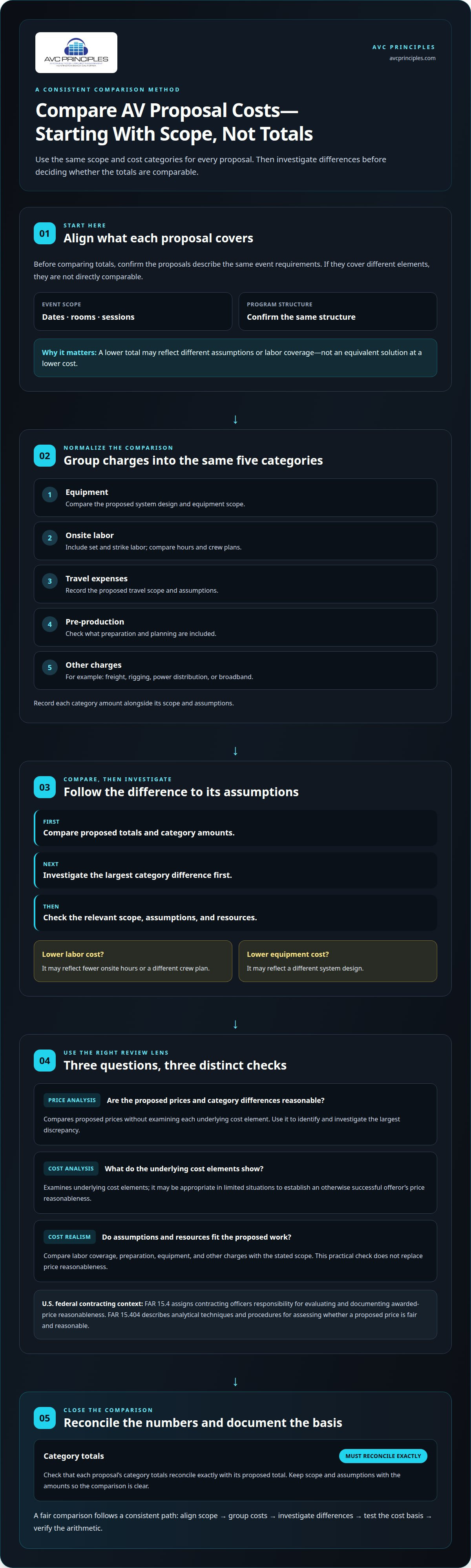
For a useful cost comparison, align proposal scopes, then group charges consistently. Investigate the largest category difference first and confirm that each category total reconciles with the proposed total.
Cost and Price Reasonableness
Reasonableness asks whether a proposed price is fair for the defined work, rather than simply whether it is the lowest. Under FAR 15.4, U.S. contracting officers are responsible for evaluating and documenting the reasonableness of the awarded price. For AV proposals, consistent scope and cost categories make differences easier to assess and support in the evaluation record.
Cost or Price Analysis
Price analysis compares proposed prices without examining each underlying cost element; cost analysis examines those elements. Under FAR 15.404, contracting officers may use analytical techniques and procedures individually or together to assess whether a proposed price is fair and reasonable. Under FAR 15.403-1(c)(1)(i)(C), cost analysis may be appropriate in limited situations to establish an otherwise successful offeror’s price reasonableness.
Use the same categories for every proposal:
- Equipment
- Onsite labor, including set and strike labor
- Travel expenses
- Pre-production
- Other charges, such as freight, rigging, power distribution, or broadband
Record each category’s proposed amount alongside its scope and assumptions. Lower labor costs, for example, may reflect fewer onsite hours or a different crew plan. Lower equipment costs may reflect a different system design. Investigate these differences before comparing totals. Check the arithmetic too: category totals should reconcile exactly with each proposal’s total.
Cost realism adds a practical test: do the assumptions and resources appear consistent with the proposed work? Compare labor coverage, preparation, equipment, and other charges with the stated scope. This checks whether the cost structure supports the plan, but does not replace an assessment of price reasonableness.
| Review approach | What it examines | Best use in comparison |
|---|---|---|
| Price analysis | Proposed prices and category differences | Identify and investigate the largest discrepancy |
| Cost analysis | Underlying cost elements | Examine cost structure where appropriate |
| Cost realism | Fit between assumptions, resources, and scope | Assess whether the plan’s cost basis supports the work |
Match the depth of your review to the discrepancy: compare totals first, then examine the relevant category and its assumptions.
Technical proposal assessment
Assess each technical plan against the same venue requirements, operating needs, and acceptance criteria. A proposal should define responsibilities for installation, testing, training, and support, including commissioning and handover. Technical evidence is central to evaluating AV design proposals because it shows how the proposed approach addresses project requirements.
For U.S. federal tradeoff evaluations, records must document technical capability and proposal comparisons. The Federal Acquisition Regulation (FAR) Council states that, under FAR 15.101-1, source selection records must include an assessment of each offeror’s ability to accomplish the technical requirements and a supported summary, matrix, or quantitative ranking of each technical proposal.
Ancillary and Support-Space Coverage
Ancillary coverage assesses whether the design addresses spaces beyond the primary room, such as control positions, equipment rooms, and presenter preparation areas. This differs from evaluating the main-room system because support spaces can affect operations without appearing prominently in the event-facing plan.
Compare which spaces are included, their intended functions, and how they connect. For example, a proposal may detail presentation-room audio and video but leave control-position requirements unclear. Record these omissions as scope differences rather than assuming they are covered.
Technical Risk Assessment
Technical risk assessment considers the likelihood and consequences of a design failing to meet its requirements. Compare each proposal’s stated dependencies, unresolved interfaces, and operational assumptions. For example, a plan that relies on venue infrastructure should identify that dependency and explain its effect on system operation.
Assess risk alongside potential benefit. A technically complex approach may offer useful capabilities but require more coordination or create additional points of failure. Record the possible consequence if a critical element does not perform, then compare how each proposal manages that exposure.
Scalability, Compatibility, and Future-Proofing
Scalability is the defined ability to accommodate changes in capacity or function; compatibility is how well proposed components fit existing systems. Assess future-proofing through documented expansion paths, interface requirements, and design assumptions, not broad promises of long-term suitability.
Compare how each proposal handles a potential room change, added source, or connection to existing infrastructure. A clear technical plan identifies constraints and the implications of expansion. It should also explain how components interact, so later changes do not depend on unsupported assumptions.
Assess technical completeness in sequence: map requirements to proposed solutions, identify dependencies, then evaluate testing and acceptance. Connect each requirement to a design element, drawing, schedule, or stated deliverable. Where approaches differ, determine whether each meets the same requirement. This evidence-based method makes evaluating AV design proposals more consistent and defensible.
- Installation: Identify the work included, site interfaces, and handover boundary.
- Testing: Define system tests, acceptance criteria, and commissioning responsibilities.
- Training: State the intended users, subject matter, and delivery scope.
- Support: Clarify the period, responsibilities, and exclusions included in the proposal.
Use the technical comparison to distinguish design merit from presentation quality. A concise matrix can record each requirement, proposed response, evidence, dependency, and risk. For a project requiring coordinated audiovisual infrastructure, a structured system design approach can help translate operational requirements into a technical plan.
Clarifying pre-production and planning scope
Pre-production turns the event brief into an executable production plan. Compare what each proposal includes before treating its planning line or bundled price as equivalent. A proposal should show how the production company understands the event, translate that understanding into requirements, and identify gaps or open questions.
Venue conditions shape the plan. Room dimensions, ceiling height, rigging points, power, dock access, house AV rules, and union requirements can change equipment, crew, and setup assumptions. For example, a plan that assumes venue-supplied power differs from one that includes power distribution. Record these differences as assumptions, not equivalent scope.
Program format also affects preparation. A keynote with slides has different production needs from a program involving live cameras and video, which may require more people and planning. Compare proposals against the same program structure, including sessions, rooms, and content formats. A different schedule or production build can explain a scope difference without indicating a missing service.
Review the setup and strike plan against the venue’s load-in window, production build, and onsite crew. A project plan can define tasks, sequence, duration, milestones, required effort, costs, and resources. Look for dependencies: if equipment installation depends on room access or another task, a changed sequence can affect timing, benefits, and risk.
Content management is a distinct planning activity. It can include collecting and checking slides, videos, and graphics before the event. Compare whether this work is assigned, when content is due, and how late changes enter the production workflow. A proposal that lists equipment but omits content preparation may describe a different operational scope.
Labor coverage should connect directly to the schedule. Compare technician coverage during load-in, show operation, and load-out, including support if content or schedules change. When labor is under-scoped, planners may need to escalate fixes, flag problems, and stay closely involved in production. Treat this potential workload as a scope consequence, not an abstract concern.
Pre-production may appear as a separate charge or be bundled into the proposal. Either format can work, but the included preparation should be clear. Compare planning tasks, deliverables, and responsibilities rather than assuming similar labels mean similar work. For example, one proposal may include content checks while another covers only schedule coordination.
Resolve ambiguity consistently. Involve evaluators early in proposal development, and use their input to define measurable objectives and organize the evaluation. Send each finalist the same questions about assumptions, event approach, support priorities, and preventing show-week surprises. This produces comparable responses and surfaces the planning decisions that shape each proposal’s scope.
Comparing equipment lists and engineering
An equipment list is useful only when each item connects to a defined function. Compare proposals item by item, then trace how each system supports the venue’s rooms, program, and operating requirements. A long inventory alone does not establish technical suitability. The engineering narrative should explain why the proposed system configuration meets its intended use.
Start with the signal path. For example, trace how presenter microphones, playback sources, and live cameras reach the audio and video systems, then how those systems feed room displays or loudspeakers. Compare the functional design, not just equipment names. Different selections may serve the same function, but the proposal should make that relationship clear.
Review the engineering documents alongside the equipment list. AV engineering can include audio system design, wireless frequency coordination, power distribution, and detailed CAD drawings. Each should support the proposed configuration. A drawing, for instance, can show equipment locations and system relationships that an inventory alone does not explain. Note where the technical narrative, drawings, and equipment schedule align or diverge.
- Audio: Compare the proposed system design with the venue’s intended listening areas and program use.
- Wireless: Review whether frequency coordination is identified where wireless systems are proposed.
- Power: Trace how power distribution supports the equipment configuration.
- Drawings: Check whether CAD documentation clarifies locations and system relationships.
Then assess whether the schedule and management approach support the engineered plan. Equipment must be coordinated with installation sequencing, access, and other project activities. Compare how each proposal connects technical documentation to its work plan. If a drawing depicts equipment that the schedule does not account for, record the inconsistency and its likely effect on delivery.
Separate substitutions from omissions. A different device or design approach may meet the same requirement, while a missing function creates a genuine scope gap. Compare each item’s stated role, quantity, location, and connection to the wider system. If a proposal uses an alternative, assess the documented functional outcome rather than assuming equipment names must match.
Use a comparison matrix to keep the review consistent. Include the requirement, proposed function, supporting equipment, engineering evidence, and any unresolved interface. This makes discrepancies visible without treating every equipment difference as a defect. It also records why a proposed configuration meets, partially meets, or fails a stated need.
Close the equipment review by checking alignment across the proposal. The list, drawings, system description, schedule, and management plan should describe one coherent design. For example, an audio system shown in a CAD drawing should also appear in the equipment schedule and match the documented system function. Resolve inconsistencies before treating the equipment list as evidence of technical completeness.
Proposal evaluation methods and documentation
Set evaluation criteria before reviewing individual responses. For an audiovisual design, useful criteria include requirements compliance, technical approach, scope, risk, schedule, cost, and alignment with organizational goals. Criteria should reflect project priorities, not simply reward the longest equipment list or lowest total. A documented method for evaluating AV design proposals makes the decision traceable from requirements to findings.
For U.S. federal competitive acquisitions, agencies must evaluate each proposal solely against the factors and subfactors stated in the request for proposals. The stated selection approach also governs best-value decisions, such as a tradeoff or Lowest Price Technically Acceptable method. Under the latter, proposals are assessed for technical acceptability only.
For other project evaluations, define how each criterion will be judged before scoring. A matrix can map requirements to evidence, evaluation questions, and objectives. For example, a venue requirement may connect to a proposed design element, a drawing, and a documented operational outcome. This gives evaluators a consistent basis for evaluating AV design proposals without relying on general impressions.
- Compliance: Does the proposal address each stated requirement?
- Technical approach: Does its design and evidence support the required functions?
- Scope and schedule: Do deliverables, responsibilities, and timing align with project needs?
- Risk and value: What are the likely consequences, benefits, and dependencies?
- Cost: Do the proposed resources and cost categories fit the described scope?
Keep the evaluation record concise and supportable. Record the criterion, proposal evidence, finding, and rationale. For example, if a schedule conflicts with a stated venue access window, cite the schedule detail and explain the effect. Distinguish a documented gap from an evaluator’s assumption. This creates a clear path from project objective to conclusion.
Check each submission for consistency. The technical narrative, schedule, staffing table, and pricing assumptions should describe a coherent plan. If the narrative describes support that the staffing table omits, record the mismatch and assess its relevance against the stated criteria. Apply the same questions to every proposal to limit inconsistent interpretations.
Use clarification carefully in federal acquisitions. Offerors may resolve minor or clerical errors or clarify aspects of a proposal, but may not revise it during clarifications. Evaluation notes should distinguish an explanation of submitted content from a change to the offer. For other procurement settings, document the applicable process and treat proposals consistently.
A defensible decision connects evidence to criteria, then explains the tradeoff. Record why a strength, weakness, or risk matters to the project. This final rationale is the practical outcome of evaluating AV design proposals: a clear account of how the selected direction addresses project needs. For a complex venue system, discuss a structured AV design evaluation with AVC Principles to connect requirements, technical evidence, and decision records.
AVC Principles
AVC Principles is a natural next step when venue requirements need to become a coordinated AV design and defined technical scope. Its design work connects operational needs with system architecture, infrastructure interfaces, and delivery considerations. That gives project teams a structured basis for understanding what proposals need to address before implementation. The approach is relevant to venues such as auditoriums, command centers, and sports arenas, where audiovisual systems must align with the space and its use. Services extend from concept development through commissioning, supporting continuity between design intent and project delivery. For a venue project requiring this coordination, contact AVC Principles to discuss the design requirements.
Set the Next Project Up for a Clear Decision
A disciplined approach to evaluating AV design proposals gives project teams a stronger basis for moving from comparison to implementation. The next step is to turn the selected direction into a coordinated design brief, aligning requirements, interfaces, and responsibilities before delivery begins. This creates continuity between the decision record and the work that follows.
AVC Principles supports this transition through AV Systems Design, ICT Infrastructure Design, and Staged Environment Engineering. These services fit projects where audiovisual requirements intersect with broader infrastructure or a staged environment. The appropriate scope depends on the project’s needs and design objectives.
Bring the venue requirements and project priorities into the next planning discussion. Contact AVC Principles to discuss your project and its design requirements. A clear next step can help move the evaluation into purposeful project planning.
Frequently Asked Questions
How do venue requirements affect an AV proposal?
Venue requirements shape system design, installation approaches, and proposal assumptions. For example, limited dock access can affect equipment movement and setup sequencing, while house AV rules can constrain connections to existing facilities. Room dimensions and ceiling height also influence equipment placement. Compare how each proposal responds to actual venue conditions rather than assuming a plan transfers unchanged between spaces.
What Does It Mean to Compare AV Proposals?
Compare AV proposals against the same project needs, not by ranking totals in isolation. First align event dates, rooms, sessions, and program structure. Then examine how each proposal addresses required functions, scope, schedule, staffing, and assumptions. For instance, a design covering a different set of rooms is not directly comparable until you align the scope or record the difference.
What if I don’t have all the event details yet?
You can evaluate a proposal with incomplete event details by separating established requirements from open decisions. Record assumptions about the program, venue access, content, and technical interfaces, then identify how each could affect the plan. For example, if the session format may change, note whether that affects camera, playback, or staffing needs. This creates a decision list for refining the scope as details develop.
Why would one AV proposal include more labor than another?
Labor can differ because proposals assume different crew coverage, work periods, or production complexity. A program with live cameras and video may require more planning and personnel than a keynote using slides. Compare coverage during load-in, the live program, load-out, and any schedule or content changes. A labor difference is meaningful only when considered alongside the responsibilities and operating conditions included in each proposal.
How do you assess whether an AV system design meets the project requirements?
Map each project requirement to evidence in the proposal, such as a system description, drawing, schedule, or stated deliverable. Then assess whether the proposed design addresses the intended function and its interfaces. For example, a presentation-audio requirement should connect to the described audio system and intended room use. Record unresolved requirements separately from those supported by clear design evidence.
What technical specifications should an AV proposal include?
A useful proposal describes system functions, equipment roles, and the engineering documentation needed to understand the design. Depending on project scope, this may include audio system design, wireless frequency coordination, power distribution, and detailed CAD drawings. It should connect these elements to the proposed system configuration. For example, drawings and equipment schedules should describe compatible parts of the same design, not conflicting versions.
How do you compare AV design proposals from different integrators?
Use one set of project requirements and evaluation criteria for every integrator. Confirm that proposals address the same spaces, dates, sessions, and program structure, then compare technical responses, assumptions, schedules, staffing, and cost categories. Send each finalist the same questions about unclear details. A comparison matrix can record evidence and rationale for each finding, making differences easier to discuss and document consistently.
What is a typical cost breakdown for a commercial AV design proposal?
Cost categories vary with project scope and how preparation or other charges are presented. A proposal may separate equipment, onsite labor, set and strike labor, travel, and pre-production. Other charges can include freight, rigging, power distribution, or broadband. Some items may be bundled, so compare what each category includes and whether the category totals reconcile with the proposal total.


