

A high-performance network is not a byproduct of hardware procurement. It is the result of rigorous engineering discipline. Many organizations mistakenly assume that selecting design-build contractors ensures a functional environment, only to face vendor lock-in and systemic failures. These failures often stem from incomplete technical documentation and a lack of independent oversight. Selecting from a pool of ICT infrastructure design companies requires more than a review of past portfolios; it demands a deep evaluation of their adherence to international engineering standards and their methodology for multi-disciplinary system integration.
You likely understand the high stakes of mission-critical infrastructure. A single architectural oversight can lead to catastrophic downtime or unmanageable project delays. This guide identifies the critical engineering criteria and methodology required to select a high-stakes partner. We examine the transition toward vendor-neutral architecture, the necessity of rigorous technical documentation for competitive bidding, and the implementation of ISO/IEC/IEEE 8802-3:2026 standards. By prioritizing structural integrity and comprehensive oversight, you can ensure a fully calibrated and commissioned ICT environment that supports long-term operational resilience.
Key Takeaways
- Define ICT infrastructure design as a specialized engineering discipline. Learn how to integrate network architecture with physical layer precision for mission-critical environments.
- Identify the technical benchmarks required to vet ICT infrastructure design companies. Focus on multi-disciplinary expertise and the depth of system architecture documentation.
- Contrast independent engineering with design-build procurement. Understand how vendor-neutral consulting eliminates conflicts of interest and protects your long-term ROI.
- Navigate the technical design lifecycle from concept to commissioning. Discover the phased methodology required to ensure your infrastructure meets rigorous 2026 engineering standards.
- Minimize project risk through clinical documentation. Use standardized engineering workflows to prevent vendor lock-in and avoid catastrophic system failures.
The Role of Professional ICT Infrastructure Design Companies
ICT infrastructure design is a specialized engineering discipline. It defines the foundational skeletal system of modern enterprise operations. While general IT support focuses on software deployment and endpoint management, professional ICT infrastructure design companies apply clinical precision to the physical layer and systemic architecture. This discipline exists at the intersection of network architecture, physical layer design, and multi-disciplinary system integration. It requires a methodical approach to ensure that high-stakes environments remain operational under extreme data loads.
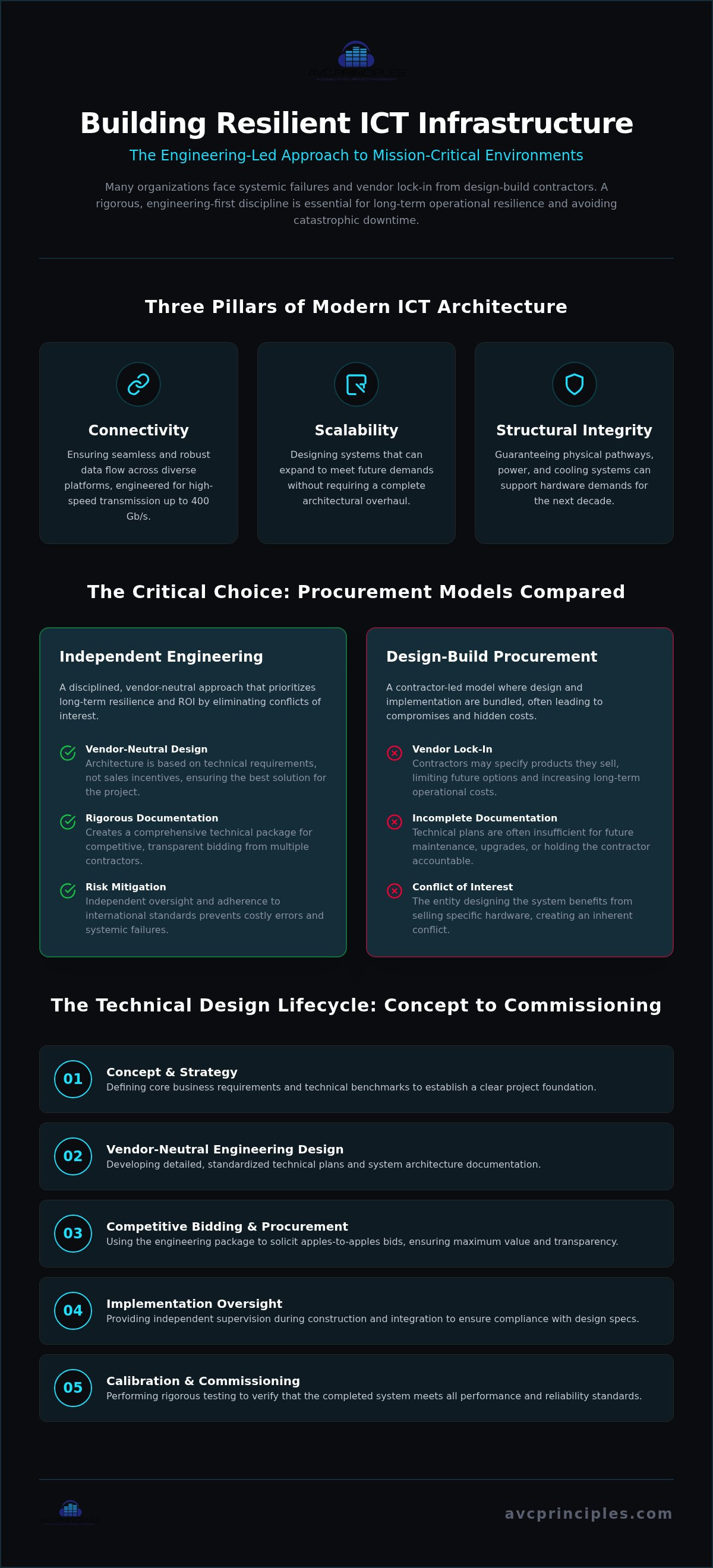
Enterprise-scale projects demand a level of technical reliability that standard IT services cannot provide. A comprehensive ICT infrastructure includes the hardware, software, and network resources required for the existence, operation, and management of an enterprise IT environment. Achieving this requires a focus on three core pillars. Connectivity ensures seamless data flow across diverse platforms. Scalability allows the system to expand without requiring a total architectural overhaul. Structural integrity guarantees that the physical pathways and cooling systems can support the hardware demands of the next decade.
Core Components of Modern ICT Architecture
Rigorous design begins at the physical layer. Structured cabling systems and physical layer pathways must be engineered to support high-density environments. In 2026, data center connectivity has reached a critical inflection point. The adoption of the ISO/IEC/IEEE 8802-3:2026 standard for Ethernet now supports operations from 1 Mb/s up to 400 Gb/s. This requires specialized pathway design to manage the heat and power demands of high-speed transmission. Integrated security and low voltage system specifications are also vital. Access control, power monitoring, and data networks must function as a single, integrated system to prevent the silos that lead to catastrophic failure.
The Value of Engineering-Led Design
Engineering-led design is a tool for risk mitigation. It replaces guesswork with clinical technical precision. As AI-driven infrastructure transformation accelerates, data centers face unprecedented constraints in power, cabling, and cooling. Modern ICT infrastructure design companies prioritize power availability as a primary design constraint. They secure energy resources and thermal management strategies before finalized hardware procurement occurs. This proactive methodology future-proofs the environment against emerging AI demands. It also ensures compliance with updated standards like ISO 27001, which now mandates that cloud-native infrastructure and supply chain security are fundamental components of a compliant system. Using an independent engineering partner ensures that the final environment is fully calibrated, commissioned, and free from the conflicts of interest inherent in design-build contractor models.
Essential Evaluation Criteria for Selecting a Design Partner
Selecting a partner for high-stakes environments requires a transition from generalist IT oversight to specialized engineering vetting. High-density enterprise projects carry significant risks of systemic failure if the underlying architecture is flawed. When evaluating ICT infrastructure design companies, the primary focus must remain on their ability to manage multi-disciplinary technical environments. This includes the seamless integration of AV systems, data networks, and security protocols within a single, unified framework. Precision is mandatory. A disciplined approach ensures that the "how" of engineering is prioritized as highly as the "what" of the technology itself.
Standardization of engineering workflows is a key indicator of firm maturity. A methodical veteran projects confidence through established protocols that govern every phase of the project. This oversight prevents the common pitfalls of contractor-led designs, such as vendor lock-in or inadequate power planning. Professional firms align their methodologies with established infrastructure standards for ICT to ensure global interoperability and long-term reliability.
Technical Documentation Standards
Technical documentation is the primary deliverable of a professional engineering consultancy. It's the blueprint that prevents project delays and ensures accurate bidding. Top-tier ICT infrastructure design companies provide detailed system schematics, architectural layouts, and categorical technical specifications. This documentation must be rigorous enough for competitive bidding, allowing the client to maintain cost control. The use of CAD and Building Information Modeling (BIM) is essential for infrastructure visualization. These tools allow engineers to identify physical layer conflicts before construction begins, reducing the need for costly field changes. Engaging an independent engineering strategist ensures that these documents remain vendor-neutral and focused on performance rather than hardware sales.
Sector-Specific Engineering Expertise
Different environments demand distinct engineering parameters. Mission-critical command and control centers require redundant pathways and high-availability power configurations that standard office buildings don't need. Enterprise-grade data center infrastructure must account for the massive energy and cooling demands of AI workloads. Large-scale venue technology master planning involves managing high-density user environments where connectivity must remain stable for thousands of concurrent devices. Expertise in these specific sectors ensures that the design partner understands the unique pressures of the environment. They apply clinical precision to staged environment engineering and broadcast design, ensuring the infrastructure supports the specific operational goals of the facility without compromise.
Independent Engineering vs. Design-Build Procurement
Design-build procurement introduces a structural conflict of interest. Contractors often prioritize inventory movement and hardware margins over architectural optimization. This model frequently results in vendor lock-in, where the owner is tethered to a proprietary ecosystem that limits future flexibility. Independent ICT infrastructure design companies operate under a different mandate. They function as pure consultancies, prioritizing the client's operational requirements and long-term ROI. By decoupling design from procurement, these firms ensure that the system architecture is driven by technical necessity rather than sales quotas.
Financial transparency is a hallmark of the independent engineering model. Clients pay for specialized expertise through fixed design fees rather than hidden equipment markups. This approach allows for a truly competitive bidding process. When technical documentation is rigorous and vendor-neutral, multiple contractors can bid on the same set of specifications. This competition naturally drives down installation costs while ensuring that the final build meets the high standards of a seasoned expert. It's a methodical transition from a "product-first" mentality to an "engineering-first" strategy.
The Advantages of Vendor Neutrality
Vendor neutrality provides broad market access. It allows the engineer to select best-in-class hardware from multiple manufacturers to solve specific multi-disciplinary challenges. For example, a command and control center might require specialized displays from one vendor and high-density networking components from another. Independent ICT infrastructure design companies evaluate these components based on clinical performance data rather than brand affiliation. This ensures the system is optimized for the energy demands and thermal constraints of 2026 AI workloads. Eliminating procurement bias protects the owner from purchasing obsolete or mismatched equipment that doesn't align with the broader technical master plan.
Ensuring Objective Project Oversight
Objective oversight is the final safeguard of infrastructure integrity. An independent engineer acts as the owner's strategist during the installation phase, managing vendor accountability with clinical precision. They verify that every cable run, cooling pathway, and security endpoint matches the original technical specifications. This oversight is critical for compliance with emerging regulations such as the Digital Operational Resilience Act (DORA), which mandates strict third-party risk visibility and incident monitoring. The engineer ensures that the contractor delivers a fully calibrated environment. They don't just oversee the installation; they validate the performance. This disciplined approach guarantees that the infrastructure is commissioned to the exact standards required for mission-critical reliability.
The Technical Design Lifecycle: From Concept to Commissioning
The technical design lifecycle is a phased progression from engineering theory to operational reality. Professional ICT infrastructure design companies operate with clinical precision throughout this sequence to ensure structural integrity. Phase 1: Conceptual development. We identify core technical requirements and multi-disciplinary constraints. Phase 2: Detailed engineering. This stage produces the rigorous technical documentation and system architecture required for complex environments. Phase 3: Bid management. We conduct a technical evaluation of vendors to ensure alignment with engineering specifications. Phase 4: Construction oversight. The independent engineer maintains rigorous oversight to prevent architectural drift during the build. This methodical approach ensures that the "how" of engineering is executed with the same discipline as the "what."
Effective bid management is a critical safeguard for the owner's budget. By providing vendor-neutral documentation, we enable a competitive bidding process that forces contractors to compete on performance and price. This prevents the hidden equipment markups common in design-build models. During construction, the independent strategist manages vendor accountability. They ensure that every physical layer pathway and data center connection adheres to the finalized design. This oversight minimizes the risk of project delays caused by incomplete documentation or technical misunderstandings. Engaging a firm for independent ICT infrastructure engineering ensures that the project remains focused on technical performance throughout the entire lifecycle.
Technical Commissioning and Testing
Technical commissioning is the final safeguard of system reliability. It's not a cursory check; it's a clinical validation process. We verify network reliability and performance metrics against the original engineering standards. This includes the final calibration of complex integrated systems, such as command and control centers or staged environments. Performance testing for acoustics and broadcast controls is essential for specialized venues. This phase ensures that the infrastructure meets the requirements of the Digital Operational Resilience Act (DORA) and other 2026 mandates for operational resilience. Every system must be fully calibrated before it's deemed ready for enterprise use.
Project Handover and Lifecycle Support
Handover marks the transition to operational readiness. We provide comprehensive "as-built" records that reflect the final state of the technical environment. These documents are essential for future maintenance and troubleshooting. We conduct team technical orientation to ensure the operational staff understands the system's architecture and capabilities. Long-term infrastructure scalability is built into the final records. This planning ensures the environment can adapt to the energy demands and power availability constraints of 2026 AI workloads without requiring a total redesign. A successful handover results in a fully commissioned environment that's grounded in engineering excellence.
AVC Principles: Independent ICT Infrastructure Engineering
AVC Principles is a national engineering consultancy specializing in ICT and AV system design. Independent engineering oversight. End-to-end technical documentation. Specialized expertise in mission-critical environments. Our firm serves enterprise, government, and entertainment sectors with a focus on high-stakes infrastructure. We manage the entire lifecycle from initial theory to final technical commissioning. Among ICT infrastructure design companies, our firm's defined by clinical precision and structural integrity. Our role is that of a trusted strategist. We ensure complex systems are integrated with a steady hand and comprehensive oversight. Our core services include AV systems design, staged environment engineering, and the development of command and control centers.
Our Engineering Methodology
Our methodology's rooted in rigorous technical documentation. We produce architectural standards that define the physical layer and systemic integration with absolute clarity. This methodical approach is essential for mission-critical design. As one of the premier ICT infrastructure design companies specializing in independent oversight, we operate as a vendor-neutral strategist. This allows us to focus on technical performance rather than hardware sales quotas. By maintaining high standards, we prevent the architectural drift that leads to project delays. Our veteran expertise ensures multi-disciplinary challenges are identified and resolved during the design phase.
Our national reach allows us to support large-scale enterprise projects and high-density venues. We bring the same level of clinical precision to a government command center as we do to a major sports stadium. This breadth of experience allows our team to navigate the complex regulatory landscapes of 2026, including ISO/IEC 38505-1:2026 for data governance. We understand every sector has unique technical pressures. Our team addresses these through specialized engineering that bridges the gap between high-level theory and granular execution. We prioritize the "how" of engineering to guarantee the final environment supports high-density data demands and AI-driven workloads.
Partnering for Infrastructure Excellence
Excellence in infrastructure requires disciplined engineering workflows. We instill a sense of security in our clients through comprehensive oversight and objective project management. Our focus remains on the structural integrity of the network and the reliability of the integrated environment. We manage high-stakes transitions with the composure of a seasoned expert. This disciplined approach ensures your ICT environment's fully calibrated and commissioned to the highest standards. We don't just oversee the installation; we validate the performance. We provide specialized expertise in sports and entertainment broadcast design, ensuring even the most complex venues operate with zero-fail reliability. To secure the reliability of your next project, consult with our engineering team today.
Achieving Operational Resilience Through Engineering Precision
High-stakes environments require more than a list of hardware. They demand a disciplined architectural foundation. Selecting from the landscape of ICT infrastructure design companies requires a focus on clinical technical documentation and independent commissioning. We've examined how vendor-neutral system architecture protects against proprietary lock-in and systemic failure. This methodology ensures that every physical layer pathway and data network's calibrated for long-term reliability. A focused strategy replaces guesswork with technical certainty. Rigorous evaluation of engineering standards remains the only path to project success.
Structural integrity's the result of rigorous oversight. AVC Principles provides specialized mission-critical engineering and comprehensive architectural documentation to navigate these multidisciplinary challenges. Our veteran approach ensures that your infrastructure meets the demanding standards of the 2026 technical landscape. Independent technical commissioning remains the final safeguard for network performance. Engage AVC Principles for Independent Engineering Design to secure the stability of your next enterprise project. A methodical strategy today prevents catastrophic failure tomorrow. Build with confidence.
Frequently Asked Questions
What is the primary difference between an ICT design company and an IT managed service provider?
An ICT design company specializes in the architectural engineering of the physical layer and system integration. They focus on the design, documentation, and commissioning phases of a project. Conversely, managed service providers handle ongoing operational maintenance and software support. AVC Principles doesn't offer managed IT services. Our firm provides project-based engineering to ensure the structural integrity of high-stakes environments.
Why is independent engineering oversight critical for large-scale ICT projects?
Independent oversight eliminates the conflict of interest found in contractor-led design-build models. It ensures that technical specifications are met without bias toward hardware sales or inventory movement. This strategist role protects the owner's investment by managing vendor accountability and preventing architectural drift. It is a clinical approach that guarantees the final environment meets the rigorous performance metrics defined in the initial engineering theory.
What technical documentation should I expect from a professional ICT design firm?
You should expect comprehensive system schematics, architectural layouts, and categorical technical specifications. This documentation allows for competitive bidding and ensures that all vendors are held to the same high standards. Leading ICT infrastructure design companies also utilize CAD and BIM for precise infrastructure visualization. During project handover, you'll receive "as-built" records that provide a clinical roadmap for future maintenance and scalability.
How do ICT infrastructure design companies ensure vendor neutrality?
Neutrality is maintained by decoupling design services from equipment retail sales. Professional ICT infrastructure design companies evaluate hardware based on technical performance data and international standards like ISO/IEC/IEEE 8802-3:2026. This allows the engineer to select best-in-class components from multiple manufacturers. It prevents vendor lock-in and ensures the system architecture is driven by operational requirements rather than sales quotas or proprietary limitations.
What is technical commissioning, and why is it necessary for ICT systems?
Technical commissioning is the final verification and calibration of the integrated system. It ensures that every component functions according to the original engineering blueprints. This process includes performance testing for network reliability, acoustics, and broadcast controls. It's a necessary safeguard that validates the system's operational readiness. Without clinical commissioning, organizations risk failures due to uncalibrated hardware or incomplete system integration.
Can an ICT design firm manage both AV and network infrastructure?
Yes, integrated firms bridge the gap between audio-visual systems and data networks. Modern enterprise environments require a unified approach where AV, security, and data function as a single, cohesive system. This holistic engineering prevents technical silos and ensures the physical layer can support high-density workloads. It requires a deep understanding of multi-disciplinary challenges to ensure connectivity remains stable across all operational platforms.
What sectors benefit most from specialized ICT infrastructure engineering?
Sectors with mission-critical requirements or high-density venues see the most benefit. This includes government command centers, enterprise data centers, and major sports arenas. These environments demand the high level of technical reliability and clinical precision that only a seasoned strategist can provide. Specialized engineering ensures that these facilities can handle the massive energy and cooling demands of 2026 AI-driven infrastructure.


