
What determines whether an arena can support a dependable live broadcast: the equipment list, or the way every signal path is engineered? Sports arena broadcast engineering begins with the connections between systems. Camera feeds, audio, replay and graphics, production control, in-venue displays, and outbound distribution must work together as one operational infrastructure.
Broadcast requirements span venue, production, and technology teams. When each group plans in isolation, integration gaps and live-event constraints can surface too late. Equipment choices matter, but so do signal relationships, infrastructure capacity, operating workflows, and the provisions that support reliable event delivery. Start by identifying who supplies, routes, monitors, and receives each signal.
This guide explains how the main arena broadcast systems connect and how signals move through them during an event. It also covers the planning decisions that shape dependable operations, including coordination across broadcast, AV, and ICT requirements. You’ll see where specialist engineering input can help translate production and venue needs into documented system requirements, from early project planning through commissioning.
Key Takeaways
- Define the operational needs first so sports arena broadcast engineering reflects how events are produced and distributed, not just which equipment is selected.
- Trace the signal path from capture through distribution to identify critical interfaces and dependencies.
- Assess reliability through redundancy, monitoring, operating procedures, and tested system interfaces, not equipment quality alone.
- Document use cases, performance requirements, and responsibility boundaries before design coordination begins.
- Use commissioning to verify the implemented system against documented requirements and support an orderly operational handover.
What Sports Arena Broadcast Engineering Covers and Why It Starts with Operations
Sports arena broadcast engineering is the planning and integration of the systems that support live-event production and content distribution from a venue. Its scope is broader than specifying equipment. Engineering design documents system requirements, signal relationships, infrastructure, interfaces, and operational needs. It is distinct from equipment purchasing, installation labor, and the creative and technical work of producing a broadcast, though it must coordinate with each.
The design brief should start with the event workflow. Who captures each source? Who operates and routes it? Which teams receive the resulting signals, and where? A useful Broadcast engineering overview places the discipline across studio, transmitter, and remote broadcast environments. An arena adds changing event configurations and shared venue infrastructure. The system must account for broadcast needs as well as how spaces and resources are used outside production.
Which arena workflows should shape the engineering brief?
Document the events the venue is expected to support, then map the people, positions, and signal handoffs involved. Consider broadcaster and venue teams, event producers, and technical crews. Record production positions, camera locations, source contributions, operational responsibilities, and intended signal recipients. For each connection, note where the signal originates, who routes it, and who needs to receive it. These details turn general expectations into design inputs.
Separate permanent venue capabilities from temporary production equipment and event-specific requirements. A fixed camera position or venue connection has different planning implications from equipment brought in for a particular event. This distinction helps teams identify what the venue must provide, what production must supply, and which interfaces need coordination before event day.
Where does broadcast engineering end and other venue design begin?
There is no universal boundary. Broadcast systems may interface with AV systems, ICT infrastructure, power, architectural provisions, and production disciplines. For example, a signal connection may depend on both broadcast routing design and the infrastructure planned for the venue. The project scope determines who owns each requirement and interface.
Document responsibilities and handoffs early. Clarify who defines requirements, provides infrastructure, coordinates connections, and validates that interfaces work as intended. This is where sports arena broadcast engineering contributes beyond equipment selection: it translates operational needs into coordinated design requirements. Early alignment helps reveal gaps between venue capabilities and production expectations while there is still time to address them.
How a Sports Arena Broadcast System Moves Signals from Capture to Distribution
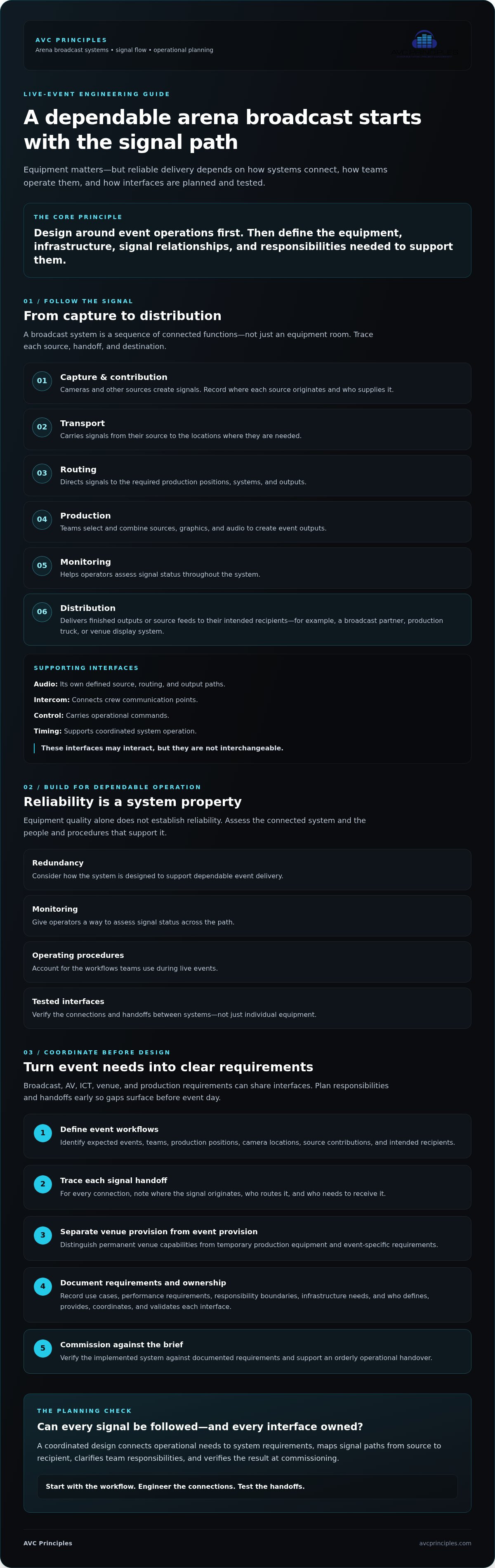
A broadcast system is best understood as a sequence of connected functions, not a single equipment room. Cameras and other sources create signals; transport carries them to the required locations; routing directs them; production teams select and combine them; monitoring helps operators assess signal status; and distribution delivers finished or source feeds to their intended recipients. Audio, communications, control, and timing support this chain, but each has distinct requirements and interfaces.
What systems sit along the arena broadcast signal path?
Consider a camera feed captured at an arena position and sent to a production position. The connections and routing resources along the way determine where that video can go. Production may combine it with other sources, graphics, and audio before sending outputs to a broadcast partner, production truck, venue display system, or another destination defined by the event brief. Examples of live production systems show how cameras and control rooms can form part of a venue production environment.
Conceptual signal flow: Capture and contribution → Transport → Routing → Production → Monitoring → Distribution
Related interfaces: Audio follows its defined source, routing, and output paths; intercom connects crew communication points; control carries operational commands; timing supports coordinated system operation. These interfaces may interact, but they are not interchangeable.
Use this flow as a planning aid, not a fixed topology. For each stage, identify the signal source, destination, responsible team, and relevant interface. The production formats, venue requirements, and operating model determine how sources enter the system, where signals are processed, and which teams receive each output.
How do IP and baseband approaches affect system design?
Baseband transport, commonly using SDI connections, carries audio and video as dedicated signals over physical links. IP transport moves media as data across a network. Each approach affects how infrastructure, routing, interfaces, monitoring, and expansion are planned. Neither is the universal answer for every arena. A design may use one approach or coordinate multiple types of transport, depending on documented requirements.
Where a project requires standards-based IP media transport, SMPTE ST 2110 may be relevant. Its use should follow the project’s technical requirements, not a general assumption that every venue should migrate. Before fixing the design, verify supported formats, network design, timing, and interoperability against project-specific documentation.
These choices connect broadcast requirements with venue AV and ICT infrastructure. For projects defining those interfaces, specialist sports and entertainment broadcast design can help translate production needs into coordinated system requirements.
What Makes Sports Arena Broadcast Engineering Reliable During Live Events?
Reliable coverage doesn’t come from equipment quality alone. A capable component can still be affected by a failed connection, an unavailable shared resource, an unclear handoff, or an operating procedure that hasn’t been tested. Sports arena broadcast engineering must account for the complete operational chain, including how people identify a fault and respond while an event is underway.
Broadcast-system resilience is the ability to detect and manage a failure while maintaining the required event operations through planned system paths and procedures.
Redundancy can reduce dependence on a single route or resource, but it must be defined for the system it supports. Design intent is not a performance guarantee. Actual outcomes depend on implementation, configuration, maintenance responsibilities, and operational practice. Testing helps confirm what the system can do and where its limits remain.
Which dependencies should engineering teams identify early?
Map dependencies across the broadcast system and the venue. Include shared networks, signal routes, control interfaces, power sources, and handoffs between venue staff, production crews, and external providers. A connection may appear available on a drawing while relying on infrastructure or ownership outside the broadcast scope.
Identify single points of failure and document mitigation options for project review. Consider how fixed venue infrastructure connects to temporary event systems and external production requirements. The goal is not to assume every dependency can be duplicated; it is to make risks, ownership, and decisions visible before they become live-event constraints.
How should teams plan monitoring and fault response?
Monitoring should give operators useful visibility at points along the signal path, such as source inputs, key routing stages, production interfaces, and outputs. That visibility helps narrow down where a problem occurs instead of leaving teams to troubleshoot the entire chain at once. Choose monitoring points based on the design and the operational roles assigned to each team.
Pair status information with documented escalation and fallback procedures. Define who assesses an alert, who coordinates with other teams, and which approved alternative path or operating response applies. Test interfaces and planned redundancy under documented conditions, then record the results and limitations. Avoid broad claims of “full redundancy” unless the specific paths, dependencies, and test evidence support them.
How to Plan a Sports Arena Broadcast Engineering Project
A disciplined planning sequence turns event needs into coordinated design requirements. For sports arena broadcast engineering, the aim is not to select equipment before the brief is complete. It is to establish how the venue will be used, define system interfaces, coordinate design disciplines, and provide a basis for implementation and validation.
- Discover stakeholders and event use cases. Identify broadcasters, venue teams, event producers, technical crews, and other users. Record the event formats and production workflows the facility must support.
- Develop the operational brief. Document facility constraints, production positions, camera locations, signal types, interface needs, and distribution destinations. Separate confirmed requirements from open questions. Mark unknown formats or capabilities for discovery rather than assuming them.
- Define performance requirements and ownership. State what the system must support and clarify responsibility for each interface, infrastructure provision, and operational handoff. Coordinate broadcast needs with AV, ICT, architectural, power, and production design.
- Develop and coordinate the system architecture. Translate the brief into system diagrams, interface schedules, technical specifications, and a design narrative. Review dependencies and boundaries across disciplines before procurement and implementation decisions are made.
- Validate the design and its implementation basis. Check that the documents address the agreed use cases, interfaces, and performance requirements. Identify how later testing will verify the delivered system against those documented criteria.
What should the project brief establish before system design?
A useful brief describes who uses the facility, how event workflows operate, what the venue can support, and which signals must move between production positions and destinations. It should also capture constraints that affect design, such as shared spaces or infrastructure. Unresolved requirements belong in a discovery register, not in unstated assumptions that later become procurement or integration gaps.
How do engineering documents support coordination?
System diagrams show intended connections and signal relationships. Interface schedules identify handoffs between systems and disciplines. Technical specifications record project requirements, while a design narrative explains the architecture and its rationale. Together, these documents give project teams a common reference for coordinating procurement and implementation without implying that engineering design itself supplies equipment or installation labor.
Documenting responsibility boundaries matters as much as drawing the system. It clarifies who provides each connection, coordinates each interface, and confirms requirements during later validation. This gives project teams a shared basis for planning venue broadcast infrastructure alongside AV and ICT systems.
For project-specific engineering scope, review AVC Principles broadcast engineering services.
From Engineering Design to an Operational Arena Broadcast System
Design intent must carry through implementation before a broadcast system is ready for operational use. The sequence connects the approved architecture to coordinated installation, interface integration, testing, and handover. Each phase should refer to the same documented requirements, so project teams can assess whether the system has been delivered and verified as intended.
Commissioning is part of this lifecycle. It verifies system performance against project requirements; it does not correct gaps in the original design brief or replace sound engineering. A test can confirm that a defined signal path operates under specified conditions, for example, while leaving other untested use cases outside its scope. Clear documentation helps stakeholders understand both results and limitations.
What should system verification demonstrate?
Verification procedures should map to approved requirements, signal paths, interfaces, and operational use cases. Test records can identify the configuration assessed, observed results, unresolved issues, and corrective actions for the relevant project stakeholders. Acceptance criteria and applicable standards should be confirmed for the specific project. They should not be assumed to be universal across venues or system architectures.
That record supports operational handover. Venue and production teams need to understand what was tested, what remains open, and which operating procedures apply. Commissioning and performance testing provide evidence for those decisions, but the scope and outcomes depend on the agreed requirements and completed work.
When should a venue engage broadcast engineering expertise?
Bring specialist input into the project while venue layouts, infrastructure, and production requirements are still being coordinated. At concept stage, engineering teams can help identify where broadcast systems depend on AV, ICT, architectural, power, or production interfaces. Resolving those questions early can inform project decisions before implementation makes changes more difficult.
Across project phases, an independent engineering consultant can translate venue and production needs into documented requirements, coordinate broadcast with AV and ICT design, and help maintain alignment through testing and commissioning. The value lies in defined scope and coordinated interfaces, not assumptions about equipment or delivery responsibilities.
For project-specific planning, discuss broadcast engineering requirements with AVC Principles. Early sports arena broadcast engineering input can help establish a clear path from design criteria to an operational system.
Build a Broadcast System Around the Event
A dependable arena broadcast system begins with operational requirements, not an isolated equipment list. Map how signals move from capture through production and distribution, then document the interfaces, responsibilities, and performance needs that connect venue and production teams.
Reliability also depends on how the system is coordinated and verified. Redundancy, monitoring, clear procedures, and tested interfaces support live-event operations, while commissioning checks the completed system against project-specific requirements. Strong sports arena broadcast engineering carries design intent through planning, implementation coordination, and operational handover.
AVC Principles provides sports and entertainment broadcast design alongside broader AV and ICT expertise, with engineering consultancy from concept development through commissioning. This integrated perspective can help translate venue and production needs into coordinated system requirements.
Discuss your arena broadcast engineering requirements with AVC Principles and take the next step toward a system planned around your venue’s operational needs.
Frequently Asked Questions
What does sports arena broadcast engineering include?
Sports arena broadcast engineering plans and coordinates the technical systems that support live-event production in a venue. Depending on the project, this can include signal capture and transport, routing, production positions, monitoring, communications, control interfaces, and distribution. The scope should begin with event workflows and documented performance requirements. From there, the design defines how venue infrastructure and production systems connect, including the interfaces and responsibilities that support each required signal path.
How is arena broadcast engineering different from buying broadcast equipment?
Equipment purchasing selects individual components; engineering defines how systems must work together to meet operational requirements. The design documents signal paths, interfaces, infrastructure dependencies, performance criteria, and coordination responsibilities. Equipment selection may follow from that work, but capable devices alone don’t establish interoperability or effective workflows. For example, the brief should clarify how a source reaches a production position and which team is responsible for the connection before components are selected.
Which systems need to connect for a sports arena broadcast?
A design may connect cameras and other sources with transport, routing, production areas, monitoring, audio, intercom, control, and distribution systems. Exact requirements depend on event formats and the venue’s production model. Teams should document signal types, interfaces, ownership, and operational handoffs rather than assume every arena needs the same topology. A camera feed, for example, may pass through venue infrastructure before reaching a production position, then be routed to one or more defined destinations.
How do engineers support reliable broadcasts during live events?
Engineers identify system dependencies, define monitoring points, document fault responses, and verify interfaces against project requirements. Resilience may involve appropriate redundancy and fallback paths, but these must match the designed architecture and operational needs. Monitoring can help operators isolate whether an issue occurs at a source, route, or destination. Testing and clear procedures support a coordinated response, but no design alone guarantees uninterrupted service under every event condition.
How much bandwidth does a sports arena broadcast system need?
There’s no single bandwidth figure that applies to every arena. Capacity depends on the number and type of media streams, formats, transport methods, routing architecture, and other network traffic. The engineering brief should define expected workflows and performance needs. Designers can then calculate and validate capacity, headroom, and network behavior for the specific project. Confirm assumptions against project documentation rather than relying on a generic estimate or another venue’s design.
When should broadcast engineers be involved in an arena project?
Involve broadcast engineering during early planning, while venue layouts, production workflows, and infrastructure interfaces can still be coordinated. Early input helps stakeholders document requirements before design decisions constrain routing, connectivity, or operating positions. Engineering support may continue through technical documentation, project coordination, and commissioning, with scope defined for the project delivery model. AVC Principles provides sports and entertainment broadcast design alongside AV and ICT expertise from concept development through commissioning.


