

The lowest-priced AV proposal may not be the lowest-cost system to own. An AV system lifecycle cost analysis shifts the comparison from initial procurement to the decisions and expenditures that shape planning, operation, maintenance, and renewal.
That distinction matters. Purchase prices are easy to compare, while support requirements, replacement assumptions, and operational demands are often spread across technical and financial teams. Early choices in system architecture can also affect maintainability and future integration. A credible comparison makes these assumptions visible instead of relying on unsupported savings claims.
This practical framework shows how to set consistent lifecycle boundaries, identify cost categories, and compare options using shared assumptions. It covers planning and design, energy and operational needs, maintenance and support, technology obsolescence, and end-of-life renewal. It also explains how AV and ICT coordination, acoustics, commissioning, and documentation can inform the analysis.
The result is a defensible basis for decisions that weighs performance, maintainability, and budget across the system’s useful life, not just at procurement. For complex projects, lifecycle analysis is an engineering input to system architecture and project oversight, giving decision-makers a clearer view of what each option requires over time.
Key Takeaways
- An AV system lifecycle cost analysis creates a more defensible comparison by setting consistent scope, assumptions, and time boundaries for each option.
- Separate acquisition and implementation costs from operations, support, system changes, and eventual renewal or retirement.
- Compare proposals against the same functional and performance requirements, and make evidence quality and support assumptions visible.
- Build the model in a repeatable sequence: define scope, establish alternatives, gather project-specific inputs, test assumptions, and document decisions.
- Use engineering input on architecture, acoustics, integration, documentation, and commissioning to connect performance requirements with maintainability and project constraints.
What AV System Lifecycle Cost Analysis Measures, and Why It Matters
An AV system lifecycle cost analysis compares the relevant costs of defined system options across an agreed scope and analysis period, using consistent assumptions to support a specific decision. The period is project-specific. It should reflect the decision being made, rather than rely on a universal timeframe or promise a particular saving.
Initial capital outlay is only one part of the comparison. Depending on the scope, the model may also account for operation, support, system changes, and eventual renewal or retirement. The broader concept of Life-cycle cost analysis (LCCA) provides a basis for comparing options across their relevant life cycle. For AV, the comparison is useful only when the team defines what is being measured and why.
What belongs inside an AV system lifecycle boundary?
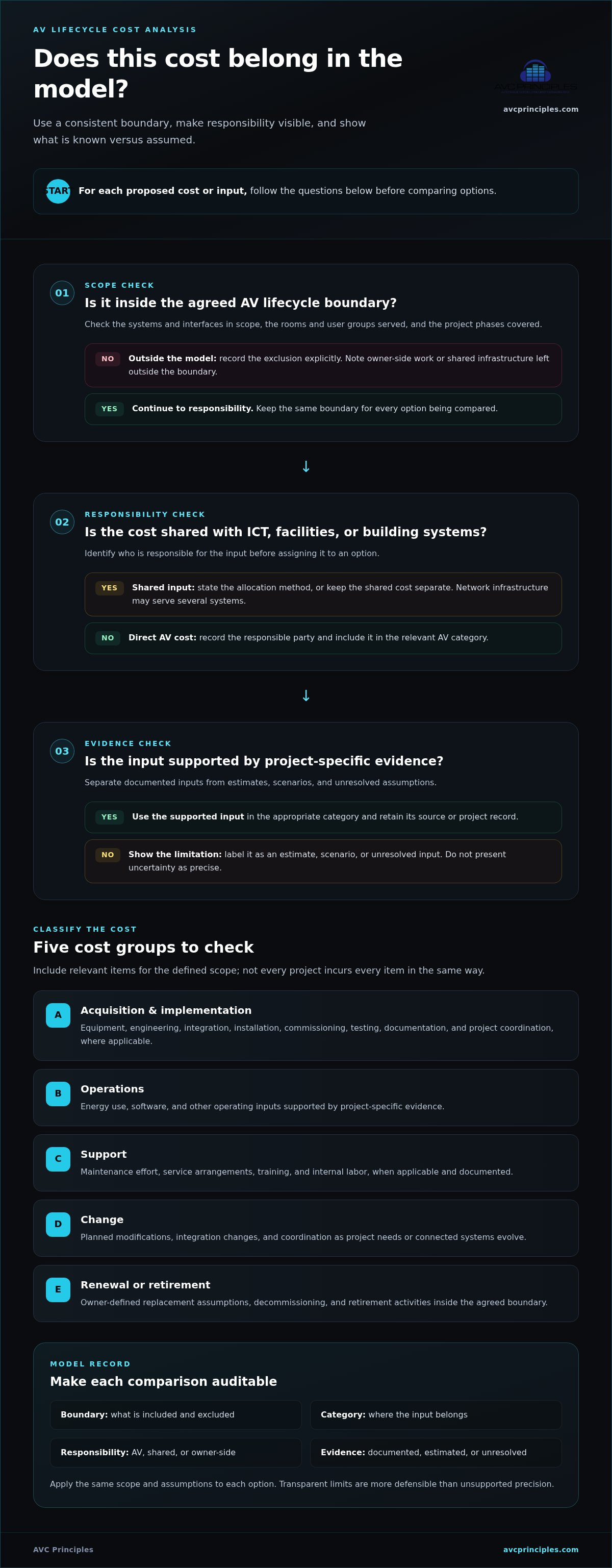
Set the boundary before estimating or comparing costs. Identify the AV systems and interfaces in scope, the rooms and user groups they serve, and the project phases covered. For example, a project may include room control and conferencing systems while treating shared network infrastructure as a separate, coordinated scope.
Record how responsibilities are divided among AV, ICT, facilities, and building systems. Document exclusions explicitly, including shared infrastructure or owner-side work left outside the model. This prevents one option from appearing less costly simply because its comparison omits responsibilities included in another.
Who uses the analysis and what decision should it support?
Owners and finance leaders use the analysis to inform planning and capital approval. Facilities teams assess operational implications, while architects, contractors, and AV integrators use the defined scope to coordinate design, procurement, and delivery. A shared model gives each group a consistent basis for reviewing assumptions and responsibilities.
Use the analysis at the decision point it is meant to support, such as comparing concepts during planning, reviewing design alternatives, or evaluating procurement options. Keep performance requirements as constraints, not variables to trade away for a lower modeled cost. The analysis supports professional judgment. It does not replace the requirement to provide a system that meets the project’s functional and technical needs.
Which AV Lifecycle Cost Categories Should the Model Include?
A useful model follows costs beyond the initial purchase and separates what is known from what is assumed. Category completeness matters more than unsupported precision: a transparent estimate with stated limits is more defensible than a detailed figure built on unverified inputs.
Organize the analysis across five cost groups:
- Acquisition and implementation: Equipment, engineering, integration, installation, commissioning, testing, documentation, and project coordination, where these apply to the defined scope.
- Operations: Energy use, software, and other operating inputs supported by project-specific evidence.
- Support: Maintenance effort, service arrangements, training, and internal labor, when applicable and documented.
- Change: Planned modifications, integration changes, and coordination required as project needs or connected systems evolve.
- Renewal or retirement: Owner-defined replacement assumptions, decommissioning, and retirement activities within the agreed boundary.
For each category, identify the responsible party and whether the cost is directly attributable to AV, shared with ICT or facilities, or retained by the owner. For example, network infrastructure may serve several systems, so allocating its full cost to AV could distort the comparison. State the allocation method or keep the shared input separate. Include labor, training, testing, and coordination only when the project record supports their inclusion.
How do capital and operating costs differ for AV systems?
Capital costs generally relate to creating and delivering the system, such as equipment, design engineering, integration, installation, and commissioning. Operating costs arise during use and may include energy, software, support effort, maintenance, and user or facilities training. Not every project incurs each item in the same way. Avoid standard percentages or assumed prices. Use documented project inputs and make gaps visible.
How should renewal, change, and downtime exposure be represented?
Record expected change drivers, dependencies, and renewal assumptions supplied or approved by the owner. Distinguish firm commitments from estimates, scenarios, and unresolved inputs. If a system outage could interrupt a room’s or venue’s operations, describe the exposure in operational terms unless defensible project data supports quantification. Do not turn a possible disruption into an invented financial loss.
This structure helps an AV system lifecycle cost analysis show where options differ without implying that uncertain inputs are precise. AV systems design can connect architecture, integration, and commissioning requirements to a project’s cost assumptions. Explore AV systems design as part of the planning process.
How to Compare AV System Options Without Overvaluing the Lowest Bid
A bid comparison is meaningful only when each alternative meets the same functional scope, performance requirements, and analysis boundary. If one proposal omits a required interface, documentation, testing, or coordination responsibility, its lower initial price does not establish a lower lifecycle cost. Normalize the alternatives first. Then compare what each option requires to deliver and sustain the intended performance.
Use a common comparison structure to make differences and evidence gaps visible:
| Comparison area | What to record |
|---|---|
| Upfront cost | Included equipment, engineering, integration, installation, and commissioning; identify exclusions. |
| Operational implications | Relevant energy, software, user workflow, and facilities impacts, supported by project information. |
| Support assumptions | Documented maintenance, training, internal labor, and support responsibilities. |
| Change exposure | Known dependencies, interfaces, and potential modifications tied to project requirements. |
| Evidence quality | Source, confidence, responsible owner, and whether each input is a commitment, estimate, or open assumption. |
This framework prevents missing scope from being mistaken for efficiency. A lower bid may still be appropriate, but the decision should reflect comparable deliverables and explicit assumptions, not price alone.
Which technical and operational criteria make alternatives comparable?
Assess interoperability, control strategy, acoustic requirements, maintainability, and user workflows against stated project needs. Map relevant interfaces across AV, control, network, and facility systems, and assign each coordination responsibility. For instance, evaluate an alternative that uses a different integration approach against the same required functions and operating conditions. Clarify criteria that lack a clear requirement or accountable stakeholder before they influence the ranking.
How should teams handle uncertain lifecycle assumptions?
For each uncertain input, record its source, confidence, owner, and relevance to the decision. Then test whether a reasonable change in that assumption affects the alternatives’ relative ranking. Focus sensitivity analysis on inputs that could change the decision, rather than adding detail that the evidence cannot support. Label scenarios as illustrative, not as forecasts or guaranteed outcomes.
A defensible AV system lifecycle cost analysis does not conceal uncertainty. It shows which differences are supported by evidence, which depend on assumptions, and where additional project information could affect the choice. Technical performance requirements remain the baseline for comparison. Cost analysis informs the decision without substituting for them.
How to Build an AV System Lifecycle Cost Analysis Step by Step
A repeatable process keeps the model traceable as technical design and project assumptions develop. An AV system lifecycle cost analysis is a structured decision process, not a savings guarantee. Use these steps to build a comparison that stakeholders can review and update:
- Set the scope. Define the systems, interfaces, rooms, project phases, analysis period, and exclusions. Clarify where AV responsibilities end and ICT, facilities, or owner responsibilities begin.
- Define alternatives. Describe each option against the same functional and performance requirements. Record differences in architecture, integration, and operating approach without changing the required outcome.
- Collect evidence. Gather design information, equipment assumptions, known operating responsibilities, and project-specific inputs. Assign an owner to each material input.
- Build the model. Organize inputs into consistent cost categories and show their source, confidence, and treatment. Keep estimates distinct from known commitments.
- Test assumptions. Examine how changes to uncertain inputs affect the comparison. Focus review on assumptions that could influence the decision.
- Document the decision. Present results with scope, exclusions, assumptions, and trade-offs so reviewers can understand both the comparison and its limits.
What inputs should the project team collect first?
Start with system requirements, current design documents, equipment assumptions, and known responsibilities for operations and support. Gather project-specific energy, labor, renewal, or other inputs only when evidence is available. Do not substitute generic rates or schedules. Where relevant, Revit BIM, AutoCAD, Bluebeam Revu, or BIM 360 documentation can help align system scope and design information. For each material input, record its source, date, owner, and uncertainty.
Assign input ownership according to expertise. Engineering can document system configuration and interfaces; facilities can identify operational responsibilities; finance can define how costs should be represented for review. Project stakeholders can resolve scope boundaries and approval requirements. This shared ownership makes assumptions visible instead of leaving them embedded in separate technical or financial records.
How should results be documented for review and approval?
Keep the comparison table, assumptions register, scope boundaries, and exclusions together. Summarize the principal cost drivers and trade-offs in direct language that technical and financial reviewers can both use. Include a revision trail showing what changed, when it changed, and which inputs or results were affected. That record lets the analysis track design development without obscuring earlier decisions.
For project-specific AV planning and design, AV system design at AVC Principles brings performance, budget, and project constraints into the planning process.
How AV Engineering Makes Lifecycle Cost Analysis Useful in Practice
A cost model becomes useful when it reflects how the system must perform, integrate, and be maintained. Engineering connects those requirements to the proposed architecture and project constraints. A design that meets the same functional need through different integration, control, or acoustic strategies may also create different documentation, coordination, testing, and support demands. Those implications belong in the decision, even when they cannot be reduced to a single cost figure.
Lifecycle analysis is one decision tool, not a substitute for functional and technical requirements. Teams should assess cost alongside performance, schedule, budget, and operational responsibilities. This keeps the AV system lifecycle cost analysis grounded in the system the project actually needs, rather than treating the lowest modeled total as the only measure of value.
Where should AV engineering input enter the lifecycle analysis?
Bring engineering into concept development and alternatives evaluation, before system choices become fixed. Review architecture and acoustic requirements alongside room use, AV and ICT interfaces, construction schedules, and related building systems. BIM coordination can help identify dependencies that affect installation and project sequencing. Document the required control functions and interfaces so cost assumptions correspond to a defined design.
Commissioning and testing requirements also shape the model. They clarify how the project will verify that the installed system meets its intended performance. Clear design documentation supports that verification and helps distinguish the cost of delivering a maintainable system from the cost of equipment alone.
When is specialist consulting a logical next step?
Specialist input is particularly relevant when a project includes complex integrations, multiple stakeholder groups, or competing performance, budget, and schedule requirements. AVC Principles provides audio visual consulting, design engineering, programming, and project management for integrated AV and control systems. Its expertise includes acoustics, BIM coordination, and commissioning, connecting system design decisions with construction and operational considerations.
For a closer look at the engineering process, review this AV design and engineering consulting guide. Where network and AV responsibilities intersect, the ICT infrastructure design guide provides related context.
For a project team preparing a lifecycle comparison, bring the system requirements, design alternatives, and known operational responsibilities into one coordinated review. This gives technical and financial stakeholders a shared basis for evaluating options against project needs.
Make the Next AV Investment Decision With Greater Clarity
A defensible AV system lifecycle cost analysis looks beyond procurement. It defines consistent boundaries, includes relevant operating and renewal considerations, and makes assumptions visible so decision-makers can compare alternatives on a shared basis. The lowest initial bid may not represent the best fit when performance, support, integration, and project constraints are considered together.
Engineering input gives that comparison practical context. Architecture, acoustics, BIM coordination, and commissioning connect stated performance needs to system design and verification. AVC Principles brings expertise in these areas, balancing technical performance, budget requirements, and construction schedules on complex projects.
Set the next step around your project’s requirements, alternatives, and known operating responsibilities. Discuss an AV system lifecycle analysis with AVC Principles to bring cost assumptions and engineering decisions into a coordinated review.
Frequently Asked Questions
What is AV system lifecycle cost analysis?
AV system lifecycle cost analysis compares relevant costs for defined system options across an agreed scope and analysis period. It can include initial delivery as well as applicable operating, support, change, and renewal costs. The period and boundaries depend on the project and decision being considered. The analysis makes assumptions visible so stakeholders can compare alternatives consistently. It supports professional judgment rather than guaranteeing savings or replacing performance requirements.
What costs should an AV lifecycle cost analysis include?
Include applicable acquisition and implementation costs, such as equipment, engineering, integration, installation, testing, and commissioning. The model may also account for energy, software, support, maintenance, training, internal labor, system changes, and eventual renewal or retirement when project evidence supports them. Separate costs directly attributable to AV from shared ICT or facilities infrastructure and owner responsibilities. Record exclusions so the comparison does not hide scope differences.
How is lifecycle cost different from the initial AV system price?
The initial AV system price represents the cost of a defined purchase or delivery scope. Lifecycle cost considers that outlay alongside other relevant costs over the agreed analysis period, such as operation, support, changes, and renewal. The distinction matters because proposals may exclude responsibilities or future needs that affect ownership. A higher initial price is not automatically higher over the lifecycle, just as a lower bid is not proof of lower overall cost.
How do you compare AV system proposals with different scopes?
First align each proposal to the same functional requirements, performance criteria, system boundary, and analysis period. Identify differences in included equipment, interfaces, engineering, installation, testing, documentation, and assigned responsibilities. Record exclusions and distinguish shared infrastructure from AV-specific scope. If a proposal omits a required element, show that gap rather than treating its lower price as directly comparable. This produces a clearer, like-for-like review without changing the project’s requirements.
Can lifecycle cost analysis account for maintenance and future upgrades?
Yes. The model can include maintenance, support effort, and future changes or upgrades when these are relevant to the system and supported by project information. Document the source and owner of each assumption, and distinguish known commitments from estimates or scenarios. Renewal timing should be based on project-specific assumptions rather than a generic schedule. This helps decision-makers see potential lifecycle exposure without presenting uncertain future needs as fixed costs.
How do you handle uncertain costs and system life assumptions?
Label each uncertain input with its source, date, responsible owner, confidence, and relevance to the decision. Avoid inventing service lives, labor or energy rates, and replacement schedules. Where uncertainty could change the preferred option, test alternative assumptions through clearly labeled scenarios or sensitivity analysis. Keep these scenarios distinct from forecasts. The aim is to show which assumptions influence the comparison and where better project evidence would strengthen it.
When should AV lifecycle cost analysis begin in a project?
Begin during concept development, while system architecture and alternatives are still being evaluated. Early analysis lets the team connect functional requirements, AV and ICT coordination, acoustics, operational responsibilities, and project constraints to the comparison. Update the model as design documentation and project assumptions develop, especially when a change affects scope, integration, or responsibilities. Starting early supports planning and design review before decisions become difficult to revise.


