

85% of mission-critical managers identify data overload as the primary barrier to operational success. This systemic failure often stems from a lack of integration between technical systems and the human environment. You recognize that high operator fatigue and turnover are not merely administrative challenges. They're direct consequences of non-compliance with international engineering standards. A poorly designed workspace forces the operator to compensate for environmental friction. This leads to diminished situational awareness and increased human error.
This article serves as a technical reference for command center ergonomics and design. It prioritizes human performance and operational reliability through rigorous adherence to the ISO 11064 framework. We will examine the essential pillars of control suite engineering: anthropometric workstation dimensions, acoustic limits, and the decoupling of compute hardware. By moving from simple furniture selection to disciplined environmental engineering, you ensure long-term structural integrity and technical reliability. This is the strategist's guide to engineering a mission-critical environment that sustains performance under pressure.
Key Takeaways
- Transition from aesthetic furniture selection to a process-driven engineering methodology governed by the ISO 11064 multi-part standard suite.
- Learn how rigorous command center ergonomics and design mitigate cognitive fatigue by optimizing visual hierarchies and data visualization systems.
- Identify the specific technical thresholds for acoustic management and circadian lighting required to sustain 24/7 operator vigilance in high-stakes environments.
- Understand the necessity of independent engineering oversight to verify vendor compliance and ensure long-term mission-critical reliability.
- Explore the role of end-to-end technical commissioning in safeguarding infrastructure through rigorous site acceptance testing and comprehensive documentation.
Fundamental Principles of Command Center Ergonomics
Mission-critical ergonomics is not a subset of interior design. It's a rigorous engineering discipline focused on the interface between human operators and complex technical systems. In high-stakes infrastructure, the priority is operational reliability. General office ergonomics focuses on individual comfort during a standard work week. Command center ergonomics and design, however, must support continuous 24/7/365 operations where the cost of error is absolute.
A failure in ergonomic engineering manifests as increased cognitive load. When an environment is poorly integrated, operators spend mental energy compensating for glare, noise, or poor sightlines. This reduces the speed of decision-making. In critical sectors like emergency response or utility grid management, these delays are unacceptable. Structural integrity. Technical reliability. Operational oversight. These are the service pillars that define a mission-ready environment.
Situational Awareness and Cognitive Load
Situational awareness is the primary metric of a successful command room. Engineering the interface requires a deep understanding of how operators process data streams. Cognitive tunneling, a state where an operator focuses exclusively on one data point while ignoring critical system alerts, often results from poor visualization design. 85 percent of mission-critical managers identify data overload as the primary barrier to operational success. We quantify information density to prevent this. This involves defining visual hierarchies across multi-display consoles and eliminating noise from non-essential indicators. The goal is a seamless interaction that allows for rapid analytical decision-making without physical strain.
The 24/7 Operational Lifecycle
Continuous operation demands structural and technical durability. Standard office furniture is rated only for single-occupancy use. Mission-critical environments require seating and consoles that meet intensive-use certifications, such as FNEW-83-269E. This ensures the equipment survives the cyclic loading of three-shift rotations. Shift handovers represent a critical point of operational risk. The environment must facilitate the rapid transfer of situational context while maintaining individual operator health.
- Anthropometric Flexibility: Programmable sit-stand height adjustments accommodate the 5th to 95th percentile of human geometry.
- Fatigue Mitigation: Research shows that dynamic cycles can reduce cumulative fatigue by up to 30 percent compared to static 12-hour shifts.
- Environmental Stability: Decoupled compute hardware removes heat and noise from the operator's immediate vicinity, preserving focus.
By integrating these principles into command center ergonomics and design, we prioritize long-term operational health over short-term aesthetics. The result is a facility that maintains its technical integrity through years of intensive use. This methodological approach ensures that human performance remains the central focus of the mission-critical environment.
Technical Standards: Adhering to ISO 11064
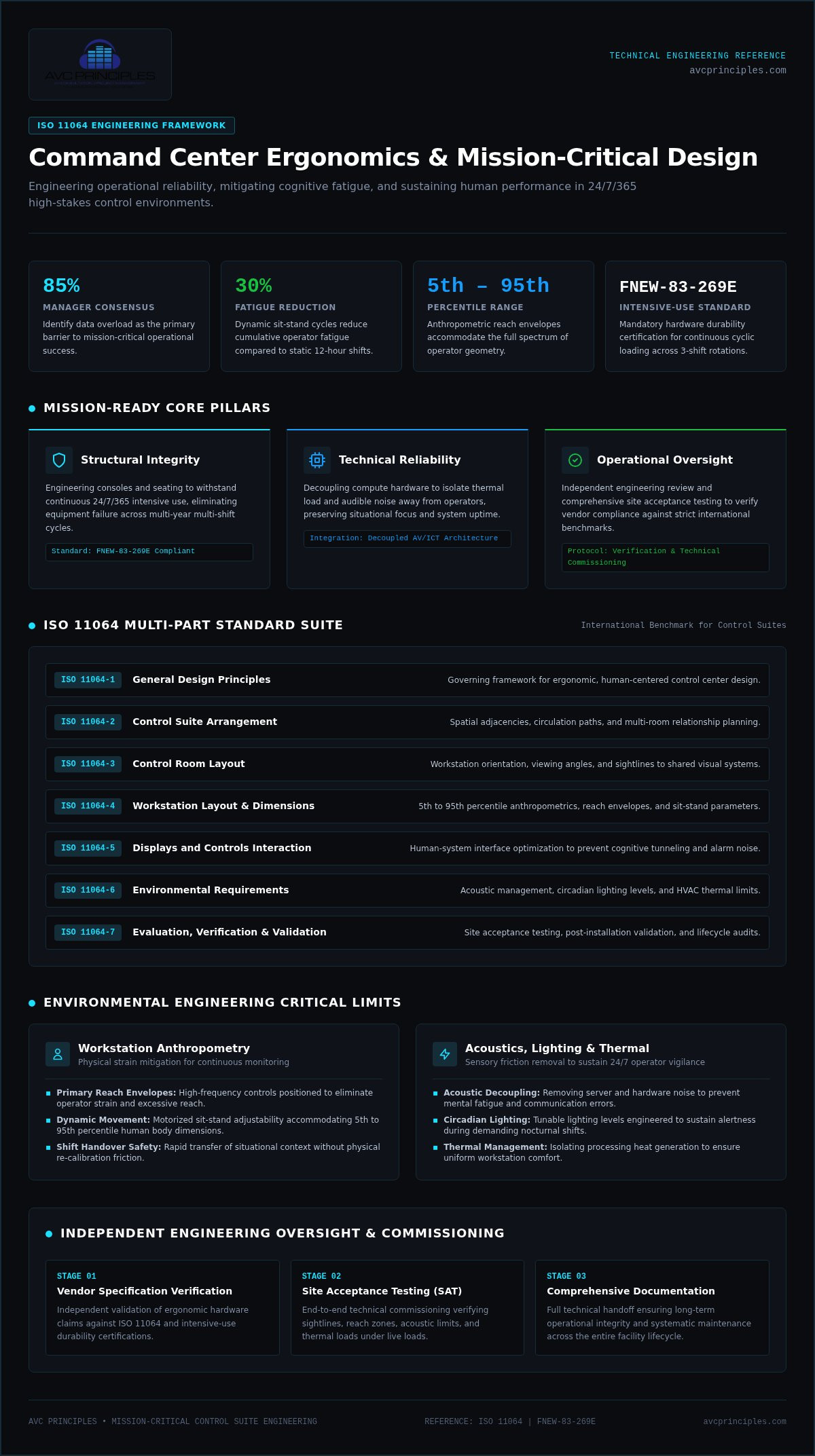
ISO 11064 is the definitive international benchmark for mission-critical facilities. It provides a structured, iterative methodology for control center engineering. Compliance isn't achieved by simply purchasing a specific console. It requires a comprehensive analysis of the entire control suite. This includes spatial adjacencies, anthropometric reach envelopes, and environmental verification. Effective command center ergonomics and design requires more than selecting hardware; it demands a rigorous adherence to these seven core parts:
- ISO 11064-1: Principles for the design of control centers.
- ISO 11064-2: Principles for the arrangement of control suites and architectural adjacencies.
- ISO 11064-3: Control room layout, including viewing distances and workstation orientation.
- ISO 11064-4: Layout and dimensions of workstations based on the 5th to 95th percentile anthropometric range.
- ISO 11064-5: Human-system interface and display/control interaction.
- ISO 11064-6: Environmental requirements, including acoustics, lighting, and thermal parameters.
- ISO 11064-7: Principles for the evaluation, verification, and validation of the facility.
Reach envelopes are a critical geometric constraint. Every control must be accessible without operator strain. We define the primary reach zone for high-frequency tasks and secondary zones for periodic interactions. This geometry ensures that technical consoles aren't just furniture, but functional components of the operational workflow. Consulting an expert in Command and Control Center Design provides the independent oversight necessary to verify vendor compliance with these complex standards.
Sightline Engineering for Video Walls
Sightline engineering utilizes the ANSI/AVIXA V202.01 standard (DISCAS) to calculate display sizing. For mission-critical environments, we prioritize Analytical Decision Making (ADM). This requires a mathematical calculation based on a 1 arcminute human visual acuity. We define primary, secondary, and tertiary viewing zones to prevent neck strain. The vertical viewing angle should not exceed 15 to 20 degrees above the horizontal eye level. This prevents long-term musculoskeletal fatigue during 12-hour shifts. Proper tilt angles and display heights are engineered into the architectural footprint before fabrication begins.
Traffic Flow and Spatial Architecture
Spatial architecture must facilitate non-disruptive movement. ISO 11064-2 dictates that entry and exit points should not cross an operator's primary field of view. During critical incidents, supervisors and technical staff must move freely without distracting the primary operators. We separate technical maintenance access from operational zones. This allows ICT staff to access the rear of video walls or consoles without entering the operator's immediate workspace. Collaborative pods are positioned to balance the need for team-wide communication with the requirement for individual focus. This architectural flow is essential for maintaining situational awareness under high-stress conditions.
Integrated AV and ICT Infrastructure Design
The technical backbone defines the limits of human performance. In mission-critical environments, command center ergonomics and design relies on robust ICT Infrastructure Design to sustain situational awareness. If the underlying systems suffer from latency or fragmentation, the most ergonomic console cannot prevent operational failure. We prioritize the integration of low-voltage systems and high-density cabling management to ensure that technical infrastructure supports, rather than hinders, the operator. It's a matter of structural integrity meeting digital reliability.
Visualization systems represent the primary interface for data interpretation. Engineering a Common Operational Picture (COP) across multiple displays requires precise resolution and pixel pitch calculations. We utilize sub-1.0mm pixel pitch LED arrays to eliminate bezels that might obscure critical SCADA lines or GIS coordinates. Standardizing technical documentation for these signal paths ensures that visualization remains consistent and reliable throughout the facility lifecycle. This disciplined approach prevents the information overload that often plagues poorly integrated centers.
Data Visualization and Information Architecture
Information density must be managed to prevent cognitive overload. We engineer visualization layers that allow for rapid data interpretation during high-stress incidents. This involves selecting display technologies that support long-duration viewing without triggering eye strain. By adhering to analytical decision-making standards, we ensure that every pixel serves a purpose. Clear, unambiguous data presentation is the foundation of rapid response.
ICT Support for Ergonomic Flexibility
Ergonomic flexibility is achieved through the strategic decoupling of compute hardware. By implementing ultra-low-latency KVM-over-IP systems, we move high-heat, high-noise server towers into dedicated, climate-controlled rooms. This follows BICSI 002-2024 standards and significantly reduces the acoustic and thermal load at the workstation. It's a critical step in maintaining operator comfort and system longevity.
- Redundancy: Engineering dual-path 10GbE fiber backbones ensures 99.999% uptime for critical data streams.
- Clutter Reduction: KVM systems allow a single operator to manage multiple secure networks from one keyboard and mouse set.
- Thermal Management: Isolating active computing hardware prevents the 19% of hardware failures typically caused by thermal mismanagement.
Independent engineering oversight is vital during the ICT planning phase. It ensures that the system architecture remains vendor-neutral and focused on operational requirements rather than hardware sales. This disciplined approach to infrastructure design guarantees that the command center remains a reliable tool for mission-critical oversight. Precision in the cabling and network layer is just as vital as the layout of the room itself.
Environmental Engineering: Acoustics, Lighting, and HVAC
Environmental engineering is the final safeguard for operational accuracy. In command center ergonomics and design, the physical environment must be tuned to prevent sensory degradation. We don't prioritize aesthetics. Instead, we prioritize the biological requirements of the operator. High-density AV and ICT equipment racks generate significant thermal and acoustic loads. If these aren't managed through rigorous engineering, the result is diminished reaction time and increased error rates.
Acoustical Treatment for Command Centers
Acoustic engineering ensures that critical communications remain intelligible. ISO 11064-6 specifies that ambient noise levels shouldn't exceed 45 dB(A). For optimal focus, we target a baseline between 30 dB(A) and 35 dB(A). We calculate Noise Criteria (NC) ratings to ensure that HVAC systems and equipment fans don't mask verbal instructions. This requires a precise balance of absorption and diffusion across the watch floor. It's a technical necessity for maintaining speech privacy and clarity.
- Reverberation Control: Mid-frequency reverberation time (RT60) is restricted to 0.4 to 0.6 seconds to preserve speech clarity.
- Sound Masking: Strategically deployed absorption prevents acoustic spill between collaborative pods and individual workstations.
- Alarm Audibility: Signals are calibrated to 10 dB above background noise to ensure detection without triggering a startle response.
Lighting Design for Situational Awareness
Lighting in mission-critical spaces must support 24/7 vigilance. Windowless environments disrupt natural circadian rhythms, leading to fatigue. We implement automated tunable white LED systems that shift between 2700K and 6500K based on the astronomical clock. This suppresses melatonin during peak shifts and aids recovery during off-hours. It's a technical solution to a biological challenge.
Effective lighting also requires precise glare management. The Unified Glare Rating (UGR) must remain below 19 to prevent eye strain. We engineer task lighting at the console to provide 300 to 500 lux, with granular dimming to accommodate high-contrast video walls. This ensures that visualization surfaces remain the primary focus of the operator's field of view.
HVAC design must also separate human thermal comfort from machine cooling. ASHRAE 55-2023 standards dictate operative temperatures between 20°C and 24°C. We restrict air speeds to under 0.2 m/s at the console position. This prevents draft-induced discomfort and dry eyes. To ensure your facility meets these rigorous thresholds, engage an independent engineering consultant for comprehensive environmental verification.
Independent Engineering Oversight and Commissioning
Independent engineering oversight is the primary safeguard for mission-critical reliability. In high-stakes infrastructure projects, the separation of design and installation is essential. Relying on a design-build model often introduces vendor bias. It creates a self-policing environment where compliance gaps may be overlooked to meet hardware sales targets. A methodical veteran approach prioritizes structural integrity and technical reliability over vendor-driven agendas. It ensures that the facility serves the operator's needs rather than the manufacturer's inventory.
The engineering lifecycle moves through distinct, modular phases: conceptual theory, technical documentation, and final commissioning. This phased progression ensures that the initial requirements for command center ergonomics and design are maintained through to final execution. It's a disciplined process that values the how of engineering as much as the what. By maintaining a vendor-neutral philosophy, we verify that every component meets the rigorous standards defined in the project specifications.
Technical Commissioning and Verification
Technical commissioning involves rigorous testing protocols to verify system performance before handover. We utilize Factory Acceptance Testing (FAT) and Site Acceptance Testing (SAT) to validate every technical parameter. This includes measuring acoustic sound pressure levels and reverberation times against ISO 11064-6 thresholds. We test sightlines and reach envelopes against the specific dimensions of the 5th to 95th percentile anthropometric range. This verification ensures that command center ergonomics and design principles aren't just theoretical, but functionally active in the workspace.
- System Calibration: Verifying display color rendering and luminance ratios to prevent eye strain.
- Network Validation: Testing redundant 10GbE fiber paths for failover reliability and sub-30 millisecond latency.
- Environmental Audit: Confirming that HVAC air speeds remain below 0.2 m/s at the console to prevent operator discomfort.
Standardizing Documentation for Future Scalability
Comprehensive as-built documentation is the foundation of long-term lifecycle performance. We produce granular technical specifications that define every signal path, network adjacency, and low-voltage connection. This documentation serves as the blueprint for future system upgrades. It ensures that any expansion maintains the same rigorous ergonomic standards as the original build. Without standardized documentation, scalability is compromised by technical fragmentation and institutional knowledge loss.
Ensuring your facility meets professional standards requires a methodical approach to verification. You can safeguard your infrastructure and ensure compliance with AVC Principles engineering consulting. This provides the clinical precision and independent oversight necessary for mission-critical success. A final engineering audit is the only way to guarantee that your command center operates as a unified, reliable tool for situational awareness.
Engineering Operational Reliability
The transition from aesthetic furniture selection to a process-driven engineering methodology is essential for mission-critical success. Rigorous adherence to the ISO 11064 framework ensures that every spatial adjacency and anthropometric reach envelope supports human performance. Effective command center ergonomics and design requires a deep integration of specialized ICT infrastructure and environmental controls. This disciplined approach mitigates cognitive load and prevents the data overload that often leads to operational hesitation.
Reliability is not a passive outcome. It's the result of structural integrity and technical precision. Independent engineering oversight provides the final safeguard against vendor bias, ensuring that your facility meets international standards. Through end-to-end technical commissioning, you verify that every acoustic, thermal, and visual parameter operates within specified limits. This methodical validation protects your long-term investment and secures the steady hand of your operators during high-stakes incidents.
Take the final step toward a resilient operational environment. Consult with AVC Principles for independent command center engineering to ensure your facility is engineered for professional excellence. Secure your infrastructure with the precision it demands.
Frequently Asked Questions
What is the primary goal of command center ergonomics?
The primary goal is the optimization of human performance and operational reliability. It involves engineering a mission-critical environment that prioritizes situational awareness while minimizing cognitive load. Effective command center ergonomics and design reduce the physiological and psychological stressors that lead to human error. By focusing on the interface between the operator and the technical system, the design ensures that personnel remain vigilant and responsive during high-stakes incidents.
How does ISO 11064 affect the design of a control room?
ISO 11064 establishes a multi-part, iterative methodology for the comprehensive engineering of control centers. It governs everything from architectural adjacencies and room layout to specific workstation dimensions and environmental parameters. Compliance requires a structured approach to verification and validation. This standard ensures that the facility accommodates the full 5th to 95th percentile anthropometric range, moving the design process from subjective furniture selection to objective, data-driven engineering.
Why is independent engineering oversight important for mission-critical centers?
Independent engineering oversight is essential to verify vendor compliance and eliminate hardware-driven bias. It ensures that the technical architecture prioritizes operational requirements rather than manufacturer inventory. This neutral perspective provides the final safeguard for mission-critical reliability through rigorous technical documentation and commissioning. By engaging an independent consultant, you secure a trusted strategist who navigates complex multi-disciplinary challenges without the conflict of interest inherent in equipment retail sales models.
What are the lighting requirements for a 24/7 operations center?
24/7 operations require automated circadian lighting systems to sustain operator alertness in windowless environments. These systems utilize tunable white LEDs to shift color temperatures between 2700K and 6500K, mirroring natural daylight cycles. Task lighting must provide between 300 and 500 lux at the console surface with granular dimming capabilities. Engineering for glare management is also vital, requiring a Unified Glare Rating below 19 to prevent eye strain and cognitive fatigue.
How do visualization systems impact operator fatigue?
Visualization systems impact fatigue by dictating how an operator processes complex data streams. Poorly engineered displays cause cognitive tunneling and physical strain from improper sightlines. We utilize sub-1.0mm pixel pitch arrays to eliminate bezels and improve data clarity. By applying Analytical Decision Making standards to display sizing, we ensure that operators interpret critical information rapidly without the visual exhaustion caused by low-resolution or improperly positioned screens.
What is the difference between an NOC and an EOC in terms of design?
A Network Operations Center typically requires a fixed, linear layout optimized for continuous monitoring and rapid technical troubleshooting. In contrast, an Emergency Operations Center demands a more flexible, collaborative architecture to support multi-agency coordination during crisis events. While both environments rely on rigorous command center ergonomics and design, the EOC requires specialized ICT infrastructure that allows for rapid reconfiguration and the scaling of situational awareness as incidents evolve.
Can ergonomics be retrofitted into an existing command center?
Ergonomics can be successfully retrofitted through a phased engineering audit of the existing control suite. This process involves identifying compliance gaps in sightlines, reach envelopes, and environmental parameters like acoustics. Upgrading to programmable sit-stand consoles and implementing sound-masking strategies can significantly improve operator performance. Retrofitting allows legacy facilities to meet ISO 11064 standards by integrating modern technical solutions into the established architectural footprint without requiring a total rebuild.
What role does ICT infrastructure play in ergonomic workstation design?
ICT infrastructure is the technical backbone that enables ergonomic flexibility at the workstation. By implementing KVM-over-IP systems, we decouple high-heat and high-noise computing hardware from the operator space. This reduces the thermal and acoustic load at the console, adhering to BICSI 002-2024 and ASHRAE TC 9.9 standards. Proper infrastructure design ensures a clean, quiet environment that allows the operator to focus entirely on mission-critical data streams without environmental distraction.


