

Network reliability for broadcast systems is not a feature you purchase from a switch manufacturer's catalog; it is an engineered discipline. Every broadcast engineer understands that uncompressed IP media fabrics operate under zero-tolerance conditions. Unlike standard enterprise networks that rely on TCP packet retransmissions, live multicast streams run across high-bandwidth UDP datagrams without second chances. A single switch buffer overflow, unmitigated microburst, or minor timing drift translates directly into dropped frames, audio pops, or on-air failure during high-stakes live events.
Eliminating these vulnerabilities requires moving past generic IT configurations to construct deterministic, standards-compliant infrastructure. This guide delivers a technical blueprint for engineering hitless media transport, locking sub-microsecond SMPTE ST 2059-2 PTP synchronization, and mastering the operational demands of SMPTE ST 2110 deployments. We examine the exact design criteria for non-blocking spine-leaf fabrics, seamless dual-path ST 2022-7 redundancy, and the empirical verification frameworks required for successful technical commissioning.
Key Takeaways
- Achieving network reliability for broadcast systems requires shifting from probabilistic IT switching to deterministic, non-blocking media fabric architectures.
- Elementary stream isolation under SMPTE ST 2110 relies on nanosecond-level PTP timing synchronization to replace traditional black burst genlock.
- Packet-level hitless protection via SMPTE ST 2022-7 eliminates on-air disruption by transmitting duplicate active-active feeds across fully air-gapped physical pathways.
- Physical layer engineering, structured fiber topography, and dedicated power architectures establish the baseline required to prevent packet jitter and buffer overflows.
- Rigorous independent engineering oversight and phased technical commissioning validate multi-vendor interoperability while preventing vendor lock-in.
The Transition from SDI to IP: Defining Broadcast Network Reliability
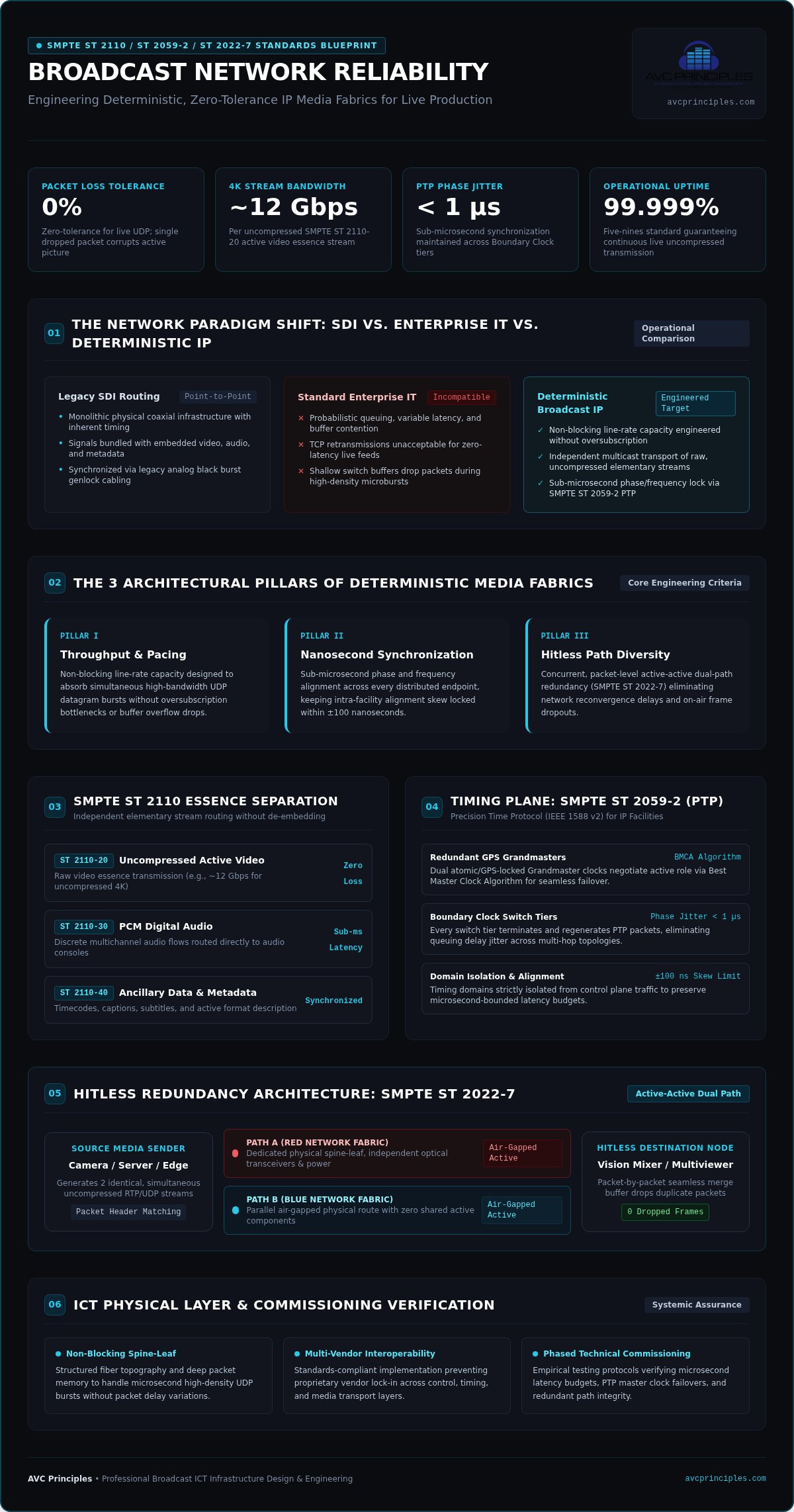
The broadcast plant was once fundamentally deterministic. Serial Digital Interface (SDI) routing relied on dedicated, point-to-point coaxial connections where bandwidth and timing were inherent to the physical medium. In contrast, modern IP topologies multiplex uncompressed video, audio, and metadata across shared network switches. Achieving network reliability for broadcast systems requires the consistent delivery of real-time elementary streams with zero packet loss. Standard "best-effort" enterprise IT networking collapses under these conditions; packet switching introduces probabilistic queuing, variable latency, and buffer contention that real-time uncompressed media cannot tolerate.
Engineering a deterministic broadcast media fabric depends on three architectural pillars:
- Throughput: Non-blocking line-rate capacity engineered to absorb simultaneous high-bandwidth flows without oversubscription bottlenecks.
- Synchronization: Sub-microsecond phase and frequency alignment across every distributed endpoint.
- Redundancy: Concurrent, packet-level path diversity that avoids routing reconvergence delays entirely.
The Structural Challenges of Media-over-IP
Uncompressed broadcast video does not generate smooth, uniform traffic. When an IP sender transmits an active video line, it releases high-density bursts of UDP datagrams within microsecond windows. Standard enterprise switches with shallow shared packet memory quickly drop packets during these microburst events. Jitter exacerbates this risk; excessive packet delay variation causes receiver buffers to underflow or overflow, triggering visible frame tear or audio dropouts. Mitigating this instability requires specialized ICT infrastructure design, deterministic traffic pacing, and non-blocking switch topologies designed to handle sustained line-rate multicast flows.
Reliability Metrics for Professional Broadcast
Live production metrics leave zero margin for statistical degradation. For uncompressed 4K video feeds requiring approximately 12 Gbps per SMPTE ST 2110-20 stream, the tolerable Packet Loss Rate (PLR) is absolute zero; every dropped packet corrupts the active picture. Latency budgets across multi-node production chains must remain deterministic and bounded within microsecond tolerances to prevent lip-sync drift and multiviewer processing delays. Within mission-critical facilities, network reliability for broadcast systems is defined as achieving a five-nines (99.999%) operational uptime standard that guarantees uninterrupted, uncompressed transmission across all production nodes during live execution.
Core Engineering Standards: SMPTE ST 2110 and PTP Synchronization
Establishing network reliability for broadcast systems requires strict adherence to open standards rather than proprietary encapsulation. The SMPTE ST 2110 suite replaces monolithic SDI cabling by breaking signals into discrete elementary essence flows: ST 2110-20 for uncompressed active video, ST 2110-30 for PCM audio, and ST 2110-40 for ancillary data. By transporting these essences independently over IP multicast, facilities eliminate processing overhead and route signals without cumbersome de-embedding hardware. Maintaining this architecture, however, requires an uncompromising timing plane.
Architecting the Timing Plane
In an asynchronous IP fabric, packet synchronization replaces traditional black burst genlock. SMPTE ST 2059-2 aligns media nodes by adapting IEEE 1588 Precision Time Protocol (PTP v2) to broadcast workflows. Reliable operation demands redundant, GPS-locked Grandmaster clocks utilizing the Best Master Clock Algorithm (BMCA) for seamless failover. Network hops introduce variable queuing delays that degrade timing packets; therefore, every switch between the Grandmaster and edge nodes must function as a PTP Boundary Clock. This approach terminates and regenerates PTP packets at each switch tier, keeping phase jitter below 1 microsecond and locking intra-facility skew within plus or minus 100 nanoseconds. Disciplined ICT infrastructure design ensures these timing domains remain strictly partitioned from unpredictable control plane traffic.
Essence Management and Bandwidth Allocation
Uncompressed broadcast workflows require deterministic traffic paths to handle sustained data rates. An uncompressed 10-bit 4:2:2 1080p stream consumes roughly 3 Gbps, while a 4K UHD feed demands up to 12 Gbps per sender. Managing these massive payloads relies on Internet Group Management Protocol Version 3 (IGMPv3) alongside Protocol Independent Multicast Source-Specific Multicast (PIM-SSM). This pairing guarantees that multicast traffic routes exclusively to subscribed switch ports, preventing packet flooding across downstream links. By parsing video, audio, and metadata into isolated RTP streams, SMPTE ST 2110 eliminates unnecessary bandwidth load, enabling endpoints to process only the specific essence flows required for production without stressing receiver buffers.
Redundancy Architectures: Hitless Switching vs. Traditional Failover
Traditional IT failover relies on active-passive topologies. Protocols such as Spanning Tree, Link Aggregation Control Protocol (LACP), or routing reconvergence mechanisms require anywhere from 50 milliseconds to 30 seconds to redirect traffic around a link failure. In an uncompressed media environment, even a 50-millisecond drop corrupts several consecutive video frames and introduces harsh audio distortion. True network reliability for broadcast systems rejects active-passive models in favor of concurrent, active-active packet transport governed by SMPTE ST 2022-7.
Under SMPTE ST 2022-7 Seamless Protection Switching, transmitting endpoints generate two identical streams of RTP packets simultaneously. These streams traverse two physically isolated, air-gapped networks known as the Red and Blue fabrics. The receiving node monitors both interfaces, reading RTP sequence numbers and time stamps to reconstruct an intact stream. If an entire core switch fails on the Red path, the receiver dynamically pulls corresponding datagrams from the Blue path. Frame loss is zero; failover time is literally 0 milliseconds.
Implementing SMPTE ST 2022-7
Deploying ST 2022-7 doubles bandwidth consumption and network port density across the entire production infrastructure. Transmitters and receivers require dual high-bandwidth network interfaces (such as dual 25GbE or 100GbE uplinks), while spine and leaf switching capacity must mirror this redundancy identically. System engineers must carefully manage differential delay between the disjoint paths. Receivers buffer incoming packets according to standard skew tolerance classes, such as Class A (up to 10 milliseconds differential skew) or Class B (up to 50 milliseconds). Skew exceeding receiver buffer limits triggers packet loss; therefore, fiber lengths and switch hop counts between Red and Blue topologies must remain tightly matched.
Network Topology and Resilience
Legacy core-aggregation architectures introduce severe oversubscription bottlenecks and variable latency. Modern broadcast media fabrics require a non-blocking spine-leaf topology providing a strict 1:1 oversubscription ratio. In this layout, every leaf switch connects directly to every spine switch, ensuring deterministic, single-hop latency across any two edge endpoints. Software-Defined Networking (SDN) broadcast controllers integrate with AMWA IS-04 and IS-05 to dynamically manage bandwidth reservations across these dual fabrics. In stadium or campus ICT designs, physical path diversity is mandatory: Red and Blue fiber trunks must occupy physically separate conduit systems and raceways, eliminating single points of failure caused by accidental physical damage.
Design Parameters for High-Capacity Broadcast ICT Infrastructure
Engineering network reliability for broadcast systems begins well below the protocol layer. Theoretical network architectures collapse if physical layer engineering and environmental controls cannot sustain high-density switching loads. High-capacity media facilities demand specialized low-voltage pathway engineering, isolated power distributions, and precise thermal regulation. These physical boundaries ensure that hardware processors operate within specified clock frequencies and that optical links maintain link budget integrity without introducing bit errors.
Facility resilience depends on the rigid segregation of critical operational tiers:
- Power Continuity: Dual-corded, N+1 uninterruptible power supply (UPS) systems delivering isolated feeds to redundant A/B power distribution units (PDUs) in every rack.
- Thermal Stabilization: Dedicated hot-aisle/cold-aisle containment and precision cooling maintaining switch intake temperatures below 24 degrees Celsius to prevent thermal throttling.
- Physical Path Diversity: Structurally separated conveyance pathways ensuring Red and Blue optical backbones never share raceways or distribution enclosures.
Physical Layer and Connectivity Standards
Modern production facilities rely on OS2 single-mode fiber infrastructure for high-bandwidth uplinks spanning 25GbE, 100GbE, and 400GbE backbones. While multi-mode fiber (OM4/OM5) handles short intra-rack connections, single-mode infrastructure prevents modal dispersion over extended facility runs. Strict bend-radius limits, standardized MPO/MTP cabling assemblies, and ultra-clean angled physical contact (APC) or physical contact (UPC) terminations prevent back-reflection and signal attenuation. When planning multi-tiered broadcast control rooms and stadium equipment hubs, partnering with a specialist in ICT infrastructure design guarantees structured cable layouts that preserve signal integrity while accommodating ongoing maintenance.
Network Security and Broadcast Integrity
Corporate ICT networks rely on deep packet inspection firewalls, but these devices introduce variable latency that destroys real-time media flows. Mission-critical broadcast plants enforce security through physical air-gapping or Layer 2 hardware cryptography via MACsec (IEEE 802.1AE). MACsec authenticates and encrypts media traffic directly at the switch silicon layer, protecting uncompressed streams against unauthorized snooping or injection without adding perceptible packet jitter. A Zero Trust approach to broadcast infrastructure assumes every attached media endpoint is potentially compromised, requiring continuous cryptographic identity verification, rigid port isolation, and automated device authorization via AMWA NMOS before admitting any node onto the media fabric.
Independent Engineering Oversight: The Key to Systemic Reliability
Standards compliance on paper does not guarantee operational stability in production. While manufacturers advertise strict conformance to SMPTE ST 2110 and NMOS, multi-vendor environments regularly expose subtle incompatibilities in packet pacing, Session Description Protocol (SDP) syntax, and PTP boundary clock locking. Vendor-led deployments inherently face conflicts of interest when diagnosing edge anomalies across competing hardware ecosystems. Independent engineering oversight serves as the objective bridge between design intent and physical execution, protecting facility owners from proprietary lock-in and ensuring true network reliability for broadcast systems.
Methodical oversight systematically manages the project lifecycle across four distinct phases:
- Phase 1: Architecture Validation. Auditing IP addressing topologies, multicast allocation plans, and non-blocking bandwidth calculations before procurement.
- Phase 2: Factory Acceptance Testing (FAT). Isolating media nodes in bench-test environments to verify transmitter pacing models and receiver buffer behaviors.
- Phase 3: Site Acceptance Testing (SAT). Stressing deployed spine-leaf fabrics with simulated maximum-density multicast payloads under full operational load.
- Phase 4: Operational Commissioning. Finalizing end-to-end timing alignment, failover validation, and handover protocols for technical facility staff.
The Commissioning and Testing Phase
Empirical verification is the foundation of technical commissioning. Using hardware protocol analyzers, engineers perform deep packet inspection to measure inter-packet arrival times, buffer occupancy, and SMPTE ST 2110-21 traffic pacing compliance (Narrow versus Wide senders). PTP timing audits capture boundary clock jitter to prove nanosecond-level lock across all edge ports under simulated link-failure conditions. This neutral, standards-based verification confirms that cameras, vision mixers, audio consoles, and multiviewers communicate seamlessly without masking underlying network jitter.
Ensuring Long-Term Operational Integrity
Commissioning delivers lasting value only when accompanied by exhaustive technical documentation. Comprehensive port mappings, multicast routing tables, PTP domain hierarchies, and NMOS registry configurations establish the long-term operational roadmap for the facility. Without these certified baselines, subsequent firmware updates or hardware additions risk degrading systemic stability. Facility teams require unambiguous documentation to maintain network reliability for broadcast systems as production scales. Consult with AVC Principles for independent broadcast engineering oversight to ensure mission-critical infrastructure meets uncompromising standards from initial validation through on-air execution.
Engineering Deterministic IP Infrastructure for Live Media
Achieving true network reliability for broadcast systems requires treating IP media transport as an exact engineering discipline rather than a standard IT deployment. Uncompressed live production leaves no margin for probabilistic packet delivery. Systemic stability depends on non-blocking spine-leaf topologies, disciplined SMPTE ST 2059-2 timing planes, and redundant ST 2022-7 hitless transport paths that eliminate single points of failure across every tier.
Specializing in Sports & Entertainment Broadcast Design, AVC Principles delivers independent verification of AV/ICT engineering standards across complex, high-capacity venue environments. Through vendor-neutral testing, empirical packet audits, and thorough technical commissioning, we verify that multi-vendor fabrics operate deterministically under maximum production load. Comprehensive technical documentation provides your engineering team with the operational roadmap required to preserve structural integrity as workflows scale. Secure your broadcast infrastructure with independent engineering oversight from AVC Principles to safeguard your facility with uncompromised live-to-air performance.
Frequently Asked Questions
What is the primary cause of network failure in broadcast systems?
Uncontrolled packet jitter and switch buffer overflows represent the most frequent causes of failure. When senders burst uncompressed UDP traffic faster than intermediate switch buffers can process it, packets drop instantly. Because real-time broadcast media cannot rely on TCP retransmissions, these dropped datagrams immediately corrupt the video signal. Achieving long-term network reliability for broadcast systems requires strict traffic shaping under SMPTE ST 2110-21 and non-blocking switch fabric designs.
How does SMPTE ST 2110 improve network reliability over previous standards?
SMPTE ST 2110 separates video, audio, and metadata into independent elementary streams rather than multiplexing them into a single heavy transport stream like ST 2022-6. This granular separation allows endpoints to subscribe only to the specific media essences they require. Routing individual essence flows reduces processing overhead, optimizes link bandwidth across core switches, and eliminates unnecessary multiplexing hardware that historically introduced single points of failure.
Is hitless switching (ST 2022-7) necessary for all broadcast applications?
Hitless switching is mandatory for live, uncompressed, mission-critical operations where on-air disruption is unacceptable. Facilities handling primary sports feeds, live entertainment broadcasts, and critical control room outputs require active-active ST 2022-7 redundancy. For non-live workflows, secondary monitoring, or turnaround environments where brief reconvergence delays do not compromise live operations, standard link aggregation or single-path topologies may suffice while reducing port density demands.
What are the bandwidth requirements for 4K uncompressed media over IP?
A single uncompressed 4K UHD (2160p 59.94 Hz) 10-bit 4:2:2 video feed requires approximately 12 Gbps of network throughput under SMPTE ST 2110-20. When engineering dual-path ST 2022-7 redundancy, this requirement doubles to roughly 24 Gbps total per endpoint across both fabrics. Consequently, production facilities building around 4K uncompressed transport require 25GbE edge uplinks and 100GbE or 400GbE backbone aggregation.
How do you manage PTP timing across a large stadium network?
Large stadium deployments manage timing by implementing redundant, GPS-locked PTP Grandmasters coupled with Boundary Clocks on every intermediate network switch. Boundary Clocks terminate incoming PTP packets and generate fresh synchronization messages locally. This design prevents packet delay variation from accumulating across long fiber runs between control rooms and field nodes, keeping timing jitter below 1 microsecond across all distributed endpoints.
What is the difference between a converged and a dedicated broadcast network?
A dedicated broadcast network physically isolates uncompressed media traffic onto air-gapped switches reserved exclusively for production. A converged network carries media essence flows, corporate data, and facility control signals across shared physical switching hardware using VLAN segmentation and Quality of Service (QoS) prioritization. While converged networks reduce hardware footprint, dedicated media fabrics eliminate contention risks and remain the standard for high-density production environments.
Why is independent commissioning necessary if the equipment is certified?
Manufacturer compliance certifications prove only that a device functions according to specifications in an isolated testing environment. In production, multi-vendor interactions expose subtle variations in PTP locking, SDP parsing, and packet pacing that laboratory tests don't capture. Independent commissioning provides unbiased empirical verification across the integrated fabric, ensuring true network reliability for broadcast systems before the infrastructure carries live operational loads.
Can existing ICT infrastructure be used for professional broadcast transport?
Standard enterprise ICT infrastructure rarely supports uncompressed broadcast transport without extensive architectural redesign. Enterprise switches often feature oversubscribed spine-leaf fabrics, shallow packet buffers, and lack PTP Boundary Clock support. Deploying SMPTE ST 2110 over existing cabling requires verifying single-mode fiber link budgets, replacing oversubscribed switches with non-blocking hardware, and re-architecting multicast routing to handle sustained line-rate UDP traffic.


