
A broadcast look can be visually polished and still fail on air if creative development and production are planned separately. Entertainment broadcast design services connect a show’s concept and visual direction with graphics, studio design, and the technical systems that bring them to screen. The result is a coordinated design framework, not a collection of disconnected assets.
A strong visual identity matters, but it must work within the production environment and support the way a show tells its story. Consider creative direction alongside the studio, on-screen graphics, and technical requirements from the start.
This article explains how concept development, art direction, and visualization shape a show’s design before production begins. It also covers how graphics and studio design integrate with broadcast technology, what affects project scope, and when specialist support can help align creative intent with technical delivery.
Key Takeaways
- Define the show’s audience, format, and storytelling needs before developing its visual identity.
- Plan graphics with production technology so visual elements function reliably on air and across platforms.
- Coordinate studio layout, screens, lighting, and camera views to support the intended production workflow.
- Use concept boards and visualizations to align creative direction before detailed design and implementation.
- Consider AV Systems Design when a show’s creative plans need to be coordinated with the studio’s technical infrastructure.
Broadcast design for entertainment and unscripted content
Entertainment broadcast design services translate a show’s format into a coherent visual system for transmission, streaming, and replay. For a competition show, that system might include an opening sequence, contestant identifiers, score graphics, and a consistent visual treatment for studio screens. Each element should reinforce the program’s tone and help viewers follow its story.
Designers develop graphics and electronic media for television productions, including material used by character generator operators. An award show might use animated titles and transitions to build drama around presenter entrances, while unscripted programming may need adaptable lower thirds for interviews and changing storylines. The design should support the action, not obscure it.
Branding needs to work across original programming and licensed content. Define which elements belong to the show, the broadcaster, or a license holder. Review contracts for permitted uses, territories, platforms, duration, and approval processes. Clarify ownership and reuse rights for source files, logos, music, fonts, and third-party artwork before production begins.
Experiential and interactive content extends the visual system beyond the broadcast frame. In a live talent competition, audience-voting graphics may need clear instructions, while an event screen can carry related visual elements without competing with performers. Plan the viewer’s path from the on-screen prompt to the intended digital interaction, making each step easy to understand.
On-demand storage and replay require orderly asset management. Group program masters, graphics, captions, and promotional versions by show, episode, and usage rights. Use consistent labels and version details so replay editors can distinguish approved assets from superseded ones. This structure supports efficient retrieval and helps prevent licensed material from appearing outside its permitted use.
Streaming and digital-first releases also affect design decisions. A graphic composed for television may need a revised layout for a phone screen or vertical social clip. Build a format matrix that identifies each destination, aspect ratio, safe text area, and required asset version before final delivery. This makes platform adaptation part of the original workflow.
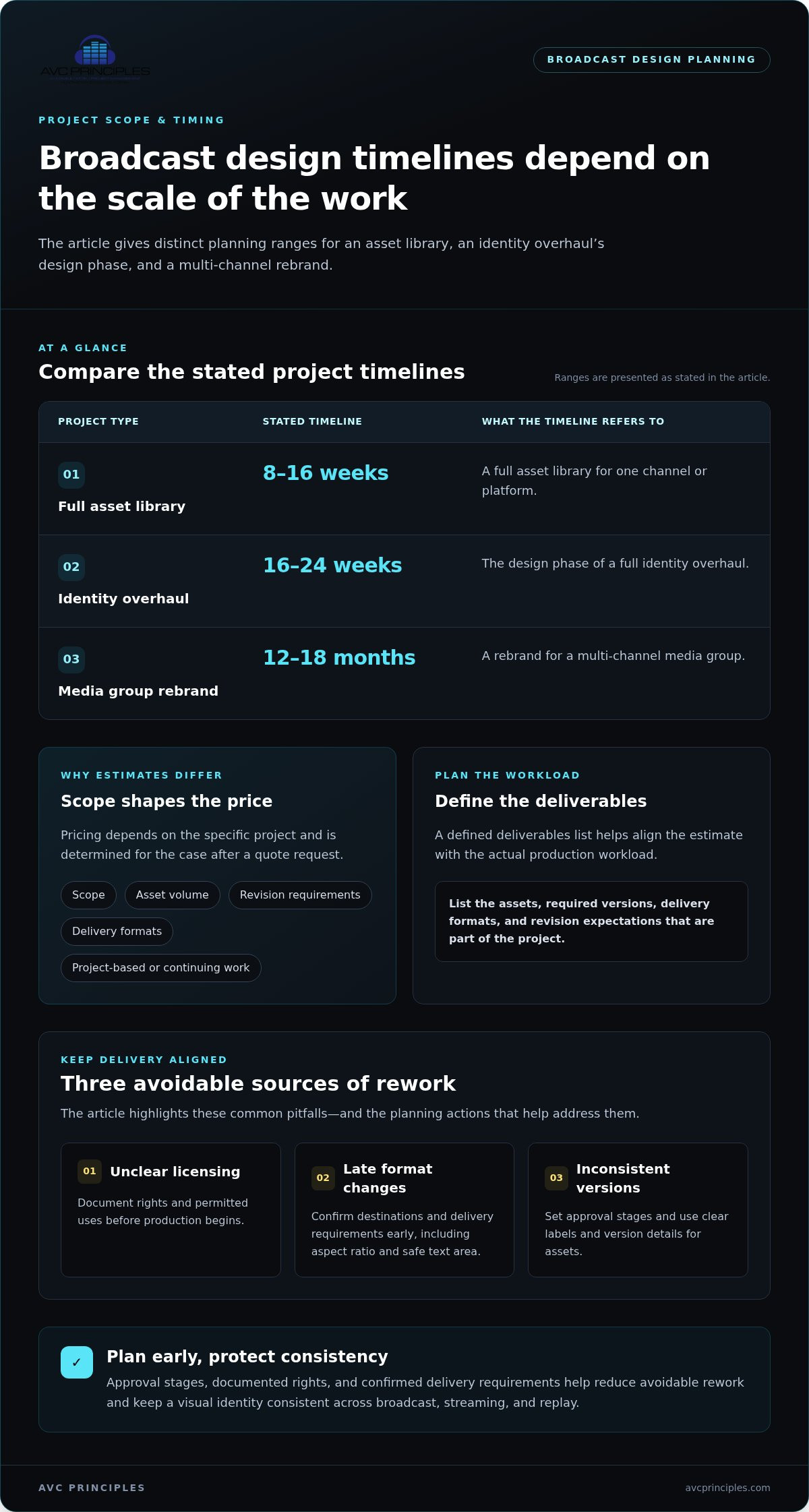
How do broadcast design agencies price projects and ongoing work? Pricing depends on scope, asset volume, revision requirements, delivery formats, and whether work is project-based or continuing; the price is determined for the specific case after a quote request. A defined deliverables list helps align the estimate with the actual production workload.
How long does a broadcast design project typically take? A full asset library for one channel or platform can take 8 to 16 weeks, while a full identity overhaul’s design phase can take 16 to 24 weeks. A multi-channel media group rebrand may take 12 to 18 months.
Common pitfalls include unclear licensing, late format changes, and inconsistent asset versions. Set approval stages, document rights, and confirm delivery requirements early. These steps reduce avoidable rework and help preserve a consistent identity across broadcast, streaming, and replay.
Integration of creative with technical production
Creative decisions must translate into production assets that work within the broadcaster’s systems. Align the visual brief, workflow, and delivery requirements before production begins.
REMI Workflows and Infrastructure
In a REMI workflow, production activity is distributed between a venue and a central control location. The production plan must account for signal contribution, communications, control-room access, and coordination between on-site and remote teams. For a sports program, camera feeds and commentary may originate at the venue while directing and graphics operations happen elsewhere. Map each signal path and responsibility before the event, including how the team will respond to a disrupted feed.
Graphics Specifications and Delivery Formats
Broadcasters define graphics and motion-design specifications through their technical delivery requirements. Confirm the required frame dimensions, frame rate, codec, color space, transparency, safe areas, and file format for each channel or platform. Also agree on whether delivery requires rendered playback files, editable project files, or both. A shared specification sheet gives the creative team, agency, and production staff one reference for naming, version control, and final approvals.
Commercial and entertainment productions require different creative choices, but both depend on a workable technical plan. A commercial may need product graphics that remain legible beside legal copy, while a studio show may rely on lower thirds and animated transitions. In sports, score graphics must present information without obscuring play. Establish who approves each asset and how the production team cues it during transmission.
Post-production connects captured material with the final program package. Editors need access to approved graphics, fonts, logos, and version notes, alongside clear instructions for timing and placement. A title animation, for example, may need an editable version for a late editorial change and a final render for playback. Organize source files by episode and revision so teams can identify the correct asset without rebuilding it.
Scalable production starts with a modular design system. Separate reusable elements, such as channel identifiers and transition templates, from episode-specific graphics. This lets a production adapt its visual package for a new format or digital release without redesigning every component. For global distribution, plan for localization, including text expansion and alternate language versions. Define the required outputs early, then match production resources to the delivery plan.
When a show’s creative plan depends on coordinated audiovisual infrastructure, review how broadcast production infrastructure can support the required signal paths, control spaces, and operational workflow.
When localizing, check that translated wording fits the available space and preserves the intended hierarchy. Review localized assets in context, rather than relying on a design file alone, so creative choices remain practical throughout the production workflow.
Broadcast designers need to understand storytelling and the technology behind their work. They can use that understanding to connect visual decisions with the program’s purpose and the systems that carry each asset to air. Encourage creative and technical teams to review work together, flag constraints early, and confirm that revisions preserve both meaning and usability. A consistent handoff process also helps keep approved versions clear as work moves between design, production, and post-production.
Broadcast and entertainment studio design
A broadcast studio is both a performance environment and a working production space. Its design must support camera positions, presenter movement, lighting, sound, screens, and the program’s visual identity. For a panel show, set geometry needs to preserve sightlines between guests while giving cameras usable angles for wide shots and close-ups. Scenic elements, graphics, and motion design should reinforce the same storytelling direction.
Scenic design establishes the physical setting viewers recognize. A competition format may use a central stage, audience seating, and display surfaces for scores or contestant information. The layout affects performer entrances, camera coverage, and lighting positions. Build these relationships into plans and visualizations before fabrication, so set features and production requirements are considered together.
Extended reality adds another design layer. Major broadcasters have adopted XR studios to create virtual environments that make the studio backdrop part of the program’s visual narrative, illustrating how digital layers expand physical footprints. For any XR concept, map the intended camera views and screen content together. This helps keep virtual scenery, physical set pieces, and on-screen graphics visually consistent.
Studio design companies and broadcast design agencies can work across different parts of this process. Their scope may involve concept design, scenic environments, graphic systems, or coordination with production infrastructure. Across the national market, hundreds of specialized providers support entertainment productions nationwide. These directory records highlight a deep talent pool, though evaluating specific project fit and capability remains essential for every production.
What should you look for when choosing a provider of entertainment broadcast design services? Assess how its workflow connects creative development, studio planning, and technical production. Review relevant project examples, defined deliverables, approval stages, and how the team will coordinate with the production staff responsible for the studio.
Before launch, assess the space against the show’s operating requirements. Use the floor plan to review presenter routes, camera positions, audience access, lighting coverage, and equipment locations. For a studio with moving scenic elements, identify their operating paths and their effect on camera views. Resolve these interfaces during design, not after the set is built.
A practical review can group decisions into three areas:
- Identity: Check that scenic materials, color, graphics, and motion support the program’s format.
- Production: Confirm that camera coverage, lighting positions, and screen placement suit planned scenes.
- Operation: Trace performer routes, scenic movement, and equipment access across the studio plan.
These checks give creative and technical teams a shared basis for evaluating the studio before launch.
Creative direction and design development
Creative direction turns a program’s editorial purpose into a visual system viewers can recognize. In a television news format, graphics can organize information, guide attention, and reinforce editorial tone. A network identity may shape typography, color, and animation, while each program uses distinct treatments for presenters and segments. Define those relationships before producing individual assets. This gives designers a clear framework for consistency and variation.
Start by translating the brief into practical design decisions. Identify the audience, program format, editorial priorities, and delivery platforms. Then define how titles, lower thirds, transitions, and motion graphics should work. A current-affairs program, for example, may use restrained transitions and clear information graphics, while an entertainment show may use more expressive movement. The visual approach should support the content, not compete with it.
What is the process for commissioning broadcast design, from brief to delivery? Establish the brief and deliverables, develop design directions for review, approve a visual route, then produce and test the required assets. Include the broadcaster’s technical requirements and approval stages in the workflow so production teams can assess the work before final delivery.
A full identity overhaul requires a defined design phase. A typical design-phase timeline for a single channel or platform undergoing a full identity overhaul is 16 to 24 weeks. Scope depends on the number of programs, asset types, approval rounds, and platforms involved. Set review milestones for the core identity, motion tests, and template designs. Decisions made at each stage guide the next and reduce conflicting feedback during production.
Build a design system rather than treating each graphic as an isolated file. Specify how the logo, typography, colors, animation, and information hierarchy work together. A network with several programs can use shared rules while allowing program-specific treatments. Document these rules in a style guide and apply them to sample assets. A lower third and a segment title, for instance, should feel related without looking interchangeable.
Before release, review the package against its intended use. Check legibility, timing, hierarchy, and how graphics interact with footage. Test motion graphics over bright and dark scenes, then review text placement on actual program frames. A final asset list should identify approved versions, intended use, and delivery format. These checks make delivery more controlled and help preserve the approved identity across television and digital outputs.
- Brief: Record format, editorial tone, audience, and platforms.
- Direction: Compare visual routes against those requirements.
- Development: Apply the approved system to representative assets.
- Delivery: Review final versions and document their intended use.
A final asset list can cover lower-third graphics, digital on-screen graphics, and motion graphics. Television stations may use broadcast designers to create these when changing their on-air look.
Concept development, art direction, and visualization
Broadcast design can include motion graphics, branding, set design, channel logos, animation, and on-screen graphics. Concept development connects these elements to the audience, program format, and intended platforms before production commits to a visual direction.
Begin with the production brief. Record the program’s purpose, audience, tone, distribution platforms, and required deliverables. A corporate event stream, for example, may need a visual system that connects stage screens, speaker titles, and online graphics. An advertising campaign may instead prioritize a product reveal and a clear call to action. These requirements define the creative problem.
Commercial design work may start with a client or agency concept. The designer develops it into design boards for approval before production begins. Boards can show color, typography, imagery, composition, and sample screen treatments. Reviewers can assess how the proposed visual direction fits the brief, rather than judging isolated assets without context.
Art direction turns the approved concept into specific visual decisions. It sets rules for image selection, graphic hierarchy, transitions, and the relationship between live footage and designed elements. For a studio interview, the director might specify restrained title animation and a consistent treatment for guest names. For an awards sequence, more dramatic motion may support presenter entrances and winner announcements.
Visualization makes those decisions easier to evaluate before final assets are built. Use frame mockups, storyboard panels, and representative screen compositions to show how graphics appear during program moments. A lower third can be tested over a bright interview shot and a darker stage scene. This comparison reveals contrast or placement issues while revisions remain within the design phase.
Review the concept against each intended use, not just its presentation board. A graphic designed for a full-screen title may need a different layout in a social clip or streaming interface. An interactive element should make its function clear to viewers. For a voting prompt, show the instruction, response method, and visual hierarchy together in a realistic screen mockup.
- Brief: Capture audience, format, tone, and platforms.
- Explore: Develop design boards from the approved concept.
- Visualize: Test representative graphics in program frames.
- Approve: Record feedback and sign off on the visual direction.
This sequence gives creative, production, and advertising teams a shared basis for decisions. Use it to identify mismatched expectations early, such as a visual treatment that suits a stage but not a streaming layout. Clear boards and review points keep the approved concept connected to the assets that follow.
Planning a show’s visual concept alongside its physical and technical environment? Plan your broadcast environment around the production’s creative requirements.
AVC Principles: AV Systems Design
AVC Principles provides AV Systems Design for studios and production environments where creative plans depend on coordinated audiovisual infrastructure. This service is useful when system design must align with room use, signal paths, control requirements, and production workflows.
Project needs may also call for ICT Infrastructure Design to support connected systems, Staged Environment Engineering for performance spaces, or Command and Control Center Design for centralized operations. These disciplines address the technical environment around a production; they do not replace its creative direction, graphics, or content development.
Define the space’s intended use, the production workflow, and the systems that must operate together. This gives the design process a clear basis for coordinating infrastructure with operational requirements. To discuss your project’s design needs, contact AVC Principles or visit avcprinciples.com.
Move Your Show from Design Intent to Production
The next step is to translate the show’s creative direction into decisions that guide the production environment. Define the intended audience experience, operational requirements, and technical systems needed to support each program element. This gives creative and production teams a shared basis for advancing the project.
Entertainment broadcast design services are most effective when visual intent and infrastructure planning develop together. AVC Principles provides AV Systems Design, ICT Infrastructure Design, and Staged Environment Engineering for the systems and spaces that support production. These services are relevant when a studio or staged environment must align with an established production plan.
Bring the project’s objectives and requirements into the next planning conversation. Contact AVC Principles about your project to discuss the design requirements and appropriate next steps. A clear starting point can help your team move forward with purpose.
Frequently Asked Questions
What services do entertainment broadcast design companies offer?
Broadcast designers commonly develop visual assets for television, sports, award ceremonies, commercials, and informational programming. Work can include channel logos, motion graphics, lower thirds, digital on-screen graphics, and infographics. An awards broadcast, for example, might use animated graphics to emphasize a presenter’s entrance, while an infographic can clarify complex information with charts and images. The scope depends on the program’s format and intended audience.
How do broadcast design firms compare for television, streaming, and live events?
Compare firms by how clearly their work addresses each delivery environment. Television projects need graphics that function within program frames; streaming may require adaptations for different digital platforms. Live-event work can involve real-time graphics, scorebugs, player introductions, and overlays that keep attention on the action. Review relevant examples, deliverables, and how the firm coordinates visual assets with production teams.
Which U.S. cities have major entertainment broadcast design studios?
Los Angeles and New York are U.S. centers identified in broadcast-design company records. As of September 2026, Los Angeles had 210 broadcast design company records, and New York had 188. These figures describe company records, not a verified count of studios or a ranking of project quality. A location alone doesn’t establish whether a firm’s experience aligns with a show’s format, audience, and delivery needs.


