

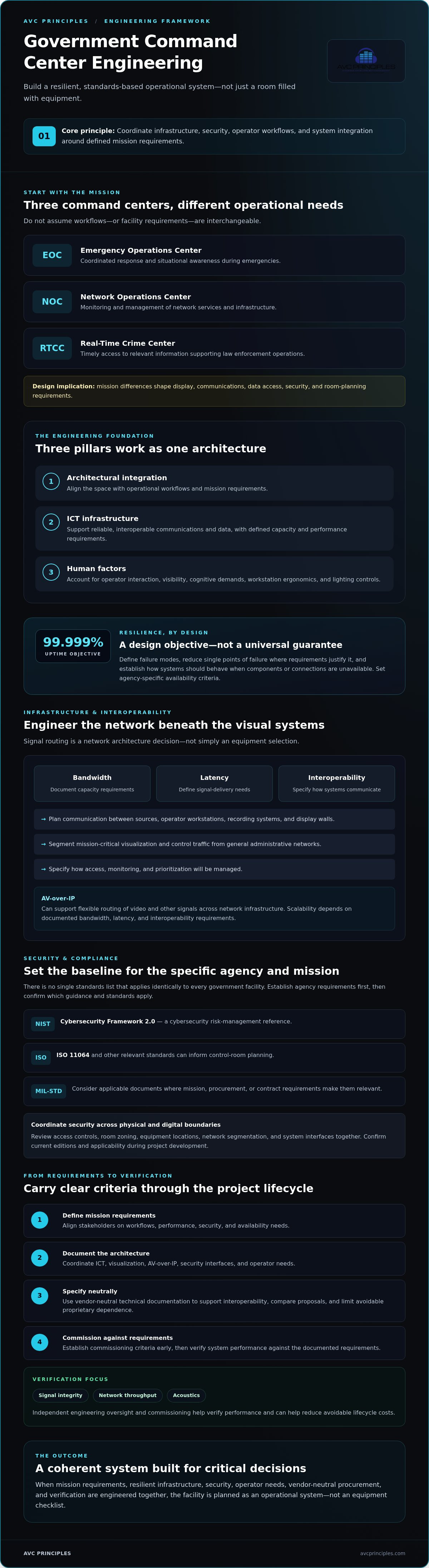
A government command center can be fully equipped and still be poorly engineered. Government command center engineering is not just an equipment checklist. It is the discipline of creating a resilient, standards-based environment for critical decisions, where infrastructure, security, operator workflows, and system integration work as one coherent architecture.
The challenge is substantial. Teams must coordinate multiple technical disciplines, meet stringent security and compliance requirements, avoid unnecessary dependence on proprietary systems, and design workspaces that support sustained operator performance. A gap in any one area can undermine the reliability of the whole facility.
This engineering-first framework outlines core requirements for planning a compliant, resilient, and future-ready command center in 2026. It covers standards and infrastructure, cybersecurity considerations, human factors, interoperability, and the technical documentation needed for clear procurement and implementation. It also explains how vendor-neutral design and commissioning can verify system performance and help reduce avoidable lifecycle costs. Use it to evaluate requirements, align stakeholders, and make informed design decisions.
Key Takeaways
- Distinguish EOCs, NOCs, and RTCCs by their operational purpose before defining facility requirements.
- Use government command center engineering to align ICT, visualization, and AV-over-IP architecture with reliability and interoperability needs.
- Account for human factors, including cognitive load, workstation ergonomics, and lighting controls, when developing design criteria.
- Specify vendor-neutral requirements and technical documentation so procurement decisions support interoperability and reduce dependence on proprietary systems.
- Establish commissioning criteria early, then verify performance against documented requirements, including signal integrity, network throughput, and acoustics.
Defining Government Command Center Engineering Foundations
Government command center engineering treats the facility as an integrated operational system, not a room arranged around screens. Architecture, ICT infrastructure, audiovisual systems, security interfaces, and operator needs must be coordinated around defined mission requirements. A Control room overview offers a high-level introduction to control room purposes and common elements. Engineering a government environment means translating those functions into documented performance criteria.
The mission shapes the design. An Emergency Operations Center (EOC) supports coordinated response and situational awareness during emergencies. For a deeper look at this facility type, see this emergency operations center system design technical reference. A Network Operations Center (NOC) focuses on monitoring and managing network services and infrastructure. A Real-Time Crime Center (RTCC) supports law enforcement operations with timely access to relevant information. Because their workflows differ, their display, communications, data access, security, and room-planning requirements should not be assumed to be interchangeable.
Three pillars establish the foundation: architectural integration aligns the space with operational workflows; ICT infrastructure supports reliable, interoperable communications and data; and human factors account for operator interaction, visibility, and cognitive demands. Furniture and visual impact matter, but they cannot replace systems engineered to perform under mission conditions.
The Mission-Critical Engineering Mindset
In this framework, mission-critical engineering is the discipline of designing and verifying systems to ensure 99.999% uptime. This figure is a design objective, not a universal guarantee or a substitute for agency-specific availability criteria. The practical mindset is resilience: define failure modes, reduce single points of failure where requirements justify it, and establish how systems should behave when components or connections are unavailable.
This calls for a shift from consumer-grade AV assumptions to industrial-grade ICT planning. Specify interfaces, capacity, maintainability, and performance requirements rather than relying on equipment labels. Carry these requirements through the project lifecycle, from concept and coordinated design to procurement documentation, implementation, and commissioning. Commissioning then verifies performance against the documented criteria.
Regulatory Frameworks and Compliance Baselines
There is no single standards list that applies identically to every government facility. Establish the agency’s requirements first, then identify relevant NIST guidance, ISO standards, and MIL-STD documents where the mission, procurement, or contract makes them applicable. NIST Cybersecurity Framework 2.0 provides a cybersecurity risk-management reference. Human-factors standards, including ISO 11064, can inform control-room planning. Confirm current editions and applicability during project development.
Security crosses physical and digital boundaries. Access controls, room zoning, equipment locations, network segmentation, and system interfaces need coordinated review rather than separate assumptions. Independent engineering oversight and clear, vendor-neutral technical documentation help agencies assess compliance, compare proposals, and limit avoidable dependence on proprietary systems.
ICT Infrastructure and High-Reliability Network Architecture
A command center’s visual systems depend on the network beneath them. General audiovisual design may focus on connecting sources to displays. Mission-critical ICT engineering must also define traffic behavior, capacity, resilience, security boundaries, and how faults affect operations. In government command center engineering, signal routing is therefore a network architecture decision, not simply an equipment selection.
AV-over-IP can support flexible routing of video and other signals across network infrastructure, but scalability depends on documented bandwidth, latency, and interoperability requirements. Define how sources, operator workstations, recording systems, and display walls will communicate. Segment mission-critical visualization and control traffic from general administrative networks, and specify how access, monitoring, and prioritization will be managed. Keep requirements technology-neutral so agencies can evaluate solutions without tying the design to a single vendor.
Network Reliability for Broadcast and Visualization
Real-time dashboards and video walls need predictable signal delivery, especially when operators rely on several sources at once. Establish performance criteria for latency, image quality, and signal integrity, then verify them during commissioning. Structured low-voltage design supports performance through planned pathways, labeled terminations, documented cable schedules, and separation of systems where required. Specify fiber-optic or copper media according to distance, capacity, interface, and environmental conditions rather than defaulting to a generic cable type.
Resilience must be designed across the full signal path. Review network routes, switching, power sources, and connections to display and compute systems for shared points of failure. Redundant paths are useful only when they are sufficiently independent and their failover behavior is understood and tested.
Data Center Infrastructure for Command Environments
Whether compute is hosted in an on-premise technical room, connected government cloud assets, or a combination, define the boundaries and dependencies. Assess latency-sensitive workloads, data movement, access controls, and which functions remain available if a connection is disrupted. The UFC 4-141-03 C5ISR Facility Standards provides a relevant reference for projects where its scope and contractual applicability fit. Confirm requirements with the responsible agency.
Plan power and cooling around the expected equipment load and the consequences of a failure. Coordinate rack layouts, heat rejection, maintainable access, and monitoring with the facility design. Structural loading and equipment anchorage also require project-specific review, including seismic bracing where applicable. These are coordinated engineering decisions, not assumptions to leave until installation.
- Document: network diagrams, cable schedules, interfaces, and performance criteria.
- Design: independent power, cooling, and network routes where mission requirements call for redundancy.
- Verify: throughput, latency, signal integrity, failover, and thermal performance during commissioning.
Agencies developing these requirements can review ICT infrastructure design considerations alongside their facility criteria to support coordinated technical documentation.
Human Factors Engineering and Ergonomic Standards
Operators are part of the command center system. Poor sightlines, competing alerts, glare, persistent background noise, or awkward workstation layouts can make information harder to interpret and increase fatigue. Government command center engineering should therefore treat human performance as a design requirement, not just a furniture selection exercise.
Human Factors Engineering optimizes system performance through human-centric design.
Begin with operator tasks and workflows. Map which displays, communications, and controls each role must use, then arrange them to reduce unnecessary head turns, visual search, and competing demands for attention. In a multi-operator room, check sightlines from every console, including seated and standing positions, so one workstation or display does not obstruct another. For large video walls, determine viewing distances based on the displayed content, screen configuration, and required legibility rather than applying a single rule of thumb.
Acoustic and Environmental Control
Acoustic design must preserve speech intelligibility without allowing equipment, conversations, or room reflections to obscure operational communication. Specify noise and reverberation performance for the intended use, then coordinate sound-absorptive finishes and, where appropriate, sound masking with the communications system. Review HVAC equipment, airflow, and duct paths for acoustic effects as well. Cooling should maintain operator comfort and equipment conditions without introducing disruptive noise or drafts at consoles.
Lighting needs similar coordination. Provide controllable task and ambient lighting, manage reflections on displays, and assess color temperature in relation to screen use and operator tasks. Test lighting scenes at the actual consoles and display positions. A plan that looks balanced on a drawing may create glare or uneven visibility in the occupied room.
Operator Console and Visualization Ergonomics
For multi-shift operations, console layouts should accommodate adjustment and varied operator needs. Consider monitor placement, reach to controls, chair and console adjustment, cable access, and the ability to maintain equipment without disrupting adjacent workstations. Integrate collaboration and conferencing tools into the workstation plan so they are available without obscuring primary operational displays or adding unnecessary interface clutter.
Use applicable human-factors guidance as a design input, and confirm current editions and agency requirements during project development. In 2026, ANSI/HFES 100-2026 is a draft under review; the Human Factors and Ergonomics Society reported that its public comment period ended May 16, 2026. The VA Technical Reference Model is one government reference for assessed technologies and standards, but project teams should verify its relevance to their own requirements.
- Assess: sightlines, glare, lighting control, and speech intelligibility at each operator position.
- Coordinate: acoustics, HVAC, consoles, displays, and collaboration tools as one occupied environment.
- Verify: ergonomic and environmental performance under representative operating conditions.
Procurement and Regulatory Compliance Checklist
Government command center engineering needs procurement documents that convert operational and security requirements into verifiable technical criteria. A generic request for proposals may describe the project without defining how bidders must demonstrate interoperability, resilience, or system performance. Establish the agency’s applicable standards and security requirements before finalizing the tender, then express them in terms suppliers can address and evaluators can compare.
Technical Documentation and Specifications
Build a coordinated documentation set that describes the required system and how acceptance will be assessed. Include architecture diagrams, cable schedules, rack elevations, interface requirements, and system boundaries. Define performance criteria for relevant functions, such as signal integrity, network throughput, failover behavior, and audiovisual performance. Avoid naming a specific manufacturer when a measurable, interoperable requirement will serve the mission instead.
Independent engineering oversight during bidding can help identify ambiguous requirements, inconsistent assumptions, and proposed substitutions that do not meet the stated criteria. Require bidders to document exceptions and demonstrate how their approach satisfies each requirement. This creates a clearer basis for evaluation and reduces the risk that critical design decisions are deferred until implementation.
- Document: system architecture, cable schedules, rack elevations, interfaces, and required submittals.
- Specify: measurable performance and acceptance criteria tied to operational needs.
- Evaluate: interoperability, deviations, security responsibilities, and lifecycle documentation.
Cybersecurity and Information Assurance
Map physical and digital protections to the facility’s mission and the agency’s security direction. NIST SP 800-53 provides a catalog of information system and organizational security controls, but the applicable control baseline and implementation responsibilities should be confirmed with the agency. A reference to the standard is not proof of compliance. Procurement documents should identify required controls, evidence, and responsible parties.
Physical access protocols also require project-specific direction. Consultants and contractors may need facility access approval, sponsorship, or other screening under agency procedures. State the process bidders must follow without implying that every project requires the same clearance. If the facility includes a Sensitive Compartmented Information Facility (SCIF), establish applicable requirements with the responsible security authority and qualified project stakeholders before design and procurement.
Consider controls such as multi-factor authentication for relevant systems and role-based access to workstations. RFID credentials may be appropriate for specific physical access or user workflows, but they should be selected only after security officials define the use case and safeguards. No single control replaces a coordinated security architecture.
For procurement-ready technical documentation and command center design, engage AVC Principles for engineering design.
Engineering Lifecycle and Technical Commissioning Protocols
Installation does not establish operational readiness. Commissioning closes the gap between design intent and delivered performance by testing integrated systems against the project’s documented requirements. For government command center engineering, define the commissioning plan early. Identify test procedures, responsible parties, required evidence, acceptance criteria, and how deficiencies will be corrected and retested.
Independent technical testing provides an objective check that installed systems meet their specifications. It can expose issues that a basic power-on check will not reveal, such as signal degradation across a distribution path, network congestion under load, or room acoustics that impair speech clarity. Record test conditions and results so acceptance decisions are traceable.
Verification and Calibration Metrics
Set measurable criteria in the contract documents, then test each system under representative operating conditions. Evaluate display color accuracy and uniformity against project tolerances, and assess audio clarity at operator positions. Measure network throughput and test failover behavior while monitoring affected services. Compare acoustic performance with the specified criteria. Complete a final walkthrough with the design and delivery teams, assign each punch-list item an owner, and document resolution before acceptance.
- Signal and displays: Verify source-to-display performance, image quality, and calibration against specified requirements.
- Network: Record throughput and confirm redundancy and recovery behavior through planned tests.
- Room performance: Check speech intelligibility and acoustic conditions at representative workstations.
Handover and Professional Training
A controlled handover gives facility teams a reliable record of what was installed and how systems connect. Provide complete as-built drawings, current cable schedules, rack elevations, network and signal-flow diagrams, equipment configuration records, test results, and a register of unresolved items, if any. This information establishes a baseline for maintenance planning and future technology refreshes, helping teams assess proposed changes against the verified system architecture.
Training should match operator and facility responsibilities. Operators need practice with routine system workflows and approved first-response troubleshooting. Facility teams need documentation for system boundaries, dependencies, and escalation procedures. Training materials should reflect the final commissioned configuration, not superseded design documents. Independent commissioning and clear technical documentation help preserve a reliable basis for later upgrades.
For engineering consulting that supports technical documentation and commissioning, explore AVC Principles’ engineering consulting for your 2026 project requirements.
Build a Command Center Ready for Its Mission
A resilient facility depends on more than connected systems. Its architecture must align with operational needs, security requirements, and human performance. Clear technical specifications support transparent procurement, while vendor-neutral design helps preserve flexibility as technologies change.
Commissioning completes the engineering process. Independent testing checks whether integrated systems meet documented performance criteria and gives facility teams a verified basis for operations and future upgrades. Together, independent oversight, comprehensive ICT and AV documentation, and commissioning create a disciplined path from requirements to operational readiness.
For support defining technical requirements and coordinating design oversight for your command center project, schedule a technical consultation with AVC Principles.
Frequently Asked Questions
What are the primary engineering standards for government command centers in 2026?
Applicable standards depend on the facility’s mission, agency requirements, and procurement scope. References to assess include NIST Cybersecurity Framework 2.0 for cybersecurity risk management, relevant NIST security controls, ISO 11064 for control-room ergonomics, and ANSI/TIA-568-E for commercial building cabling. ANSI/TIA-942-C may be relevant to data-center infrastructure. In 2026, ANSI/HFES 100-2026 is a draft under review. Confirm current editions, contractual requirements, and applicability with the responsible agency.
How does independent engineering oversight reduce project risk in mission-critical facilities?
Independent engineering oversight gives the owner a technical review separate from the equipment or implementation proposal. The reviewer can check whether requirements are measurable, designs are coordinated, and proposed substitutions meet documented performance criteria. During procurement, this supports consistent bid evaluation. During delivery, testing can verify that systems meet specified requirements. Oversight can also identify gaps before they become acceptance or integration issues, while maintaining a clear record of decisions and test results.
What is the difference between a NOC and an Emergency Operations Center (EOC) in terms of engineering?
A NOC is engineered to support monitoring and management of network services and infrastructure, while an EOC supports coordinated emergency response and situational awareness. That difference affects system priorities. A NOC may emphasize network visibility, infrastructure status, and technical communications. An EOC may need coordinated information sharing and operational displays across response teams. Define users, workflows, information sources, and continuity requirements first, then derive the room layout, ICT architecture, display systems, and security controls.
Why is vendor-neutral design critical for government ICT infrastructure?
Vendor-neutral design specifies required capabilities, interfaces, and performance rather than relying on a particular manufacturer’s products. This gives procurement teams a consistent basis for comparing compliant proposals and helps preserve options for future replacement or expansion. Clear architecture diagrams, interface schedules, and system requirements also reduce dependence on undocumented configurations. Neutrality does not mean every product is interchangeable. Proposed components still need to satisfy the security, interoperability, support, and performance criteria established for the project.
What ergonomic factors are most important for 24/7 command center operations?
Prioritize clear sightlines, adjustable workstations, readable displays, controllable lighting, and acoustics that support speech intelligibility. Review glare and reflections at operator positions, and coordinate HVAC conditions so comfort does not come at the expense of distracting noise or drafts. Consider shift handovers and varied operator needs when planning console adjustment and control placement. ISO 11064 can inform control-room design. Verify current standards and agency criteria for the specific project and operator tasks.
How do SCIF requirements impact command center audio-visual engineering?
SCIF requirements can constrain room layout, equipment placement, cabling routes, system interfaces, and how audio-visual signals enter, leave, or move within the space. Requirements depend on the facility and its security authority, so teams should not assume a standard AV design will comply. Coordinate the AV and ICT design with responsible security officials and qualified project stakeholders early. Confirm applicable criteria before specifying equipment or pathways, and document approved interfaces and review responsibilities.
What role does AV-over-IP play in modern command center architecture?
AV-over-IP carries audiovisual signals over network infrastructure, allowing sources to be routed to displays and workstations without relying solely on fixed point-to-point connections. It can support flexible layouts and system expansion, but requires deliberate network engineering. Define bandwidth, latency, traffic segmentation, interoperability, security, and failover requirements before selecting an approach. Validate performance across the full signal path, including network equipment, endpoints, and displays, under representative operating conditions.
How is technical commissioning different from a standard system installation?
Installation places and connects system components. Commissioning tests whether the integrated system meets documented design and acceptance criteria. Depending on the project, verification may include signal integrity, network throughput, failover behavior, display calibration, and acoustic performance. Commissioning also records test conditions, results, deficiencies, and corrective actions. This evidence supports informed acceptance and gives facility teams a baseline for future maintenance and technology changes. A system turning on is not, by itself, proof of verified performance.


