

What if a room full of live feeds still fails to help responders make timely decisions? A real time crime center is more than a technology room. Its value depends on how information, people, and procedures work together. Agencies may recognize the potential of shared data and video while still facing practical questions: Who monitors information? How do analysts support dispatchers and responding personnel? What limits govern access and use?
This article explains the RTCC mission and operating model, including the distinct roles of analysts, dispatchers, and field personnel. It also outlines systems an agency may consider integrating, from video and records platforms to communications and incident data, and the planning needed to connect them reliably.
Technology selection is only one part of the work. Privacy, cybersecurity, integration, room layout, and public trust require deliberate decisions before implementation. You’ll learn how operational workflows can inform system architecture and control-room design, and why technical documentation and commissioning help verify that integrated systems perform against documented requirements.
Key Takeaways
- Distinguish an RTCC’s information-support role from dispatch, patrol, and public-facing crime maps.
- Assess potential systems by their operational purpose, integration dependencies, and fit with agency requirements.
- Plan governance alongside technology, including access controls, retention, auditing, cybersecurity, and public communication.
- Use a defined engineering lifecycle to translate a real time crime center mission into documented requirements and verify system performance at commissioning.
What Is a Real-Time Crime Center, and What Does It Do?
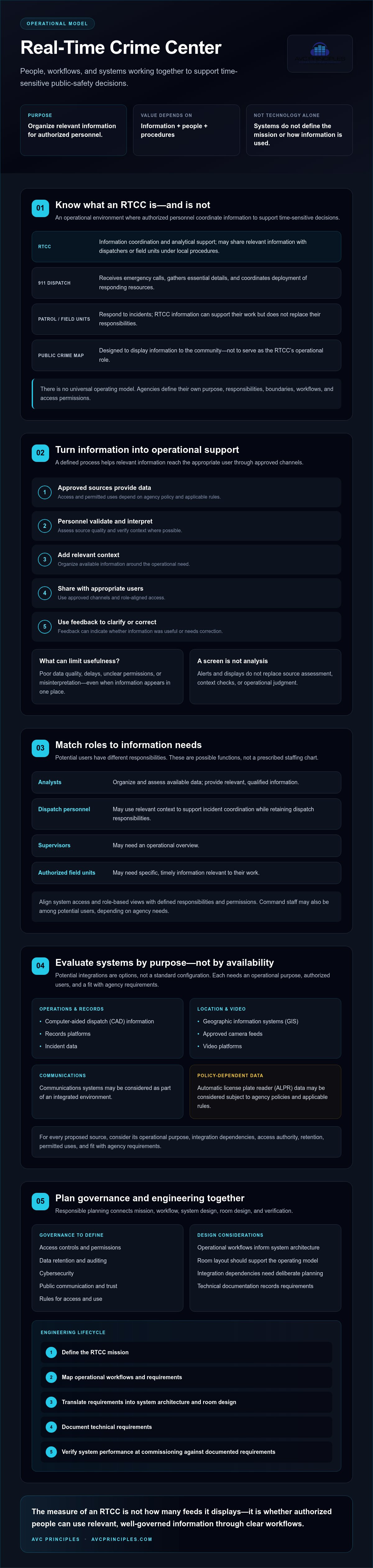
A real-time crime center (RTCC) is an agency environment where authorized personnel coordinate relevant information to support time-sensitive public-safety decisions. It is not a patrol unit that responds to incidents, a 911 dispatch center that takes calls and assigns resources, or a public crime map designed to display information to the community. Its purpose is to help designated staff access and interpret information relevant to an operational need.
An RTCC is an operational environment that combines people, workflows, and systems to organize information for authorized personnel supporting time-sensitive decisions. Systems may provide access to information from approved sources, but technology alone does not establish the center’s mission or determine how information should be used. Real-time crime centers (RTCCs) have different histories and operating approaches. An agency should define its own purpose, responsibilities, and boundaries rather than assume a universal model.
How Is an RTCC Different From a 911 Dispatch Center?
Dispatch centers focus on receiving emergency calls, gathering essential details, and coordinating the deployment of responding resources. An RTCC focuses on information coordination and analytical support. Depending on local procedures, RTCC personnel may provide relevant information to dispatchers or field units during an incident. That interaction supports existing functions. Dispatchers, investigators, and command staff retain their agency-defined responsibilities.
Who Uses a Real-Time Crime Center?
Potential users include analysts, dispatch personnel, supervisors, and authorized field units. Their information needs differ. Analysts may organize and assess available data; dispatch personnel may need relevant context to support incident coordination; supervisors may need an operational overview; and field units may require specific, timely information. These are possible functions, not a prescribed staffing chart. A real time crime center may be designed around an agency’s mission and available personnel, with workflows and system access aligned to defined responsibilities and permissions.
That distinction matters during planning. A system may make information available, but access should be governed by agency-defined permissions. Personnel also need clear procedures for interpreting and sharing what they see. Establishing those boundaries connects the room’s technical design to its operational purpose without treating every user, data source, or incident alike.
How a Real Time Crime Center Turns Information Into Operational Support
An RTCC’s operational value depends on more than connecting systems. Information must move through a defined process before it can support a decision: authorized sources provide data, personnel validate and interpret it, relevant context is added, and appropriate users receive it through approved channels. Feedback can then clarify whether the information was useful or needs correction.
Integrated information supports decisions only when paired with defined workflows and trained users. Poor data quality, delays, unclear permissions, or misinterpretation can limit usefulness, even when a system displays information in one place.
Which Information Sources May Feed an RTCC?
Potential inputs include computer-aided dispatch (CAD) information, geographic information systems (GIS), and approved camera feeds. An agency may also consider automatic license plate reader (ALPR) data, subject to its policies and applicable rules. These are possible categories, not a standard configuration. Available sources, access authority, retention periods, and permitted uses vary by agency and jurisdiction. Give each proposed integration a defined operational purpose and authorized users.
How Does Information Reach the Right User?
Consider a hypothetical report of a vehicle connected to an active incident. An analyst might check whether the available information is current, compare it with relevant incident context, and pass a concise, qualified update to an authorized user. That person assesses it alongside other information and follows agency procedures. This example illustrates a possible workflow, not a prescribed response or a guaranteed outcome.
Role-based views can limit displays to information relevant to a user’s responsibilities. Alert prioritization can help distinguish items requiring attention from routine system activity, while controlled sharing can define who may receive information and through which channels. A screen or alert is not analysis. Personnel still need to assess source quality, verify context where possible, and apply operational judgment.
Agencies should define how staff document access and information sharing, how decisions or uncertain data are escalated, and how feedback is captured. Auditability can support review of system use, while clear escalation paths help personnel identify who should assess an issue. The specific controls and sequence should reflect agency policy, approved data use, and operational responsibilities.
These decisions shape both system architecture and room workflows. Command and control center design can align information displays, infrastructure, and operational needs during planning, before integration choices become difficult to change.
Which RTCC Technologies Matter and How Should Agencies Evaluate Them?
Technology selection should follow documented operational requirements, not a preferred vendor or a standard equipment list. A real time crime center may combine several systems, but each integration should support a defined workflow and have clear access, performance, and support requirements. The appropriate configuration depends on the agency’s mission, existing infrastructure, and authorized information sources.
| System category | Operational purpose | Integration dependency | Key evaluation question |
|---|---|---|---|
| Computer-aided dispatch (CAD) | Displays incident and dispatch information. | Requires an approved method to exchange relevant data with other systems. | Can users see timely, clearly attributed incident details? |
| Geographic information systems (GIS) | Places incidents and other authorized information in geographic context. | Depends on compatible location data, mapping layers, and update processes. | Are location details accurate and useful for the intended workflow? |
| Video-management platforms | Provides access to approved live or recorded camera feeds. | Depends on camera access, network capacity, permissions, and supported interfaces. | Can authorized users locate and interpret relevant video without unnecessary delay? |
| Approved sensor or records integrations | Adds selected information from authorized sources. | Depends on policy, data formats, source quality, and permitted use. | Is each source necessary, reliable, and governed by clear access rules? |
How Do CAD, GIS, and Video Systems Work Together?
CAD can provide incident context, GIS can show where information relates geographically, and video systems can present approved camera feeds. Together, they may contribute to a shared operational picture, but integration requires project-specific verification. Agencies should assess data formats, interface compatibility, update frequency and latency, and how each item is attributed to its source. A display that combines feeds does not establish their accuracy or ensure that systems can exchange information reliably.
What Should Agencies Assess Beyond the Display Wall?
Display performance is only one design consideration. Network capacity, cybersecurity, resilience, room acoustics, workstation ergonomics, and maintainability all affect whether systems can support the intended work. Staff need usable individual workstations and collaboration methods, not only a large shared display. Agencies should also verify which standards and security requirements apply to their environment before making them design criteria.
Compare interoperability, role-based access controls, resilience, usability, and supportability against documented requirements. Consider what happens during a network or system interruption, how access is controlled, and whether staff can identify the source and status of displayed information. Room layout and audiovisual design should reflect actual workflows and operator needs. A disciplined design process connects these requirements to system architecture, technical documentation, and commissioning checks, without assuming one product stack will suit every agency.
How Should an Agency Plan an RTCC Responsibly?
Planning a real time crime center should begin with operational purpose, not a shopping list. A disciplined sequence helps agencies connect the mission to system design and governance:
- Define the mission. Identify the decisions and operational needs the center is intended to support.
- Map workflows. Document who needs information, when they need it, and how it may be shared.
- Identify authorized data. Record each source, permitted purpose, access authority, and relevant handling requirements.
- Document requirements. Translate user needs and governance decisions into technical and room-design criteria.
- Validate the design. Review integration, security, usability, and acceptance criteria with the appropriate stakeholders.
Privacy, access, retention, auditability, cybersecurity, and public communication belong in this sequence as governance workstreams, not as late-stage adjustments. Agencies should distinguish binding legal obligations from internal policy and recommended practice. Applicable laws and policies depend on the jurisdiction and data involved, so qualified agency stakeholders should verify them. The same applies to whether and how the current CJIS Security Policy applies to a proposed system.
What Governance Questions Belong in the Planning Phase?
For each data source, establish who may access it, for what purpose, and under whose authorization. Define agency controls for retention, disclosure, access logging, and review, including who is responsible for examining records and addressing exceptions. Determine how security risks will be assessed and communicated to appropriate personnel. Public communication should explain the center’s stated purpose and relevant policies in terms the community can understand, while reflecting agency-approved practices.
How Can Agencies Define Requirements Before Procurement?
Document user roles, representative operating scenarios, data dependencies, availability needs, and integration constraints before evaluating proposed systems. Include operators, IT, security, facilities, procurement, and legal stakeholders in the requirements review. Their input can reveal dependencies a technology specification alone may miss, such as room layout, network capacity, access controls, or coordination between users.
Convert each requirement into an observable acceptance criterion. For example, a test could confirm that a specified user role can access an approved source, that displayed information includes the required source or time context, or that an agreed access event is recorded. The exact criteria should reflect documented agency requirements and be checked during commissioning. These tests verify system functions, not crime reduction, response speed, or other public-safety outcomes.
For agencies developing the room, system architecture, and technical documentation together, explore command and control center design as part of the planning process.
From RTCC Concept to Commissioned System: The Engineering Role
A real time crime center moves from concept to operation through a sequence of engineering decisions. The agency defines its mission and requirements; the design team translates them into system architecture and coordinated documentation; stakeholders review dependencies across the room, audiovisual systems, and ICT infrastructure; and commissioning verifies agreed functions before handover. Each phase gives the next one a documented basis.
AVC Principles is an engineering consultancy providing AV systems design, ICT infrastructure design, and command and control center design. Its role is to develop system architecture, technical documentation, project oversight, and commissioning, not to operate an RTCC or sell equipment. Coordinating these disciplines with agency workflows can surface room, infrastructure, and interface dependencies during design, before they become constraints during installation and integration.
What Does Systems Engineering Contribute to an RTCC Project?
Systems engineering connects the operational brief to the physical and technical environment. Room layouts, operator workstations, audiovisual displays, control interfaces, and ICT infrastructure need to be considered together. Coordinated documentation can clarify how systems connect, identify infrastructure and space requirements, and give project stakeholders a shared reference for design review and delivery. Early coordination helps expose conflicts and dependencies while there is still an opportunity to address them in the design.
What Should Commissioning Confirm Before Handover?
Commissioning is verification against documented project requirements, not a guarantee of operational effectiveness, faster responses, or crime-related results. The agency and project team should agree on acceptance criteria and test the functions those criteria describe. Depending on scope, checks may include:
- Functional performance: Confirm that specified displays, interfaces, and control functions operate as documented.
- Integration behavior: Test expected information and control paths between connected systems.
- User workflows: Run role-based scenarios with agency representatives to assess whether intended tasks can be completed.
- Network performance: Verify agreed measures under defined test conditions.
- Issue resolution: Record deficiencies, assign follow-up, and document outcomes against the acceptance criteria.
These checks create a structured handover record and help distinguish verified technical performance from assumptions about future operations. Agencies assessing a new center or modernization project can discuss command-center system design with AVC Principles.
Build an RTCC Around Purpose, People, and Requirements
A capable real time crime center is defined by more than the systems it brings together. Its mission, user workflows, authorized information, and governance controls should guide technology and room design. Clear requirements also give agencies a basis for evaluating integrations and verifying system functions during commissioning, without confusing technical performance with public-safety outcomes.
AVC Principles provides engineering design from concept development through commissioning, with expertise in AV systems, ICT infrastructure, and command and control center design. For agencies assessing a new center or modernization project, discuss command-center system design with AVC Principles. A disciplined planning process can help turn operational needs into a coordinated, documented design, giving the project a sound foundation for its next steps.
Frequently Asked Questions
What is a real-time crime center?
A real time crime center is an operational environment where authorized personnel coordinate information to support time-sensitive public-safety decisions. It brings together staff, defined workflows, and selected systems, rather than serving as a patrol unit, 911 dispatch center, or public crime map. Its configuration varies by agency. The mission, user responsibilities, approved information sources, and access permissions should be defined locally.
What does a real-time crime center do?
A real-time crime center organizes and contextualizes information for personnel who need it for an operational purpose. Depending on its mission and authorized systems, staff may review incident information, maps, or approved camera feeds, then share relevant context with designated users. The center supports agency decision-making. It doesn’t make decisions automatically or replace dispatchers, investigators, supervisors, or field personnel.
What technology is used in a real-time crime center?
Possible systems include computer-aided dispatch (CAD), geographic information systems (GIS), video-management platforms, and approved sensor or records integrations. Agencies may also consider automatic license plate reader data, subject to applicable rules and agency policy. Selection should follow documented operational requirements. Evaluate how systems exchange information, control access, perform under expected conditions, and support user workflows rather than assuming every center needs the same technology stack.
Do real-time crime centers prevent crime?
An RTCC shouldn’t be treated as a guarantee of crime prevention or improved public-safety outcomes. It is designed to organize information that may support time-sensitive decisions, but results depend on information quality, timeliness, staff interpretation, agency procedures, and circumstances beyond the system’s control. Agencies can define and test technical acceptance criteria, such as whether approved information displays as specified, without claiming those tests prove crime reduction.
What privacy safeguards should an RTCC have?
Safeguards should be defined by the agency and verified against applicable laws and policies. Planning questions include who can access each information source, for what purpose, under whose authorization, and how access is logged and reviewed. Agencies should also establish controls for retention, disclosure, cybersecurity, and public communication. Qualified agency stakeholders should determine jurisdiction-specific requirements, including whether CJIS Security Policy provisions apply to particular systems or data.
How should an agency plan a real-time crime center?
Start by defining the mission and mapping the workflows the center is intended to support. Then identify authorized information sources, document user roles and technical requirements, and review governance, integration, security, and room-design needs with relevant stakeholders. Establish measurable acceptance criteria before procurement, then verify system functions and agreed workflows during commissioning. This sequence helps keep technology decisions tied to operational needs without promising specific public-safety results.


