
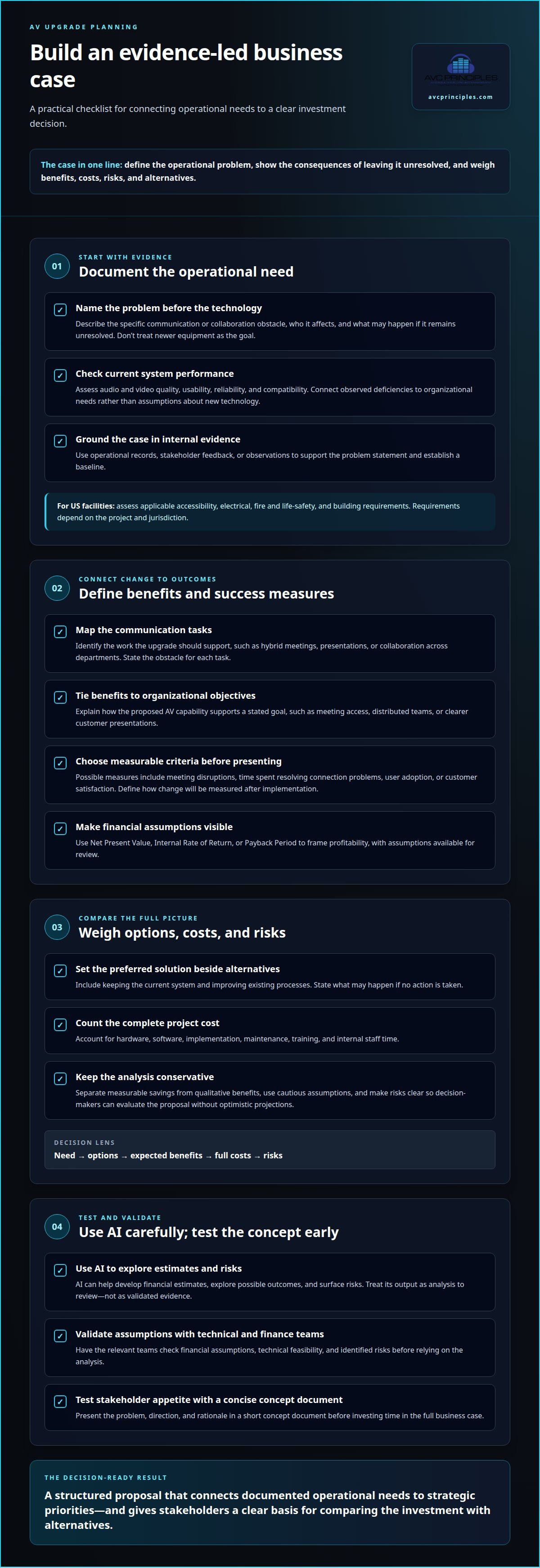
A full business case isn’t the first document you need. Building a business case for an AV system upgrade starts with defining the operational problem, showing what may happen if it remains unresolved, and weighing expected benefits, costs, and risks. A short concept document can test stakeholder support before you invest time in a full case.
That early test matters: an upgrade is easier to evaluate when it addresses documented deficiencies rather than assumptions about new technology. Assess current system performance, usability, reliability, and compatibility, then connect your findings to the organization’s needs.
This article explains how to build that evidence, use AI to develop financial estimates and identify risks, and test a concept before drafting the full business case. You’ll also see how to define success measures and compare the preferred approach with alternatives, including keeping the current system. The result is a structured proposal that gives decision-makers a clear basis for evaluating the investment.
Key Takeaways
- Define the operational problem and the consequences of leaving it unresolved before proposing an AV upgrade.
- Assess current audio and video quality, usability, reliability, and compatibility to build the case on evidence.
- Compare the preferred solution with alternatives, including maintaining the current system, and set measurable success criteria.
- Use AI to explore financial outcomes and surface risks, then have technical and finance teams validate the assumptions.
- Test stakeholder appetite with a concise concept document before developing the full business case.
What’s a business case?
A business case is a formal document that justifies an investment by defining the challenge, expected benefits, costs, and risks. For an AV upgrade, it connects operational evidence to a decision and gives stakeholders a basis for comparing the proposal with alternatives. Building a business case for AV system upgrade projects also clarifies why action is needed and what the organization expects the investment to change.
For US businesses, assess the accessibility, electrical, fire and life-safety, and building requirements that apply to the facility and its intended use. Applicable requirements depend on the project and jurisdiction. Common reasons to upgrade include deficiencies in audio or video quality, usability, reliability, or compatibility that hinder business communication and collaboration.
-
Identify Communication and Collaboration Benefits
Map the communication tasks an upgrade is expected to support, such as hybrid meetings, presentations, or collaboration across departments. For each task, identify the current obstacle: remote participants may struggle to hear discussion, or staff may lose time resolving inconsistent room controls. Describe the operational change the proposal targets. Newer equipment alone is not a benefit unless it addresses a specific business need.
-
Align Expected Benefits With Strategy
Connect each expected benefit to an organizational objective, such as improving meeting access, supporting distributed teams, or delivering clearer presentations to customers. Name the objective and explain how the AV capability contributes to it. A proposal for a large meeting space, for example, should show how improved audio coverage or simpler content sharing supports communication priorities. Avoid claims that cannot be traced to a stated organizational goal.
-
Quantify Benefits and Return on Investment
Choose measurable success criteria before presenting the investment. These might include fewer meeting disruptions, less time spent resolving connection problems, improved user adoption, or stronger customer satisfaction. Establish a baseline using operational records or structured stakeholder feedback, then define how the organization will measure change after implementation. Use Net Present Value, Internal Rate of Return, or Payback Period to frame profitability, with assumptions visible for review.
-
Present a Conservative Cost-Benefit Analysis
Compare expected benefits with full project costs, including hardware, software, implementation, maintenance, training, and internal staff time. Set the preferred solution alongside alternatives, including keeping the current system and improving existing processes. Use conservative assumptions, distinguish measurable savings from qualitative benefits, and state what may happen if the organization takes no action. This analysis helps stakeholders evaluate the investment without relying on optimistic projections.
Building a business case for AV system upgrade decisions means connecting measurable operational needs to strategic priorities, rather than treating new technology as the goal. That connection gives decision-makers a clear basis for evaluating the proposed change.
Business case versus business plan, executive summary, and project charter
An AV upgrade business case explains the problem, proposed investment, expected benefits, costs, risks, and alternatives. A business plan sets out a broader organizational direction, while an executive summary condenses a proposal and a project charter authorizes defined work.
-
State the Business Problem
Describe the specific operational problem in the executive summary, then connect it to evidence and consequences. For example, recurring meeting disruptions caused by unreliable room connections can delay decisions and weaken collaboration between teams. Identify the affected spaces, users, and communication tasks. Don’t lead with equipment models or software components; decision-makers need to understand the business challenge before reviewing a technical response.
Keep the summary concise, but make its logic traceable: problem, impact, proposed direction, and decision required. Cite internal sources such as incident records, user feedback, or meeting observations. If the organization faces several problems, distinguish the primary issue from secondary challenges so the proposal doesn’t suggest that one AV upgrade will resolve every operational weakness.
-
Secure Executive and Board Support
Identify a senior sponsor before presenting the full case. The sponsor can connect the proposal to strategic priorities, clarify the approval route, and help engage stakeholders early. For board review, present the decision required, the consequences of maintaining the status quo, and the alternatives considered. Don’t surprise executives with detailed costs before they understand the operational need and its organizational relevance.
Shape the recommendation around the audience’s responsibilities. Finance leaders need transparent cost assumptions and expected value; technical leaders need feasibility and integration implications; executives need strategic fit and decision points. Record concerns as issues to resolve, not as presumed approval. If a large funding request is difficult to authorize at once, structure the proposal in phases, each with defined objectives and success criteria.
-
Include the Required Case Content
Assemble the components decision-makers need to assess the proposal: business need, strategic alignment, options, expected benefits, costs, risks, success measures, staffing, and completion timing. Explain how the documents differ: the business case justifies whether to proceed; the business plan describes broader direction; the executive summary presents the case briefly; the project charter defines authorized scope and responsibilities.
Set execution timing around requirements gathering, design, testing, deployment, and operational dependencies. Identify deadlines that affect room availability, business events, or coordination with other technology work. Show the sponsor what needs approval now and what follows approval. A clear sequence helps stakeholders judge feasibility without confusing the investment decision with later project authorization.
Identifying technology deficiencies before requirements gathering
Compare the status quo, a targeted refresh, and full replacement against the same operational needs. Refresh components that remain reliable and compatible; consider replacement where persistent deficiencies or integration barriers prevent the system from meeting those needs.
- Document current performance before defining new requirements. Record recurring audio dropouts, unclear speech, video signal failures, network interruptions, software glitches, and control problems by room and use case. Pair those records with user feedback about usability and reliability. For example, a meeting-room issue log can show whether failures occur during connection, content sharing, or playback.
Use an equipment inventory, maintenance records, incident reports, and structured room tests as evidence. Assess audio and video quality, ease of use, reliability, and compatibility. Separate observed deficiencies from preferences for newer features. That distinction keeps the analysis focused on the operational problem instead of a technology wish list.
- Gather input from the people who use, support, and fund the system. Interview department heads and representative employees about delayed meetings, difficult controls, or inaccessible content sharing. Ask IT staff to identify signal, network, and software issues. Finance can clarify how internal staff time and recurring support demands affect the case.
Record each finding with its source, affected space, and business consequence. Compare user reports with technical observations rather than treating either as conclusive on its own. For instance, check repeated complaints about poor audio against microphone performance, speaker coverage, and room acoustics before defining a remedy.
- Build a project team with defined responsibilities and suitable assessment tools. Include technical, finance, and business representatives, then assign ownership for room testing, user input, cost assumptions, and review. A shared deficiency register can track each issue, evidence source, business impact, and open question. This gives specialists a common record before requirements are drafted.
Request independent feedback from a qualified reviewer who can assess the evidence objectively. Specialist contributors can check whether findings are accurate and whether proposed remedies address the causes. Don’t let one department’s priorities define the entire project. A successful assessment reflects operational users, technical constraints, and organizational objectives.
- Compare options against consistent criteria: performance, usability, reliability, compatibility, integration, and lifecycle implications. Include keeping the current system, refreshing usable equipment, replacing deficient components, improving processes, and optimizing existing resources. Define what each option resolves and what it leaves unresolved.
For a refresh, identify which components still meet the intended use and work with the wider system. For replacement, document why retained equipment cannot meet the stated requirements. Apply the same evidence and success measures to every option. This prevents a preferred solution from receiving more favorable assumptions than the status quo.
Using AI for data-backed insights, financial estimates, and risk identification
Use AI to organize project evidence, explore financial scenarios, and flag risks. Treat its output as an analysis aid, then have technical and finance teams validate assumptions before approval.
-
Estimate Implementation Costs
Separate one-time implementation costs from recurring costs. Group estimates into hardware, software, and services, then identify the assumptions behind each category. One-time items may include design, integration, development, testing, and deployment; recurring items may include software subscriptions, support, and maintenance. Tie each line to a defined requirement or lifecycle activity.
AI can organize historical project data and model how scope changes affect estimated totals. Use it to compare scenarios, not to establish unsupported prices. Ask finance and technical teams to review input quality, assumptions, and exclusions. Include project management, data migration where relevant, and internal staff time so the analysis reflects the full implementation effort.
-
Estimate Staffing and Lifecycle Costs
Identify the people and work required from planning through launch. Include staffing for requirements, design, integration, testing, deployment, and post-launch support. Add training for employees who will use or support the system, procurement effort, ongoing maintenance, and development work. Distinguish internal labor from external services so decision-makers can see where resources are committed.
Use AI to categorize cost records and identify omissions, such as training or maintenance appearing in separate budgets. Have finance validate cost assumptions and budget implications; technical teams should assess feasibility, timelines, and resource requirements. Don’t treat an AI-generated estimate as ready for approval. Decision-makers need traceable inputs and clear ownership for each estimate.
-
Plan Resources and Estimate Confidence
Map people, dependencies, and required work to each implementation phase. For example, testing may require access to rooms, technical staff, and representative users. Record resource conflicts and dependencies that could affect the launch sequence. Assign an owner to each critical assumption, then label estimates by their evidence and maturity rather than presenting every figure with equal confidence.
Use AI to examine project data for patterns that may indicate budget overruns, scope creep, integration challenges, or cybersecurity threats. Categorize each risk by potential impact and document a mitigation or contingency plan. Technical reviewers should assess feasibility and integration exposure; finance should test cost and return assumptions. Revisit the analysis as requirements change, and compare actual results with initial estimates after implementation.
Testing a concept document before drafting a full business case
- Draft a concise concept document to test organizational support before preparing a full business case. State the purpose, operational problem, proposed direction, and decision needed. For example, describe how unreliable meeting-room connections disrupt collaboration, then outline the kind of change under consideration without presenting a detailed equipment specification.
Keep the document focused on the decision, not the entire transformation plan. Include the evidence behind the problem, the main expected outcome, and the likely implications of taking no action. A concept document is an early test of support, not a substitute for cost analysis, implementation planning, or formal project authorization.
- Present the concept to stakeholders who influence, use, or support the affected spaces. Include representatives from business operations, IT, finance, and the departments that rely on the rooms. Invite feedback on the problem definition, strategic relevance, and proposed direction. Record areas of agreement and specific objections, such as concerns about room availability or system integration.
Engage these stakeholders before circulating a detailed business case. Early discussion helps prevent the full proposal from introducing unfamiliar objectives or assumptions. If users describe different needs, separate them by space or use case rather than forcing one solution across every room. This provides a clearer basis for deciding whether to refine, phase, or stop the proposal.
- Ask at least one person who can assess the proposal objectively to review the concept document. The reviewer should test whether the evidence supports the stated problem and whether the proposed direction follows from that evidence. For example, they can flag a gap between reports of difficult room controls and a proposed investment focused only on displays.
Use the review to identify missing perspectives, weak assumptions, and unresolved dependencies. Assign each issue to an owner, such as IT for a network question or finance for an estimate. The reviewer’s role is to strengthen the document’s logic, not endorse a predetermined outcome. Revise the concept before requesting a decision to proceed.
- Set a clear decision gate for the concept review. Ask stakeholders whether the problem merits further analysis, what evidence the full case still needs, and which alternatives require assessment. Capture the decision and its rationale. If support depends on a narrower scope, revise the proposal around that scope instead of carrying unsupported features into the next phase.
Proceed to the full business case when the problem, intended outcome, and decision path are understood. Then expand the concept into detailed cost, benefit, risk, resource, and implementation analysis. Develop an AV system concept that translates operational needs into a structured direction for further evaluation.
AVC Principles
AVC Principles can translate an approved upgrade concept into a coordinated design brief through AV Systems Design and ICT Infrastructure Design. Turn to the firm when operational findings need to become system requirements, room-level design decisions, and an integrated project direction. This is useful when the proposal spans multiple spaces or depends on coordination between AV and ICT infrastructure.
For command environments or staged venues, Command and Control Center Design and Staged Environment Engineering address distinct operational contexts. The appropriate scope follows the venue, users, content, and system functions identified in the business case. Contact AVC Principles to discuss your AV system design requirements.
Move from approval to a coordinated design
Once decision-makers authorize further work, translate the approved direction into a design that fits the organization’s spaces, users, and operational requirements. Building a business case for an AV system upgrade sets the decision framework; the next phase turns that framework into coordinated technical planning. Keep the approved objectives visible as requirements develop, so design decisions remain connected to the outcomes the organization intends to achieve.
AVC Principles supports this transition through AV Systems Design, ICT Infrastructure Design, and Staged Environment Engineering. These services address projects where audiovisual requirements intersect with infrastructure or staged environments. The appropriate design scope depends on the operational context and the system’s intended use.
For a considered next step, contact AVC Principles to discuss your project. Bring the approved direction and the questions that remain; a focused discussion can help establish how design should proceed. Your next phase can begin with a clear brief and a disciplined path forward.
Frequently Asked Questions
What are the different types of business cases?
Business cases can support technology investments, operational improvements, or broader strategic initiatives. Their format depends on the decision: a focused proposal may use a concise document, while a complex investment needs deeper analysis. A comprehensive case can follow the Five Case Model, which organizes interconnected areas of evaluation. Treat the format as a way to present evidence, not a substitute for explaining the specific decision, alternatives, expected outcomes, and delivery approach.
How do you assess an existing AV system and identify upgrade needs?
Assess the system in the spaces and situations where people rely on it. Observe a typical meeting or presentation, then record problems such as unclear speech, difficult content sharing, control confusion, or inconsistent connections. Compare user feedback with technical inspection and service records. Note which rooms and activities are affected, and distinguish recurring faults from isolated incidents. This creates a practical evidence base for deciding whether to adjust processes, refresh components, or replace a system.
How do you calculate the ROI and total cost of ownership of an AV upgrade?
Estimate ROI by comparing the value of expected benefits with the full investment, then expressing the net gain relative to that investment. Build total cost of ownership from one-time implementation and recurring expenses, including infrastructure, software, staffing, training, development, and maintenance. For example, estimate whether fewer meeting disruptions save staff time, then document the assumptions behind that estimate. Finance should validate the inputs, while technical reviewers assess scope and lifecycle implications.
What is the typical cost of upgrading a commercial AV system in the United States?
Commercial AV upgrade costs depend on project scope, not a universal typical amount. Key factors include the number and type of spaces, room acoustics, required audio and video functions, control needs, network integration, retained equipment, design complexity, and implementation requirements. Recurring software, support, training, and maintenance also affect total ownership cost. Build estimates from defined requirements and project-specific assumptions, then separate one-time work from ongoing expenses for a useful comparison.
What productivity, collaboration, and maintenance savings can AV upgrades deliver?
Potential gains include less meeting time lost to connection problems, easier participation for remote attendees, and fewer repeated setup tasks. Maintenance savings may come from reducing recurring faults and simplifying system operation, but the case should measure these outcomes against a baseline. For example, track how often a room needs technical assistance and how long meetings spend resolving AV issues. Use those records to estimate benefits, then review actual performance after deployment.
What are the risks of an AV upgrade project and how can they be mitigated?
Common risks include budget overruns, scope changes, integration challenges, cybersecurity exposure, and disruption to scheduled activities. Reduce exposure by defining scope and decision ownership, documenting system dependencies, and involving technical and finance reviewers early. Plan testing around operational access to each space, and prepare a contingency for deployment delays or failed integration. Assign each risk an owner, assess its potential impact, and revisit the mitigation plan as project assumptions change.


