
Drafting capability matters, but it isn’t the whole test. The most useful questions to ask an AV design consultant cover relevant project experience, 3D modeling and BIM, coordination with other design disciplines, and how the proposed system will serve its users. The consultant’s design philosophy and communication approach matter just as much.
It’s reasonable to expect clear drawings and technical competence. The deeper question is whether the consultant’s decisions fit your venue, workflows, and project priorities. This guide offers practical questions to help you assess design expertise, approach, and communication before work begins. It also explains how to evaluate experience across relevant disciplines and determine whether the proposed approach fits your project.
Key Takeaways
- Compare a consultant’s drafting tools and past project scope with your venue, building team, and operational requirements.
- Clarify how project complexity, timeline, and budget shape the design approach and the resources assigned to it.
- Use case studies and practical examples to assess whether a consultant’s preferences and philosophy fit your users and goals.
- Agree on project roles, decision-making authority, points of contact, and update frequency before design work progresses.
- Look for relevant expertise across the project’s disciplines and experience contributing to design, not only implementing others’ plans.
1. Question 2: What Level of Drafting Expertise Does the AV Design Consultant Have?
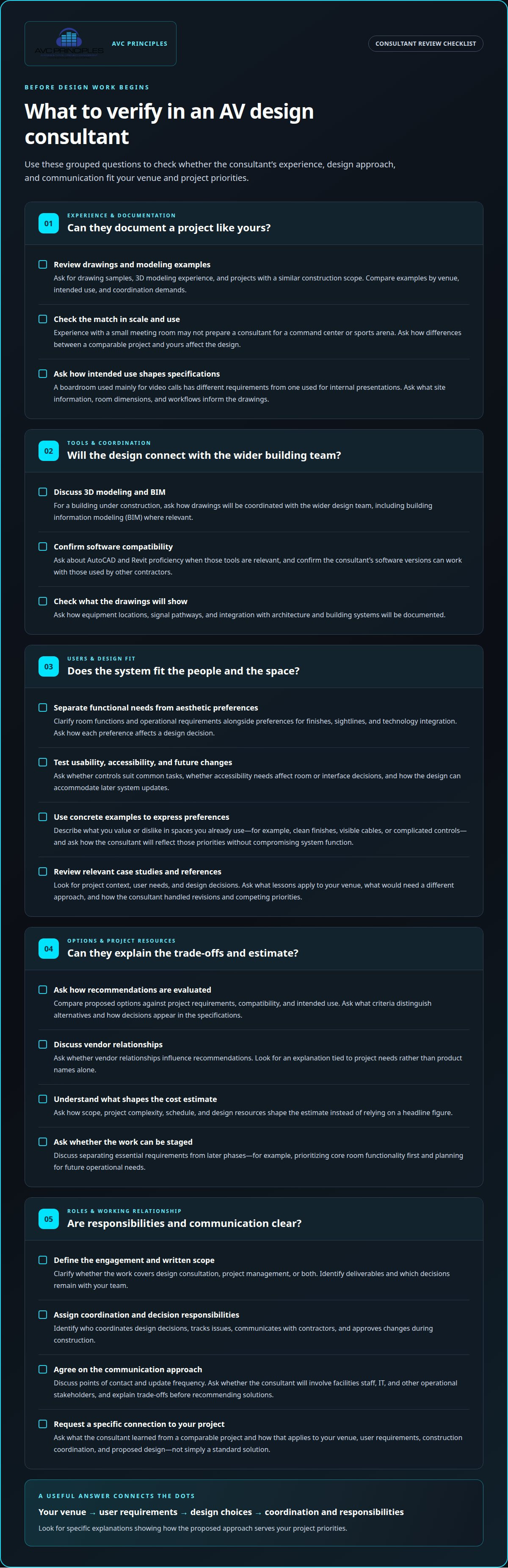
Ask for drawing samples, modeling experience, and projects with a similar construction scope. Experience designing a small meeting room may not prepare a consultant for a command center or sports arena. Compare examples by venue, intended use, and coordination demands. Among the questions to ask an AV design consultant, this helps establish whether their design and documentation experience matches your project.
For a building under construction, ask how the consultant coordinates drawings with the wider design team. Discuss 3D modeling and building information modeling (BIM), plus proficiency with AutoCAD and Revit when those tools are relevant. Confirm that their software versions can work with those used by other contractors. Ask how they document equipment locations, signal pathways, and integration with architecture and building systems.
Ask for an example of how intended use shaped a design specification. A boardroom used mainly for video calls has different requirements from one used for internal presentations. Ask what site information informs the drawings and how the consultant accounts for room dimensions and workflows. A similar project is useful evidence, but the consultant should explain which differences matter to your design.
Ask how the design will support usability, accessibility, and future changes. Discuss whether controls suit common tasks, whether accessibility needs affect room or interface decisions, and how the design can accommodate later system updates.
Ask how the design recommendations are evaluated and whether vendor relationships influence them. A useful comparison connects each proposed option to project requirements, compatibility, and intended use, rather than relying on product names alone. Ask what criteria distinguish the alternatives and how the decisions appear in the specifications.
Clarify whether the engagement covers design consultation, project management, or both. Ask who coordinates design decisions, tracks issues, communicates with contractors, and approves changes during construction. These are distinct responsibilities; a written scope should identify the consultant’s deliverables and the decisions that remain with your team.
Discuss how the consultant develops a cost estimate, rather than relying on a headline figure. Ask how scope, complexity, schedule, and design resources shape the estimate. Then ask whether the work can be staged to distinguish essential requirements from later phases. For example, a project may prioritize core room functionality first and plan for future operational needs.
Ask what the consultant learned from a comparable project and how that experience applies to yours. Listen for specific connections between your venue, user requirements, construction coordination, and proposed design. A clear explanation should show how the approach serves your project, not simply repeat a standard solution.
2. Client design preferences and aesthetic fit
Ask how the consultant will establish your priorities before developing a design. Separate operational requirements from aesthetic preferences. For example, a conference room may need clear sightlines and discreet technology, while its finishes should align with the surrounding architecture. Ask how these requirements affect layout, visibility, and integration. A useful discussion links each preference to a design decision, rather than offering general statements about style.
Describe what you like and dislike in spaces you already use. A familiar example can clarify preferences: you might value a clean finish but dislike visible cables or complicated controls. For a workplace project, translate those preferences to the relevant venue. Identify what matters, such as uncluttered surfaces, intuitive room controls, or technology that doesn’t interfere with the space’s intended use.
Ask how the consultant will reflect your priorities without compromising system function. A visible display may suit a collaborative room, while technology concealed from view may better support a formal setting. Discuss finishes, sightlines, and user access alongside operational needs. The goal is to understand how aesthetic choices affect the system, rather than treating appearance as a final layer.
Case studies can show how a consultant has addressed similar design challenges. Ask to review examples that describe the project context, user needs, and design decisions. If the venue differs from yours, ask what lessons apply and what would need a different approach. References can also provide context about collaboration, responsiveness, and whether the work matched the agreed priorities.
Ask how the consultant’s working style fits your decision-making process. Does the team explain trade-offs before recommending a solution? Will they invite input from facilities staff, IT, and other operational stakeholders? A good fit means the consultant can address disagreement professionally and keep decisions tied to the project brief.
Ask how referrals and references relate to the consultant’s experience. Find out whether a reference can speak to a similar venue or design challenge, then ask how the consultant handled revisions and competing priorities. A referral may explain why a firm was introduced, but it doesn’t replace reviewing the work and the process behind it.
Before appointing a consultant, summarize your preferences in a short design brief. Include desired room functions, features to preserve, elements to avoid, and any finish considerations. Ask the consultant to reflect those priorities in the proposed design approach. For a project requiring integrated audiovisual planning, AV design considerations can help frame the discussion around both system performance and the space.
3. Assessing a consultant’s design philosophy
Ask the consultant to explain the principles guiding design decisions from concept through documentation. A clear approach connects user workflows, the venue, and the technology instead of starting with a preferred equipment package. For example, a consultant designing a university auditorium should explain how teaching, presentations, and audience sightlines inform the system. Their reasoning should be clear.
Ask how the consultant adapts the design approach to different environments. A university auditorium may have different requirements from a retail space, where customer movement and daily operations shape the design. Ask what changes between these contexts and which underlying principles remain consistent. The answer should show how the consultant assesses the space and its users before defining the technical design.
The design process should begin with your organization’s vision and operating needs. Ask what the consultant needs to understand before proposing a concept. For example, a command center may prioritize clear information sharing and dependable operator workflows, while an event venue has different production requirements. Ask how these priorities influence layout, integration, and system design.
A design consultant can advise on spatial relationships, material intent, and the technical framework for later execution. Ask how early concepts become coordinated design decisions. If the visual concept calls for discreet technology, for example, ask how that preference will be balanced with access for operation and maintenance. This shows whether the approach connects architectural intent with practical system requirements.
Ask what makes the consultant’s approach specific to your project rather than generic. Request an example and ask which decisions responded to that client’s venue or workflow. Useful evidence is not a claim of innovation, but a clear link between a project requirement and a design choice. Ask how the approach would change to address your constraints.
A consultant’s interest should extend beyond hiring and delivery. Ask what they want to learn about your organization’s goals, users, and future plans. If a venue expects its programming to change, for instance, discuss how that affects design priorities today. A consultant who can connect your plans to technical decisions demonstrates an understanding of the project, not just a standard process.
Ask how the consultant handles disagreement when your preferences conflict with system performance or operational needs. Consider a scenario in which a preferred room layout limits sightlines. Ask what alternatives they would assess, how they would explain the trade-offs, and who would take part in the decision. Their response shows whether the approach supports informed collaboration while keeping the project’s intended use central.
4. Communication methods and frequency
Agree on a communication structure before design work begins. Identify the main point of contact, the best channel for routine updates, and how urgent decisions will be raised. For example, the team might use scheduled meetings for design decisions and written updates for open actions. Ask how meeting notes, drawing revisions, and decision records will be shared.
Set an update rhythm that matches the project phases and decision points. Ask how often you’ll receive progress reports, what they’ll cover, and who can answer technical questions between meetings. A useful update might list completed design work, pending approvals, coordination issues, and decisions needed from your team. The schedule should make responsibilities and next steps clear.
An AV consultant coordinates with architects, IT teams, and contractors by aligning design information, dependencies, and decisions across disciplines. The architect can address room layouts, IT can clarify network requirements, and contractors can coordinate construction interfaces. Ask how discussions are documented and how unresolved conflicts reach the people authorized to decide.
Clarify which stakeholders need to join each discussion. An architect may review technology locations, while IT staff assess network and security considerations. Facilities or operations staff can explain room use and access needs. Ask how the consultant will involve these groups when a decision affects their work, and how the team will ensure critical details reach everyone who needs them.
Make decision-making authority explicit. Ask which choices the consultant can develop or recommend, which need your approval, and who resolves conflicting requirements. A change to a control location, for instance, may affect user workflows and construction coordination. A written decision log can capture the issue, options, responsible decision-maker, and agreed direction. This provides a useful record when project details change.
Discuss how the consultant handles changes or delayed responses. Ask who communicates schedule impacts, how revised documents are identified, and how affected parties receive updates. If a contractor raises a concern about a technology location, establish who reviews it and how the response reaches the design team. Clear communication helps the project team manage coordination efficiently.
Communication matters at commissioning and handover, too. Ask what information the team will receive, who will address questions after installation, and whether staff training or support is part of the project arrangement. For a command center, for example, operators need a clear way to raise usability issues after the system enters service. Define the contact path and responsibilities before approving the final design.
5. What experience and certifications should an AV design consultant have?
Look for experience that matches the venue, operating needs, and design scope. A sports arena, command center, and corporate meeting space place different demands on audio, video, lighting, and acoustics. These disciplines overlap, but experience in one doesn’t automatically establish expertise in another. Ask which team members will lead each relevant discipline and what comparable work they have completed.
Distinguish design experience from implementation experience. Ask whether the consultant has developed system concepts, coordinated design documents, and worked within a multidisciplinary design team. Someone who has mainly implemented plans created by others may bring useful field knowledge, but that alone doesn’t demonstrate responsibility for the original design. Request an example showing the consultant’s role, decisions, and coordination with architects or engineers.
Assess the team, not just the person leading your discussions. Ask who is responsible for audio, video, lighting, acoustics, and integration, then clarify how those responsibilities connect. An auditorium’s audio design, for example, must relate to room acoustics and audience layout. Ask how the team resolves interfaces between disciplines and consolidates their requirements into a coordinated design.
Certifications should be relevant to the work and to the individual who holds them. Ask which credentials each proposed team member has, what subject they cover, and how that knowledge applies to your project. Then distinguish credentials from practical evidence. A credential may indicate focused training; case studies and design-team experience show how someone applies expertise across project stages.
Request case studies that identify the venue, scope, and consultant’s contribution. Ask how the design team handled a specific coordination issue, such as integrating AV requirements into a building design. If a case study focuses on installation, ask what shows the consultant’s own design role. References can also clarify how the team collaborated, documented decisions, and addressed design changes.
For a building under construction, discuss the consultant’s experience coordinating with other disciplines and their drawing tools. Ask how they develop and coordinate 3D models or BIM documents, and whether their AutoCAD or Revit workflow aligns with the project team’s software. Their answer should connect tool proficiency to practical coordination, such as identifying equipment locations and resolving drawing conflicts.
Finally, ask how the proposed team’s experience aligns with your project’s complexity and operating workflows. Compare their examples against your venue and intended use, rather than relying on credentials alone. To discuss the requirements of a project involving coordinated AV planning, discuss your AV design requirements.
AVC Principles: AV Systems Design
AVC Principles provides AV Systems Design for organizations planning systems around their venue, users, and operational requirements. Engage the team for coordinated designs for auditoriums, command centers, sports arenas, and collaborative environments, particularly when AV needs to align with architecture and ICT infrastructure.
The right questions help define project requirements, but translating them into coordinated design documents takes focused engineering. AVC Principles also provides ICT Infrastructure Design, Staged Environment Engineering, and Command and Control Center Design. These services address distinct project needs, from connected infrastructure to specialized operational environments.
If your project needs structured AV design input, contact AVC Principles to discuss the requirements.
Set the Direction for Your AV Project
Turn your evaluation into a clear project brief. Record the outcomes your team needs, the design principles that matter, and the decisions that require stakeholder input. This gives an AV design consultant a practical basis for developing an approach that fits your organization instead of relying on assumptions.
The questions to ask an AV design consultant can also help you define the right scope. AVC Principles provides AV Systems Design, ICT Infrastructure Design, and Staged Environment Engineering. These services support projects where audiovisual systems need to align with connected infrastructure or staged environments.
Bring your operational priorities and project context into an initial discussion. A focused conversation can establish whether the design work addresses your needs and how to move forward. Contact AVC Principles to discuss your AV design, and take the next step toward a well-defined project.
Frequently Asked Questions
Question 2: What Level of Drafting Expertise Does the AV Design Consultant Have?
Look for design documentation that supports coordination and clear execution. Ask how the consultant tracks drawing revisions, flags unresolved coordination items, and communicates changes to the project team. A practical test is to review a sample drawing set and trace a system from its room location through the documented connections. This shows whether the drawings convey design intent clearly, not just whether the consultant can produce them.
Who are the decision makers for this project?
Identify who can approve scope, budget, and design changes, then name the stakeholders who advise on those decisions. A facilities lead, for example, may define operational requirements while an executive sponsor approves funding. Ask who resolves conflicts if departments disagree and who signs off on the final direction. Clear authority prevents recommendations from getting stuck in an undefined approval process.
Have you done something like this before?
Ask for an example that matches the project’s purpose, not just its building type. A corporate meeting room and a training room may occupy similar spaces but serve different tasks. Ask what the earlier project aimed to accomplish, which design choices addressed those needs, and what lessons apply to yours. This turns a general claim of experience into a relevant comparison.
Do they have real-world experience?
Real-world experience includes understanding how design decisions affect construction, operation, and system use. Ask the consultant to describe a project challenge and how the design team responded. For instance, ask how a late room-layout change affected AV coordination and documentation. A specific account can show how the consultant applies technical knowledge in real project conditions, beyond describing tools or credentials.
How do you calculate your fee?
Ask what the fee covers and how the consultant accounts for scope, deliverables, complexity, schedule, and coordination demands. Clarify whether revisions, meetings, and construction-phase design support are included in the proposed scope. Design fees depend on these project factors; the amount is provided after a quote request. Compare the defined work and assigned resources, not just the fee on its own.
What should I ask an audiovisual design consultant before hiring them?
Ask who will lead the work, what decisions you need to make, how recommendations are assessed, and how the team handles changing requirements. Useful questions to ask an AV design consultant also include how the design supports user workflows and how recommendations connect to the project brief. Before hiring, request a clear scope and define what counts as an accepted deliverable.
What AV design services and deliverables are included in a consultant's scope?
Scope may include needs assessment, system architecture, coordinated drawings, specifications, bill of materials development, bid administration, and project oversight. Deliverables depend on the engagement. Ask for a written list describing each document, its purpose, and when it will be issued. Construction teams, for example, use coordinated drawings and specifications, while procurement teams may use a bill of materials to evaluate bids.
How much does an AV design consultant cost, and what affects the fee?
Fees depend on project scope, complexity, required documentation, schedule, and coordination needs. A project involving multiple rooms or building disciplines may require different design resources from a focused engagement. The amount is provided after a quote request. To understand the cost, compare what each proposed scope includes, such as drawings, specifications, meetings, and support during design coordination.


