
A polished proposal doesn’t prove that a consultant can carry your AV design intent through to verified performance. If you’re researching how to choose an AV design consultant, focus on whether each candidate can demonstrate accountability across the project, not simply recommend equipment or describe installation capabilities.
It’s reasonable to expect clear answers about experience, scope, and deliverables before you commit. Yet proposals can make different services sound alike, and broad claims may not show whether a consultant understands your environment, project scale, or coordination needs. A structured evaluation makes those differences easier to assess.
This guide offers a practical framework for comparing candidates based on evidence: relevant project experience, defined design documentation, responsibilities at each phase, and involvement in technical verification and commissioning. You’ll also learn how to set a useful scope before requesting proposals, so you can choose a consultant whose expertise and accountability fit your project requirements.
Key Takeaways
- Define users, operating scenarios, constraints, and measurable success criteria before inviting proposals.
- Assess how to choose an AV design consultant by examining comparable project responsibilities and integration complexity, not broad claims alone.
- Disclose commercial relationships and compare compensation, exclusions, assumptions, and owner decision points.
- Give every candidate the same brief, then compare proposed documentation and coordination responsibilities.
- Establish how design requirements will be traced through testing, issue resolution, and project acceptance.
How to Choose an AV Design Consultant: Define the Project Before Comparing Firms
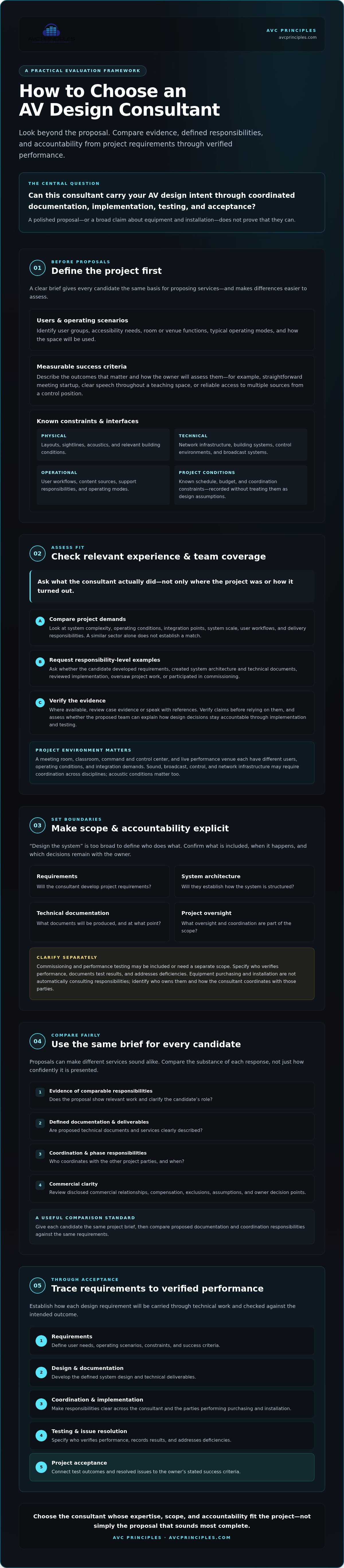
Before comparing firms, establish what the project must accomplish. An AV design consultant translates operational requirements into coordinated system design and technical deliverables. That role differs from selling equipment or performing installation. Defining the work first makes it easier to assess whether a candidate’s expertise and proposed scope match your needs. It is the practical starting point for how to choose an AV design consultant.
Start with the environment. A meeting room, classroom, command and control center, and live performance venue each have different users, operating conditions, and integration demands. A project involving sound, broadcast, control, and network infrastructure may require coordination across several disciplines. Acoustic conditions matter too: acoustical engineering provides a foundation for understanding how sound behaves in a space.
What should an AV design consultant be responsible for?
Set boundaries for each phase instead of relying on a general promise to “design the system.” Confirm whether the consultant will develop requirements, establish system architecture, produce technical documentation, and provide project oversight. These are distinct responsibilities. A proposal should state what is included, when it happens, and which decisions remain with the owner.
Define commissioning and performance testing explicitly. Ask whether they are included in the consulting scope or need to be scoped separately. Specify who will verify system performance, document test results, and address deficiencies. Equipment purchasing and installation are not automatically consulting responsibilities, so clarify who owns those activities and how the consultant will coordinate with the parties performing them.
Which project requirements should you define first?
Prepare a brief that describes the space and how it will operate. Identify room or venue functions, user groups, accessibility needs, typical operating modes, and the conditions that would indicate success. For example, a project might need straightforward meeting startup for occasional users, clear speech throughout a teaching space, or reliable access to multiple sources from a control position. State how the owner will assess those outcomes.
Then document known constraints and interfaces that could shape the design:
- Physical: Room layouts, sightlines, acoustics, and relevant building conditions.
- Technical: Connections to network infrastructure, building systems, control environments, or broadcast systems.
- Operational: User workflows, content sources, support responsibilities, and required operating modes.
Record known schedule, budget, and coordination constraints without treating them as design assumptions. For a broader overview of service scope, see the AV design and engineering consulting guide. A precise project brief gives every candidate the same basis for proposing services and makes proposals easier to compare.
Evaluate AV Consultant Experience, Technical Coverage, and Project-Team Fit
A long operating history or an impressive sector list is not proof of fit. Compare each firm’s experience with your project’s specific demands: system complexity, operating conditions, integration points, and delivery responsibilities. When considering how to choose an AV design consultant, ask whether the proposed team can provide relevant evidence and explain how design decisions will remain accountable through implementation and testing.
How do you verify relevant AV project experience?
Ask candidates to describe comparable projects in terms of their actual work. Did they develop requirements, create system architecture and technical documents, review implementation, oversee project work, or participate in commissioning? Request examples that clarify the consultant’s responsibilities, not only the venue or final result. Where available, review case evidence or speak with references, and verify claims before relying on them.
Match each example to your operational needs. A project in the same sector may still differ in integration complexity, system scale, or user workflows. A project in another sector may be relevant if it involved similar interfaces and operating demands. For a technical reference point, Georgia Institute of Technology’s university AV design standards can help frame questions about design documentation and system requirements.
How should you assess credentials and team capability?
Confirm any stated credentials using current information from the issuing body, and consider whether each credential is relevant to the assigned work. Ask who will lead the project, which specialists will contribute, who can resolve technical decisions, and whether the named team is expected to remain involved through delivery. A proposal should make responsibility and continuity visible, rather than simply presenting a firm-wide roster.
For projects with substantial network or infrastructure interfaces, assess ICT capability alongside AV expertise. The ICT infrastructure design selection guide provides further context for evaluating that discipline.
Use a consistent comparison record. Rate each item according to its importance to your project, and note both supporting evidence and unanswered questions:
Criterion | Candidate evidence | Open question | Importance
Comparable delivery | Project example and defined role | What did the consultant personally deliver? | High if scope is complex
Technical coverage | Named disciplines and interfaces | Who owns coordination gaps? | High where systems converge
Team continuity | Named lead and specialist roles | Will the proposed team remain through testing? | Set by delivery risk
This evidence-based review connects qualifications to accountability. For complex AV and ICT design requirements, you can also review AVC Principles’ engineering consultancy capabilities as one point of comparison.
Compare AV Design Consultants on Independence, Scope, and Accountability
A proposal is comparable only when you can see what informs its recommendations, what work it includes, and who owns each decision. A label such as “vendor-neutral” does not establish a consultant’s independence. Assess the commercial relationships, compensation structure, and recommendation process disclosed for your engagement. Then compare proposals against the same scope categories. This makes how to choose an AV design consultant a matter of documented evidence rather than broad assurances.
What does vendor-neutral AV consulting mean in practice?
Ask how the consultant turns your requirements into selection criteria, evaluates alternatives, and records the reasons for recommendations. Request disclosure of relevant supplier relationships or other potential conflicts, along with an explanation of how they will be managed. Recommendations should be traceable to project needs, not presented as unexplained preferences. Clear criteria also help the owner review trade-offs and make informed decisions.
Which proposal details reveal unclear accountability?
Check whether each phase identifies its deliverables, review cycles, assumptions, exclusions, and owner decision points. Assign responsibility for design coordination, bid support, installation review, change review, and commissioning. If a proposal says “coordinate as required,” ask who coordinates, what they review, and what record they provide. Confirm who approves design changes and resolves conflicts between AV, ICT, building, and other disciplines.
Pay particular attention to work that can fall between the consultant, architect, contractor, integrator, and owner. For example, if a field condition requires a design change, identify who assesses its technical impact, who documents the revision, and who authorizes it. Apply the same clarity to commissioning: specify whether the consultant observes, tests, documents results, or has another defined role. Do not assume a responsibility is included because it appears elsewhere in the project workflow.
Use a matrix for each candidate. Record the proposal’s exact language, then classify the work and flag gaps for clarification before selection:
- Included: Defined phase, deliverable, responsible party, and review process.
- Optional: Available work requiring separate approval or scope confirmation.
- Excluded: Activities expressly outside the proposed engagement.
- Unresolved risk: Vague ownership, missing interfaces, or assumptions needing a written answer.
Apply the same rows to every proposal. Add a final column for the owner’s decision or follow-up question. This exposes scope differences that headline descriptions can hide and gives both parties a clearer basis for accountability throughout delivery.
Use a Due-Diligence Checklist to Compare AV Consultant Proposals
A consistent review process turns proposals into comparable evidence. Give every candidate the same project brief and request responses in a common format. Ask each firm to state its assumptions, scope, deliverables, exclusions, and responsibilities at the same level of detail. This prevents a polished but generic proposal from appearing equivalent to one that addresses your actual operating requirements.
What should an AV design proposal include?
Check that the proposal demonstrates an understanding of the project and connects that understanding to defined phases and outputs. Look for system architecture and technical documentation, such as narratives, drawings, and schedules, along with stated performance requirements. The proposal should also identify schedule assumptions, review points, exclusions, and the process for project oversight, design coordination, and change management.
Use this checklist to structure your review:
- Project fit: Does the response address the users, operating modes, venue constraints, and interfaces in your brief?
- Design evidence: Are system narratives, drawings, schedules, and performance criteria identified as deliverables?
- Work boundaries: Are phases, review cycles, assumptions, exclusions, and owner decisions explicit?
- Delivery continuity: Does the proposal explain how the consultant will check design intent during implementation and verify requirements during commissioning?
- Coordination: Are change review, cross-discipline coordination, and project oversight assigned to named roles?
Trace an important requirement from the brief through each project stage. If a requirement calls for clear audio coverage in a defined area, look for the corresponding design documentation, the method for reviewing implementation, and the commissioning test or acceptance evidence. This trace can expose gaps that a deliverables list alone may not reveal.
What warning signs should you investigate before selection?
Investigate proposals that could apply to any project, claims of relevant experience without supporting examples, and deliverables described only in broad terms. Recommendations should connect to documented requirements and explain how alternatives were evaluated. If the proposal leaves review or coordination duties unassigned, request clarification before scoring the candidate.
Maintain a procurement record for each firm. Capture the proposal reference, evidence reviewed, clarification requested, response received, exceptions, and remaining risks. Distinguish a missing detail from a confirmed exclusion, since each needs different follow-up. Resolve material ambiguities in writing before advancing a candidate, and compare the clarified scope rather than relying on verbal assurances.
A disciplined checklist supports how to choose an AV design consultant by making the selection rationale traceable. To discuss a complex system-design engagement, review AV and ICT design capabilities from AVC Principles.
AV Consultant for Lifecycle Delivery and Commissioning
A design is useful only if its requirements remain clear as the project moves into implementation and testing. Evaluate whether each candidate can connect the owner’s brief to design documents, review activities, and commissioning evidence. This continuity is central to how to choose an AV design consultant for a complex project: accountability should follow each requirement, not stop when the drawings are issued.
How do you connect design documents to commissioning?
Ask the consultant to show how a requirement will be traced through the project. For each key outcome, identify where it appears in the design documentation, how implementation will be checked against that design, and what test or record will verify performance. Define acceptance evidence before procurement and implementation begin. Otherwise, the parties may reach commissioning without a shared basis for deciding whether the system meets the brief.
Set responsibilities in writing. Confirm who prepares or reviews test procedures, who witnesses tests, who records deficiencies, and who tracks them through resolution. Establish who makes acceptance decisions and what documentation the owner receives. The consultant’s role may involve oversight, testing, or both, depending on the agreed scope. Do not assume these tasks are included unless the proposal says so.
When is a full-service engineering consultancy the right fit?
A broader engineering engagement may suit a venue where AV needs to work with sound, broadcast, control, or ICT systems. Assess the project’s operational risk, technical complexity, internal expertise, and required oversight. Then decide whether concept development, system design, technical documentation, project oversight, commissioning, and testing belong in one coordinated scope or should be assigned separately. The aim is clear responsibility across handoffs, not simply the largest possible scope.
Before award, create a concise selection record and keep it with the approved proposal and project brief. Include:
- Chosen evidence: Relevant experience, named team, and demonstrated technical coverage.
- Agreed scope: Phases, deliverables, review responsibilities, and commissioning tasks.
- Open risks: Unresolved interfaces, exclusions, assumptions, or acceptance questions.
- Next actions: Owners and due points for resolving open items before work proceeds.
This record gives the project team a baseline for managing design intent through verification. AVC Principles’ project-based work spans system design and engineering through commissioning and testing for complex environments. If that scope aligns with your needs, discuss AV system design and commissioning requirements.
Make Your Selection With a Clear Accountability Plan
The strongest selection is grounded in project evidence. Define operating requirements first, then compare candidates on relevant experience, technical coverage, named team roles, and a clearly bounded scope. Review proposals consistently, and confirm how design requirements will be checked through implementation, testing, and commissioning.
This gives you a practical answer to how to choose an AV design consultant: select the team that can demonstrate fit and explain how it will carry design intent into verified performance. The agreed scope should make deliverables, responsibilities, acceptance evidence, and remaining risks clear before work proceeds.
AVC Principles provides AV and ICT system design services from concept development through commissioning. Its project expertise includes auditoriums, command centers, sports arenas, and staged environments, supported by technical documentation, system architecture, project oversight, testing, and commissioning. To discuss your project requirements, discuss your AV system design requirements with AVC Principles.
With a defined brief and a disciplined selection process, you can move forward with greater clarity about your project’s technical direction.
Frequently Asked Questions
What does an AV design consultant do?
An AV design consultant translates operational requirements into system architecture, technical documentation, and design criteria for commercial and institutional projects. Depending on the agreed scope, the engagement may also include coordination, project oversight, commissioning, or testing. Design consulting is distinct from equipment sales and installation. Before selecting a consultant, confirm in writing which phases, deliverables, review responsibilities, and exclusions apply to your project.
How do I choose the right AV design consultant?
Start by defining your project requirements, then compare candidates using the same brief. Evaluate relevant project evidence, the proposed team, technical deliverables, disclosed commercial relationships, and responsibilities through implementation and testing. Ask how each candidate handled projects with comparable operational and integration demands. Record clarifications, exclusions, and unresolved risks. The right fit is the consultant whose documented scope addresses your needs and establishes clear accountability, not simply the one with the broadest claims.
What qualifications should an AV design consultant have?
Appropriate qualifications depend on the systems involved, the consultant’s role, and applicable project requirements. Ask which credentials are relevant, who on the proposed team holds them, and how they relate to the work. Verify current status with the issuing organization rather than assuming any credential is universally required. Also assess practical project experience, technical documentation quality, and whether the team covers the disciplines your system requires.
Should I hire an independent AV consultant or an AV integrator?
Consultants generally focus on requirements, engineering design, and technical guidance for the owner, while integrators typically provide implementation services. Actual responsibilities vary, so compare proposed scopes rather than relying on titles. A consultant may help evaluate options against documented requirements, but review disclosed relationships and recommendation processes. Decide whether you need separate design oversight, implementation responsibility, or both, then define the handoffs before procurement begins.
What should an AV design consultant proposal include?
A proposal should identify the project-specific scope, phases, deliverables, assumptions, exclusions, schedule basis, and responsible parties. Depending on the engagement, technical content may include system architecture, design documentation, coordination duties, performance criteria, and commissioning responsibilities. Check how changes and unresolved issues will be managed. Give every candidate the same brief, compare responses on the same basis, and request written clarification wherever an owner decision or project responsibility is unclear.
When should I involve an AV design consultant in a project?
Involve a consultant early enough to translate operational needs into system requirements and coordinate AV with related design disciplines. Early input can clarify scope before procurement choices constrain the design. The right timing depends on the project’s delivery method and decision schedule. Agree with the owner and project team on when the consultant will develop requirements, issue documentation, review coordination, and provide any commissioning input included in the engagement.
How can I tell whether an AV system design is ready for commissioning?
A design is ready for commissioning when requirements, system documentation, performance criteria, and verification responsibilities are defined and traceable. Confirm who conducts or witnesses tests, records deficiencies, and verifies corrective work. Readiness depends on the project scope and installed system, so a generic checklist may not be sufficient. Before installation is complete, agree on the required test records, how outstanding issues will be handled, and the owner’s acceptance process.


