
A venue can invest in capable technology and still end up with systems that don’t work well together. Venue technology master planning addresses that risk by connecting operational priorities, system integration, and project timing from the outset.
That challenge is familiar: AV, broadcast, ICT, and building infrastructure projects often move forward on separate tracks, while stakeholders need a shared basis for investment decisions. Without a coordinated roadmap, dependencies can be missed, upgrades can conflict with venue operations, and long-term maintenance can become harder to manage.
This article explains what a practical venue technology master plan should include and how to use it to guide decisions over time. You’ll learn how to translate operational goals into coordinated requirements, identify system dependencies, and sequence projects into realistic phases. The framework also covers documentation, commissioning, and governance, so the plan can inform design and procurement while remaining useful as venue needs change.
Key Takeaways
- Use venue technology master planning to connect operational goals, spaces, systems, dependencies, and investment priorities.
- Move through discovery, assessment, requirements, options analysis, roadmap development, and governance, with a clear decision and supporting evidence at each stage.
- Compare technology priorities against consistent venue needs to identify interfaces between AV, broadcast, network, control, and room systems.
- Document goals, users, existing conditions, requirements, system owners, assumptions, interfaces, and validation status in a practical plan template.
- Carry the roadmap into project briefs and technical documentation while keeping specialist design, owner decisions, procurement, installation, and commissioning responsibilities distinct.
What venue technology master planning covers, and why it matters
Venue technology master planning establishes a coordinated direction for the systems, spaces, dependencies, and investment decisions that support a venue’s operations. It gives owners and project teams a shared view of how technology should develop over time, rather than treating each upgrade as an isolated purchase.
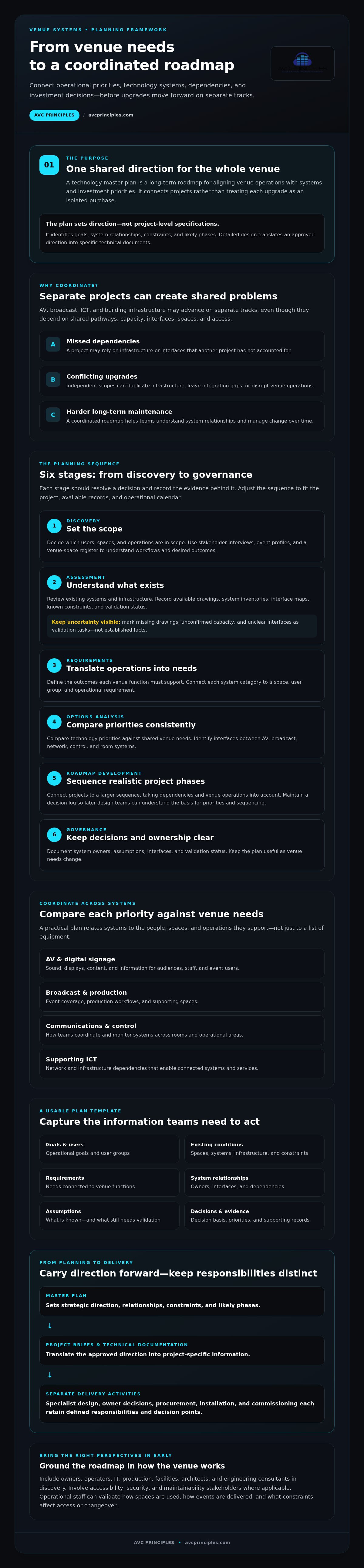
A venue technology master plan is a long-term roadmap for aligning venue operations with technology systems and investment priorities; it sets direction, not project-level specifications. It identifies goals, system relationships, constraints, and likely phases. Detailed design then translates an approved direction into specific technical documents. Procurement, installation, and commissioning follow through separate delivery activities, with defined responsibilities and decision points.
This distinction matters. If a broadcast upgrade, control-room refresh, and network project are scoped independently, each may make assumptions about pathways, capacity, interfaces, or room access. Those assumptions can produce duplicated infrastructure, integration gaps, or work that disrupts venue operations. A roadmap connects individual projects to a larger sequence. The concept is closely related to a technology roadmap, which aligns long-range objectives with technology decisions.
Which venue decisions belong in the master plan?
The plan should set requirements and relationships at a strategic level, not prescribe every device or detailed design choice. It can address:
- AV and digital signage: where audiences, staff, and event users need sound, displays, content, or information.
- Broadcast and production: how event coverage, production workflows, and supporting spaces relate to venue operations.
- Communications and control: how teams coordinate and monitor systems across rooms and operational areas.
- Supporting ICT: the network and infrastructure dependencies that enable connected systems and services.
For each category, connect the system to a space, user group, and operational requirement. A concourse information display, for example, serves different users and workflows than a production position. Exact scope varies with venue type, existing infrastructure, and project objectives.
Who should contribute to venue technology planning?
Bring owners, operators, IT teams, production staff, facilities teams, architects, and engineering consultants into discovery. Include accessibility, security, and maintainability stakeholders where applicable, and verify project-specific requirements with the responsible parties. Operational staff should validate how spaces are used, how events are delivered, and what constraints affect access or changeover before system concepts are fixed. Their input grounds the roadmap in actual venue functions and helps expose dependencies early.
Venue Technology Master Plan: Discovery to Roadmap
A workable process produces more than an inventory. It gives the project team a traceable path from venue operations to investment decisions, while recording what is known, what remains uncertain, and who must resolve it. The phases below support venue technology master planning, but teams can adjust their order to suit the project, available records, and operational calendar.
What to document during discovery and existing-system assessment
Start with the venue’s spaces, users, event types, systems, infrastructure, interfaces, constraints, and planned changes. Interview operators, IT, production, and facilities staff about workflows, recurring failure points, event demands, and desired outcomes. Keep verified conditions separate from assumptions. Mark missing drawings, unconfirmed capacity, and unclear system interfaces as validation tasks, not established facts.
How to turn requirements into a phased technology roadmap
Use each phase to resolve a specific decision and capture the evidence behind it. Maintain a decision log so later design teams can understand the basis for priorities and sequencing.
- Discovery: Decide which users, spaces, and operations are in scope. Support this with stakeholder interviews, event profiles, and a venue-space register.
- Assessment: Decide which existing assets can be retained, adapted, or require further review. Record system inventories, available drawings, interface maps, known constraints, and validation status.
- Requirements: Decide what outcomes each venue function must support. Document user needs, operational criteria, dependencies, and acceptance considerations; distinguish confirmed requirements from open questions.
- Options analysis: Decide which approaches merit further development. Compare alternatives against agreed criteria such as integration, scalability, supportability, and lifecycle fit. Record assumptions, trade-offs, and the rationale for the preferred direction.
- Roadmap: Decide what should proceed, when, and subject to which dependencies. Group requirements by venue function, urgency, system dependency, and operational impact. Show project phases, decision gates, enabling work, and commissioning considerations.
- Governance: Decide who owns updates and approves changes to priorities or assumptions. Establish a review cadence, named decision-makers, and a change log tied to project briefs and delivery milestones.
Sequence is conditional, not universal. For example, a production-system project may depend on confirming network interfaces or room readiness first. The roadmap should make that dependency visible and identify the evidence needed to release the next decision. Revisit it when venue operations, project scope, or verified site conditions change.
For work that needs coordinated AV and ICT engineering input, a specialist consultant such as AV and ICT systems design can help translate roadmap requirements into project documentation.
How to compare venue technology priorities without planning in silos
Project-by-project decisions can solve immediate problems, but they may overlook shared infrastructure and interfaces. A room display upgrade, for example, could depend on network capacity, control-system compatibility, and access to the room during installation. Comparing proposals against the same venue-wide criteria helps stakeholders see those relationships without replacing the detailed work of AV, broadcast, network, or control specialists.
Use a decision matrix to make trade-offs visible. Agree on what each criterion means and how much it matters before comparing options. Score only where evidence supports a judgment; label estimates and unknowns for follow-up rather than presenting them as confirmed findings.
A decision matrix for technology priorities
Priority or option | Operational value | Dependencies | Risk | Lifecycle fit | Readiness
Venue-wide network capacity review | Supports multiple systems and users | Requires verified demand, interfaces, and existing conditions | Unresolved capacity may affect dependent projects | Consider compatibility with planned systems and future changes | Confirm records and validation needs
Room-specific display enhancement | Improves a defined room function | Depends on local power, signal paths, control, and access | Limited scope, but interfaces still need checking | Assess alignment with the room’s use and replacement plans | Can proceed when requirements and site conditions are confirmed
The network review may enable several later projects, while the display enhancement may address a localized need. That distinction does not automatically make one the higher priority. Stakeholders should weigh operational impact, urgency, dependencies, and available evidence together. A high-priority item with unresolved assumptions may need a validation task before it is ready for design or procurement.
Where venue systems need coordinated planning
Map interfaces across production workflows, broadcast spaces, control positions, networks, and display systems. A production position may rely on network pathways, room layout, monitoring, and signal distribution; a display system may share control or content sources with other venue areas. The master plan should identify these touchpoints and assign specialist design questions to the relevant disciplines, not duplicate their technical designs.
Broadcast-specific interfaces warrant focused review. For stadium considerations, see the stadium broadcast system design requirements guide; for control-room planning, consult the broadcast control room design reference.
A master plan need not delay urgent work. It can separate immediate actions that have clear requirements and limited dependencies from investments that require enabling infrastructure, coordination, or further validation. In venue technology master planning, phasing is a way to make action more deliberate: advance ready projects while preserving decision gates for work that depends on them.
What a usable venue technology master plan template should contain
A planning document is useful when stakeholders can trace each recommendation to a venue goal, known condition, or recorded decision. In venue technology master planning, a consistent structure also makes assumptions and unresolved questions visible before they become embedded in project scopes.
Use this copy-ready outline as a starting point. Adapt it to the venue, project objectives, and information available.
- Executive summary: State the planning purpose, principal findings, recommended direction, and decisions required.
- Objectives and stakeholder findings: Record venue goals, user groups, operational needs, and the input behind each requirement.
- Spaces and existing conditions: List relevant rooms and areas, existing systems and infrastructure, documented constraints, planned changes, and information requiring site verification.
- Requirements and system concepts: Link functional requirements to venue spaces and users. Describe system-level concepts and integration dependencies without treating them as detailed design.
- Options and decisions: Summarize alternatives considered, evaluation criteria, confirmed decisions, recommendations, open questions, and items deferred to later design.
- Roadmap and governance: Capture project phases, dependencies, accountable owners, review points, change-control expectations, and reassessment triggers.
Build a systems-and-dependencies register
Give each system or requirement its own record so teams can track interfaces and validation. Include fields such as:
- System or requirement: Name the function and the spaces or user groups it serves.
- Owner and interface: Identify the accountable stakeholder and connected systems or disciplines.
- Assumption and evidence: Record the basis for the entry and whether it is confirmed, assumed, or unknown.
- Validation status: Specify what needs review, who will confirm it, and the evidence needed to close the item.
Make roadmap and lifecycle fields actionable
For each proposed project, record its priority, prerequisite, phase, decision owner, and commissioning evidence. Add review points for design progression and delivery decisions. Treat commissioning, training, documentation handover, and operational acceptance as planning considerations, with project-specific responsibilities confirmed during delivery.
Include refresh and reassessment triggers, such as a change in venue operations, a new project dependency, or verified conditions that differ from the planning basis. Avoid assigning a universal replacement interval. The plan is a decision framework, not a substitute for site-specific engineering, detailed design, or project documentation.
For support translating venue objectives into coordinated AV and ICT requirements, explore AV and ICT systems design.
How engineering support carries the master plan into venue delivery
A roadmap becomes actionable when its priorities shape project briefs, design scopes, technical documentation, and delivery decisions. Each approved initiative should identify its operational objective, interfaces, constraints, and required decisions. Engineering documentation then translates those planning requirements into project-specific design information that procurement and delivery teams can use.
Keep responsibilities distinct. The venue owner approves objectives, priorities, and investment decisions. Specialist engineers develop technical designs and document system requirements. Procurement teams manage purchasing against approved scopes, while installation teams carry out the work. Commissioning verifies system performance against defined project criteria and records relevant results. Clear role boundaries reduce ambiguity without separating the technical decisions that need coordination.
Selecting an engineering partner for venue planning
Assess a consultant’s relevant venue experience, ability to coordinate disciplines, documentation quality, and commissioning capability. Ask how they will validate existing conditions, distinguish assumptions from verified information, and gather input from operations, IT, production, and facilities stakeholders. Their process should make dependencies and open decisions traceable. For additional evaluation criteria, see the broadcast infrastructure engineering partner evaluation guide.
Turning the roadmap into accountable next steps
Before advancing a project, assign an owner to each decision, open question, dependency, and proposed phase. Confirm which recommendations require site investigation, stakeholder approval, or detailed engineering before the venue commits to a scope. Identify what documentation will support each decision and what evidence will be needed during commissioning. This creates a clear transition from strategic planning to project delivery while leaving room to revise priorities as verified conditions or operational needs change.
Engineering consultancy is particularly useful when venue systems, stakeholders, and project phases require coordinated technical planning. AVC Principles designs AV and ICT systems from concept through commissioning, including venue AV and sports and entertainment broadcast systems. If you’re defining the scope or next steps for your plan, discuss venue technology planning with AVC Principles.
Turn the Roadmap Into Your Next Project Decision
A practical venue technology master planning process gives stakeholders a shared basis for priorities, makes system dependencies visible, and sequences projects around operational needs. Its value depends on keeping assumptions distinct from verified conditions and assigning clear ownership to decisions, validation, and delivery milestones.
Use the roadmap to guide project briefs and technical scopes, then revisit it as venue requirements and conditions change. This preserves strategic direction without treating the plan as a substitute for detailed engineering. Coordinated AV and ICT expertise can help carry that direction from concept development through commissioning.
AVC Principles provides AV and ICT system design expertise, with services spanning concept development through commissioning. Discuss venue technology planning with AVC Principles to consider how engineering support could fit your project scope. With clear priorities and accountable next steps, your venue can move forward with greater coordination and confidence.
Frequently Asked Questions
What is venue technology master planning?
Venue technology master planning is the process of coordinating a venue’s technology goals, spaces, systems, dependencies, and investment priorities in a long-term roadmap. It helps owners and operators understand how projects relate before committing to individual scopes. The plan sets strategic direction rather than specifying every device or installation detail. It can cover areas such as AV, broadcast, communications, control, digital signage, and supporting ICT, based on the venue’s needs.
What should a venue technology master plan include?
A useful plan documents objectives, stakeholder needs, venue spaces, existing conditions, known constraints, functional requirements, and system dependencies. It should distinguish verified information from assumptions and open questions. Include options considered, recommendations, project priorities, prerequisites, phases, decision owners, and governance arrangements. Commissioning evidence, training, documentation handover, and operational acceptance should also be considered so delivery needs are visible during planning, rather than introduced after project scopes are set.
When should a venue develop a technology master plan?
Develop the plan early enough to inform major project and design decisions, ideally during schematic design for a new venue. For an existing stadium, begin before substantial technology upgrades or renovation scopes are fixed. Early planning gives stakeholders time to assess existing infrastructure, identify interfaces, and account for operational requirements. The plan can still be developed later, but teams may need to validate more assumptions and coordinate around decisions that are already underway.
How is a venue technology master plan different from detailed system design?
A master plan establishes long-term direction, priorities, dependencies, and project phases across the venue. Detailed system design translates an approved project scope into specific technical requirements and documentation. The plan may identify that a broadcast space depends on network, control, and room infrastructure; detailed design defines the project-specific solutions. Procurement, installation, and commissioning are further delivery activities, each with distinct responsibilities and decision points.
How do you prioritize technology projects in a venue master plan?
Compare proposed projects using agreed criteria, including operational value, urgency, dependencies, risk, lifecycle fit, and readiness. Base scores on available evidence, and flag assumptions or information gaps for validation. A venue-wide infrastructure dependency may enable several later projects, while a room-specific enhancement may address a contained need. Neither should be ranked automatically; assess operational impact and prerequisites, then sequence projects with clear decision gates.
Can a venue technology master plan be updated as requirements change?
Yes. Treat the plan as a controlled roadmap, not a fixed specification. Review it when venue operations change, new projects introduce dependencies, site investigations confirm different conditions, or stakeholder priorities shift. Record revisions, decision owners, and the evidence behind changes. Reassess projects that depend on updated assumptions before advancing their scopes. This approach keeps the plan useful while preserving a traceable basis for investment and delivery decisions.
Who should be involved in venue technology master planning?
Involve venue owners and operators, IT teams, production staff, facilities teams, architects, and engineering consultants. Include accessibility, security, and maintainability stakeholders where applicable, and confirm project-specific requirements with the responsible parties. Operational staff should describe workflows, event demands, and constraints before system concepts are established. Their input helps the planning team connect technical requirements to actual venue use and identify decisions that need further validation.


