
A stadium’s audio challenge isn’t simply making sound louder. Sports arena audio visual engineering accounts for seating geometry, building materials, crowd behavior, and equipment vibration to plan consistent coverage. It must also accommodate changes in how the venue is used when a game gives way to a concert.
A powerful sound system may seem suited to every event, but sports broadcasts, announcements, and live performances place different demands on the room, the systems, and the people operating them.
This article explains how arena AV is designed, integrated, installed, and engineered, including how sound and vibration from large equipment are addressed, how video walls fit into the wider system, and why concert sound differs from game-day audio. The result is a clearer view of the design decisions that shape a reliable, adaptable venue system.
Key Takeaways
- Start arena AV planning with the room, audience, performers, and equipment so coverage and operational needs shape the design.
- Coordinate audio, video, lighting, networking, and content systems as one venue ecosystem rather than isolated technologies.
- Understand how engineering and integration decisions affect installation, system operation, and future upgrades.
- Compare video walls and large-format projection against the venue’s viewing conditions and content requirements.
- Plan for sports and concerts as distinct sound environments, including differences in event cues, broadcast needs, and equipment vibration.
AV system design and engineering
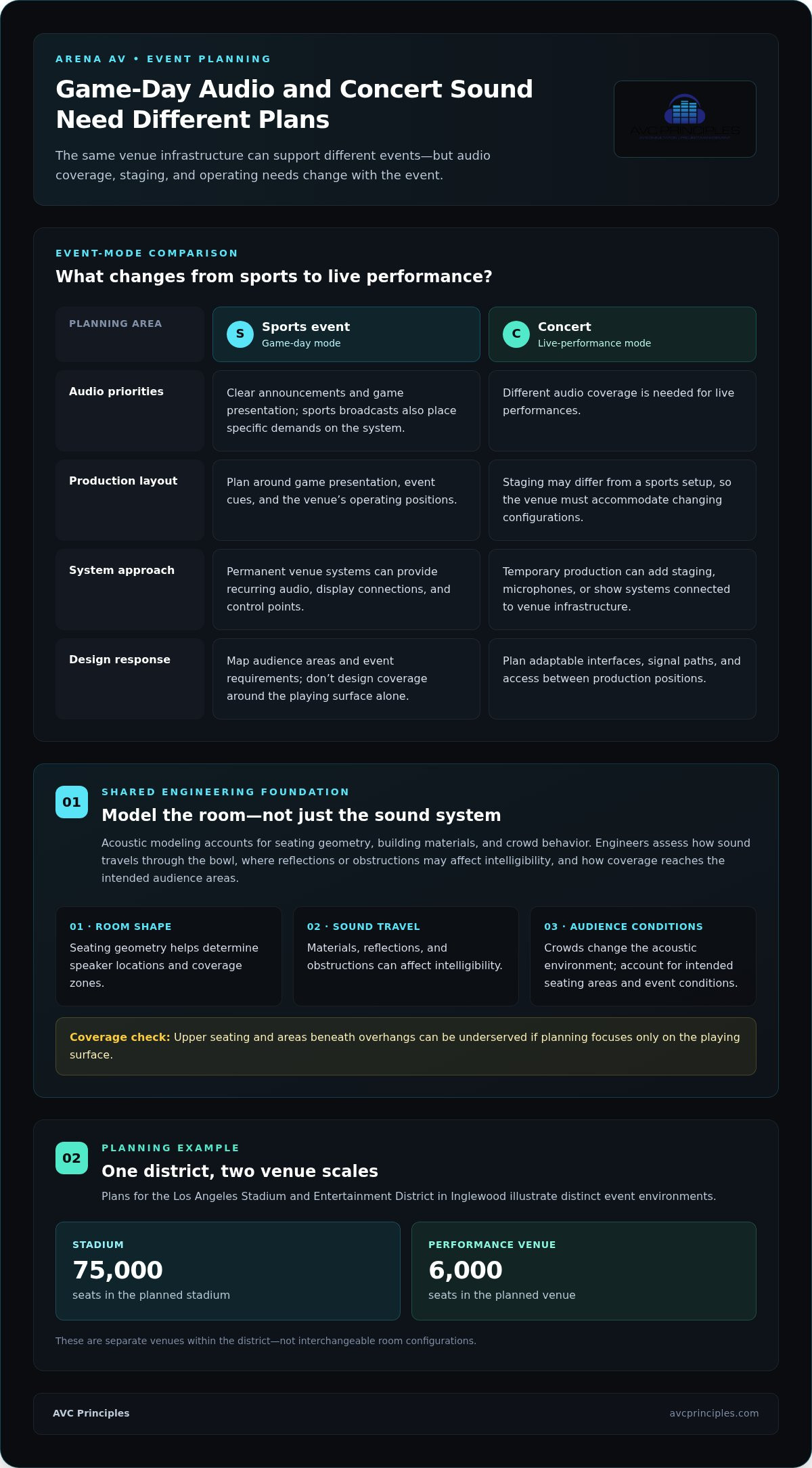
Arena AV design connects event requirements, room geometry, equipment locations, and control workflows. The Los Angeles Stadium and Entertainment District in Inglewood illustrates the scale: its plans include a 75,000-seat stadium and a 6,000-seat performance venue.
Flexible Systems for Event Types
Flexible AV systems support distinct uses, such as sports, concerts, and corporate meetings, through coordinated system and control plans. Each event changes how the venue uses audio, displays, and production resources.
Designers map the needs of each event before assigning systems permanent or adaptable roles. A stadium may need clear announcements and game presentation for sports, then different audio coverage and staging for entertainment. The Los Angeles Stadium and Entertainment District includes a stadium and a performance venue, representing separate event environments within one district. Planning for both helps define the interfaces, operating positions, and infrastructure each space requires.
Stadium Sound and Acoustic Modeling
Acoustic modeling predicts how sound interacts with seating geometry, building materials, and crowd behavior. It matters because speaker placement must support consistent coverage across seating areas, not simply maximize volume.
Engineers assess how sound travels through the specific bowl and where reflections or obstructions may affect intelligibility. Those conditions help determine speaker locations and coverage zones. Because crowds also change the acoustic environment, models should account for intended audience areas and event conditions. A plan designed around the playing surface alone, for example, may leave upper seating or areas beneath overhangs underserved.
Permanent Systems and Temporary Production
Permanent arena AV is integrated into the venue, while temporary event production adds or reconfigures systems for a particular show. Fixed infrastructure and event-specific production have different design and coordination needs.
Permanent systems can provide venue-wide audio, display connections, and control points for recurring events. Temporary production may add staging, microphones, or show systems connected to that infrastructure. Design must account for interfaces, system locations, signal paths, and access between production positions. A concert may use a different stage configuration from a sports event, so the venue plan must accommodate those changes without treating temporary systems as permanent installations.
Standards, Safety, and Engineering Risks
U.S. arena AV engineering coordinates the project’s applicable electrical, structural, fire, accessibility, and communications requirements. AV systems depend on building infrastructure and can affect public spaces, overhead installations, and event operations.
Engineers assess risks such as blocked sightlines, inadequate sound coverage, incompatible system interfaces, and equipment vibration affecting nearby spaces. They coordinate equipment loads and mounting locations with the building design, while planning cable routes, service access, and operational control. A display placed without a sightline review can obstruct views; a poorly coordinated signal path can disrupt event content. Project-specific requirements guide the design rather than a single universal code list.
Integrated audio, video, lighting, and digital systems
Integration connects venue audio, displays, lighting, networks, and event content into coordinated production workflows. Maintenance involves scheduled inspection, functional testing, and signal-path troubleshooting to help operators locate faults before an event.
System Upgrades and Retrofits
An upgrade or retrofit modifies existing venue infrastructure to meet changing event needs or replace aging components. Venues can improve system function while accounting for installed systems, cable routes, and operational requirements.
Start by documenting the current system: signal sources, distribution paths, control points, and equipment dependencies. Then identify the constraint, such as an outdated display connection or limited routing between production areas. A retrofit may replace selected components while retaining usable infrastructure; a broader upgrade may coordinate changes across audio, video, lighting, and networking. Mapping dependencies first helps prevent a new component from causing integration problems elsewhere.
Testing follows the system path from source to destination. A video feed, for example, can be checked at its origin, through switching and distribution, and at the intended display. Audio routing and control responses require separate functional checks. Troubleshooting then narrows the fault by comparing expected operation with observed signal and control behavior.
Control and Remote Monitoring
AV control systems organize equipment commands and operating modes through defined interfaces. Remote monitoring lets technical teams review system status without standing beside every rack or device.
For game-day production, operators may need to select a display source, route audio, and coordinate lighting cues. A clear control structure groups functions by space or task, reducing confusion between the control room and event positions. Remote status views can help locate an offline device or interrupted connection, while on-site testing confirms the physical signal path. Design should also define control access and how event staff use the system.
Maintenance planning should include equipment inspection, control verification, and checks of representative signal routes. A documented fault process helps staff distinguish a source issue from a distribution or destination issue. During troubleshooting, record the affected device, connection, and observed behavior to make recurring failures easier to isolate.
Sound and Display Integration
Arena sound and display systems coordinate event audio with visual content and operator cues. A change in one production element can affect timing, routing, and the audience experience elsewhere.
For example, an announcement may need to reach the public address system while a display switches from event content to venue information. Control design should make these actions clear to operators and define how audio and visual signals reach their destinations. Documented network and signal paths help production teams trace a feed when a display or audio zone behaves unexpectedly.
Digital signage can direct foot traffic, while display networks can carry transportation, weather, and safety updates. These functions depend on coordinated content delivery and venue operations. A practical design assigns each display a role and gives operators established workflows for routing or updating content.
Fire protection also intersects with AV planning, particularly around large roof structures and suspended equipment. Fire modeling has been used to assess whether sprinkler protection is effective on arena roofs more than 110 feet above the finished floor. Coordinating AV locations with building systems helps designers account for equipment placement, access, and system interfaces. An integrated design review can address these dependencies through coordinated AV system planning.
AV engineering, installation, and integration
Engineering connects the venue’s systems, signal paths, and operating positions into a functional whole. In a stadium, integration must account for the audience, event production, and the communications venue staff use to coordinate operations.
Design begins by identifying each source, destination, and control point. A broadcast camera, public address microphone, display, and production position may rely on different signal paths. Engineers document these relationships before installation, then coordinate system locations, cabling, network connections, and control interfaces. This lets production teams trace a signal from its origin to the audience and reveals dependencies that could complicate commissioning or future changes.
Installation sequence matters. Systems must be mounted, connected, configured, and tested against the design. For example, check a display feed from the production source, through switching and distribution, to its destination. Audio routes need separate end-to-end checks. A commissioning record can capture test results, control behavior, and issues to correct, giving venue staff a reference for future operation or modification.
Integrated communications support coordination between event production and venue teams. A stadium may use public address announcements alongside event cues and operator communications. Fan engagement may also include crowd polls, live social media feeds, fan-generated content, and interactive contests. These applications need a defined path between content sources, control positions, and audience-facing systems. A planned workflow clarifies who supplies content, who controls it, and where it appears during an event.
Accessibility is also part of integration. According to the U.S. Access Board, an assistive listening system uses transmitters, receivers, and coupling devices to deliver sound through induction loop, radio frequency, infrared, or direct-wired equipment. According to the U.S. Department of Justice, these systems augment standard public address and audio systems by sending signals directly to special receivers or hearing aids while eliminating or filtering background noise. Including assistive listening in system planning helps coordinate it with venue audio.
- Signal flow: Trace sources, switching, distribution, and destinations.
- Installation: Coordinate equipment, cabling, network connections, and control positions.
- Commissioning: Test audio, video, and control functions, then record results.
- Operations: Define how production and venue teams manage event content and communications.
These stages connect engineering intent with venue operation. When an arena’s event requirements include staged environments, Staged Environment Engineering can address how production elements interact with the venue’s AV infrastructure. Careful coordination helps the installed system serve event teams and audiences without treating components in isolation.
Video walls and large-format projection
Video walls and projection serve different visual roles across sports facilities. Placement, content, and the relationship to the audience determine how effectively each supports an event.
Video Walls and Large-Scale Screens
A video wall combines display surfaces into a large visual canvas, while large-format screens provide a prominent image for shared viewing. Sightlines, content scale, and viewing distance determine what the audience can read.
Start by mapping the intended viewing areas, then match the display position and content layout to those sightlines. A screen used for live action may need a different content arrangement from one carrying schedules or sponsor messages. The San Francisco 49ers Draft Room uses 4K projection, showing how high-resolution imagery can support a focused presentation environment.
Projection mapping offers another approach. The Atlanta Hawks Preview Center uses projection mapping on 3D models, while the NHL Seattle Preview Center maps projections onto a 3D scale model of an arena. These examples show how projection can make a physical model the display surface itself. The design must align projected content with the model’s shape and the audience’s viewing position.
Digital advertising inventory at stadiums can be updated in real time and tailored to audiences, making content planning part of display design. Facilities need to consider where advertising appears, how it sits alongside event information, and how operators manage changes during production.
Video Boards with Audio and Lighting
Video boards work with audio and lighting as coordinated elements of event presentation. Screen content, sound cues, and lighting transitions can direct audience attention at key moments.
For example, a video board may show a replay while audio carries commentary or an announcement. Lighting cues can support the transition between presentation modes. Production planning should define how each cue is triggered and which content appears on each display. This coordination helps operators avoid mismatched visuals, sound, and lighting during event changes.
Content also shapes a display’s role. Live action, sponsor material, event information, and audience-facing features have different layout and timing needs. Because digital advertising can be tailored and updated in real time, operators need a defined process for scheduling and changing material. The display system should support these workflows without making routine production changes cumbersome.
Choosing between a video wall and projection depends on the facility, the viewing context, and the content’s purpose. Projection mapping can suit a 3D model, as the Atlanta Hawks Preview Center demonstrates. A large screen can serve shared viewing or event messaging. Treating display selection as a design decision, rather than an equipment choice by itself, helps align the visual system with venue use and production needs.
Sports venue AV compared with concert sound
A sports venue and a concert use the same room differently. Sports AV centers on game information, announcements, and broadcast timing; concert sound prioritizes musical performance and performers’ needs. This distinction affects system routing, event cues, and production coordination.
During a game, critical audio includes public address announcements, commentary, and cues tied to play. Video may show replays, scores, or sponsor content. For televised games, operators may also need to fit television spots into the event. The show script helps align announcements, commercials, and display changes with broadcast and venue production.
A concert shifts the priority to musical sound across the audience area. Performers and production teams may use different stage positions, inputs, and mixes from those used for sports. The venue’s fixed system still plays a role, but concert production must connect to it while supporting the performance. System placement and routing must account for the stage layout and audience listening experience, not just the playing surface or scoreboard.
These different operating demands affect transitions between events. A venue can plan which AV functions remain permanent and which production elements change for a concert. It can document event cues and responsibilities so staff know who controls content, sound, and broadcast transitions. Cross-training venue staff for sports and concerts can support consistent operation across both formats.
Sponsors add another layer. Their marketing constraints can affect which content appears during an event, so operators need to coordinate sponsor material with the show script and broadcast requirements. A display sequence planned for a game, for example, may need different sponsor content or timing for a concert. Clear content approval and control workflows help reduce production conflicts.
Accessibility and fan-experience technologies can serve both formats. According to the U.S. Department of Justice, assistive listening systems send audio to special receivers or hearing aids while filtering or eliminating background noise. Venue mobile apps may provide personalized content, drink ordering, and live updates; crowd polls, social feeds, fan-generated content, and interactive contests offer further ways to engage audiences.
The practical takeaway is to design around event operations, not just equipment. Map game and concert workflows separately, then identify shared infrastructure, content controls, broadcast cues, and staff responsibilities. For venues coordinating those workflows, plan sports and entertainment broadcast design around the demands of each event.
AVC Principles: AV Systems Design
AVC Principles provides AV Systems Design for venues coordinating permanent systems with sports, concerts, and other event requirements. Engage the firm when planning a new arena system, integrating AV with ICT infrastructure, or aligning staged environments with venue operations.
Design decisions connect systems, signal paths, control positions, and event workflows. Coordinated planning clarifies how these elements support daily venue functions and live production. Where command operations need to connect with AV infrastructure, Command and Control Center Design can address that relationship within the wider project.
For arena projects that need structured AV design and integration, contact AVC Principles to discuss your requirements.
Set the Next Design Priorities
The next phase of sports arena audio visual engineering is defining how a venue should operate as its needs evolve. Before a project advances, align stakeholders on event requirements, operational responsibilities, and interfaces between AV and building infrastructure. This shared direction grounds design decisions and helps teams identify dependencies early.
AVC Principles supports this planning through AV Systems Design, ICT Infrastructure Design, and Staged Environment Engineering. These disciplines connect system requirements with venue communications infrastructure and event environments. They are useful when a project moves from concept into coordinated design, or when changing venue needs call for a broader technical plan.
Bring your project priorities into the discussion and establish a clear foundation for the next design phase. Contact AVC Principles about arena AV to discuss your requirements. A considered starting point can help your team move forward with greater clarity.
Frequently Asked Questions
How is the sound and vibration of large equipment mitigated in these specialty structures?
Engineers address transmitted vibration by coordinating system locations, mounting, and building interfaces. Rotating or high-output equipment, for example, can be separated from sensitive AV spaces, while resilient mounts and isolated supports reduce direct vibration paths. Sound control also depends on enclosure design and how mechanical noise travels through the structure. Reviewing these relationships early helps protect announcements, broadcast audio, and nearby event spaces from interference.
What trends are on the horizon for such projects?
AI-informed content delivery and more coordinated venue systems are emerging directions. AI is beginning to inform content delivery decisions at event venues, while digital advertising inventory can be updated in real time and tailored to audiences. A venue can plan how event information, promotions, and audience-specific content move across display networks. The engineering challenge is coordinating content sources, network infrastructure, and operator workflows without fragmenting system control.
What’s the biggest trend you see today in these types of specialty structures?
A major current direction is treating audio, video, lighting, networking, and content as a coordinated venue ecosystem. This connects systems that may once have been planned separately. An event cue, for example, can trigger a display change, audio playback, and lighting response under a shared production plan. The focus is shifting toward cross-system coordination and clear operating workflows rather than isolated system decisions.
What does sports arena audiovisual engineering include?
Sports arena audio visual engineering covers planning and technical coordination for event sound, displays, broadcast, lighting, communications, and digital content. It can include defining requirements, signal and network architecture, documentation, integration planning, and commissioning. A project may define how control rooms, event staff, and broadcast teams share system interfaces and operating responsibilities. The scope depends on the venue’s functions and production requirements.
What AV systems are used in sports arenas and stadiums?
Common systems include public address and event audio, video boards, digital signage, broadcast interfaces, lighting controls, operator control systems, and supporting networks. Assistive listening is another application. According to the U.S. Access Board, it uses transmitters, receivers, and coupling devices to deliver sound through induction loop, radio frequency, infrared, or direct-wired equipment. The system mix depends on the event program, audience services, and production operations.
How are arena sound systems designed for clear audio and crowd noise?
For sports arena audio visual engineering, sound design considers seating geometry, materials, and crowd behavior before setting speaker positions and coverage areas. Crowd noise changes during an event, so intelligibility depends on coverage across listening areas, not simply higher volume. Engineers also account for obstructed seating zones and reflective surfaces. Commentary, announcements, and event effects each shape routing and system configuration.
What video display technologies and scoreboard systems are used in sports arenas?
Arenas can use video boards, large-format displays, digital signage, and projection, including projection mapping onto physical models. Scoreboard systems combine event information with video and venue content, while display networks can carry advertising and operational messages. Digital advertising inventory, for example, can be updated in real time and tailored to audiences. Selection depends on viewing conditions, content purpose, sightlines, and operator workflows.
What acoustic challenges affect sports arena AV engineering?
Large seating bowls, hard building surfaces, roof geometry, and changing crowd levels can affect reflections and intelligibility. A venue must serve listening areas from lower seating to upper sections, where crowd reactions may compete with announcements. Event changes also alter acoustic needs: a concert stage and a sports presentation place different demands on sound coverage. Acoustic modeling helps engineers assess these conditions before finalizing system placement and configuration.


