
A campus master plan is more than a map of future buildings. It guides the physical development needed to support an institution’s mission and strategic plan. ICT master planning for campuses brings technology resources into that framework, aligning systems and infrastructure with institutional goals.
That alignment matters because learning spaces, campus facilities, and digital systems shape one another. Planning them separately can make it harder to coordinate priorities, implementation, and the physical changes needed to support teaching and campus operations.
This article explains what a campus master plan covers and how ICT planning fits within it. You’ll learn how to connect institutional goals with ICT resources, physical infrastructure, implementation priorities, and education management systems. The focus is how these elements work together, so decisions form a coherent campus strategy rather than a collection of disconnected projects.
Key Takeaways
- Connect campus development decisions to the institution’s mission and strategic priorities, not just immediate building needs.
- Coordinate ICT resources with implementation priorities so technology and physical infrastructure develop as an integrated plan.
- Assess how facilities, learning environments, and campus systems must support institutional goals over time.
- Consider education management information systems alongside ICT infrastructure, staffing, and digital learning materials.
- Use specialist AV and ICT design support when campus projects require coordinated systems planning across spaces and infrastructure.
What is a campus master plan?
A campus master plan guides physical development in support of an institution’s mission and strategic plan. It connects long-term priorities with facilities, infrastructure, and implementation decisions.
Strategic Documents and Priorities
An ICT master plan for a campus sets out how technology resources should support institutional priorities. It translates goals for students, teaching, research, and campus operations into coordinated infrastructure decisions. As a strategic document, it helps leaders assess proposed projects against institutional needs instead of treating each system as an isolated purchase. The University of Illinois Chicago developed Strategic Priorities in 2016 to build on its strengths and mission, illustrating how institutional direction can anchor planning.
Standards and Regulations
U.S. campus ICT projects must account for applicable requirements affecting the facilities and infrastructure where systems will operate. Campus master plans should consider local, state, and federal regulations, including zoning laws, building codes, and environmental regulations. These requirements can shape where infrastructure is installed and how physical projects proceed. The relevant considerations depend on each project’s location and scope, so regulatory review belongs alongside technical and facilities planning.
Budgeting and Phasing ICT Projects
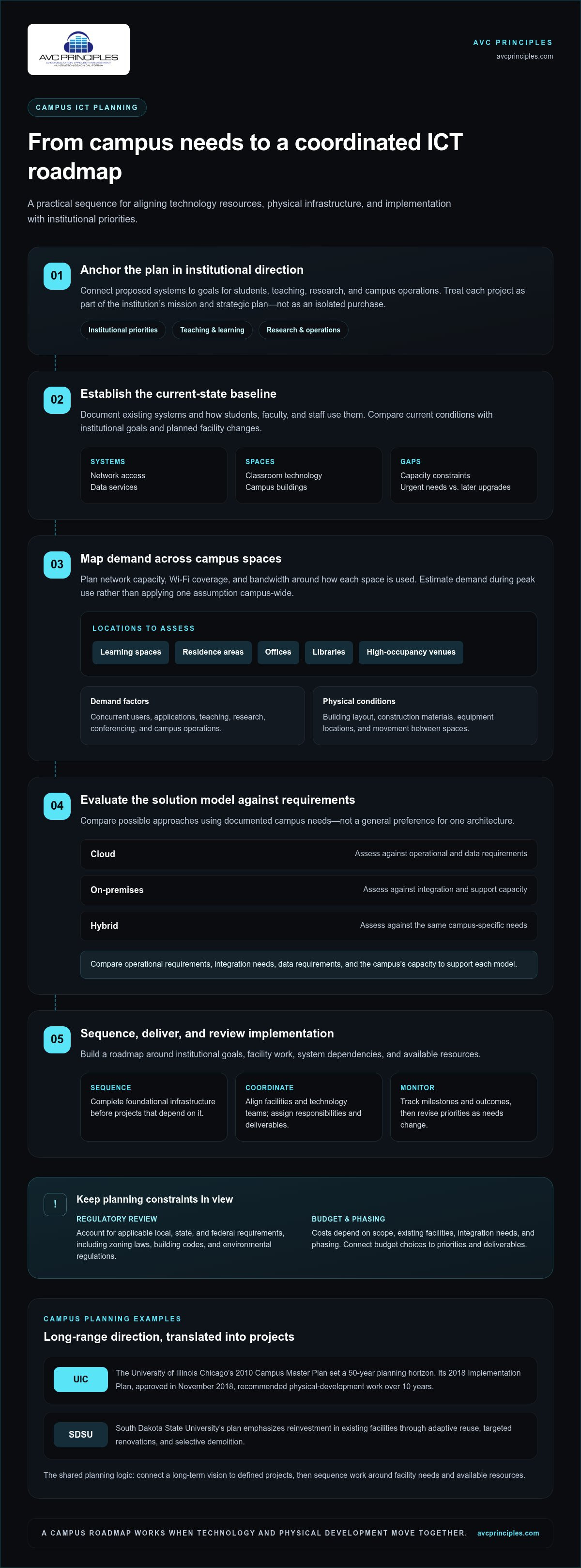
Campus teams prioritize ICT projects by comparing institutional goals, operational needs, existing assets, and dependencies between systems. They can then group work into phases, sequencing foundational infrastructure before projects that rely on it. Planning and implementation costs depend on scope, existing facilities, integration needs, and phasing; the price is determined after a quote request. This approach helps decision-makers connect budget choices to deliverables, identify which work supports urgent priorities, and coordinate technology implementation with campus development.
Examples of Successful ICT Plans
U.S. campus planning examples show how strategic priorities can guide implementation, although the cited plans focus on physical development rather than a standalone ICT master plan. The University of Illinois Chicago’s 2010 Campus Master Plan established a 50-year planning horizon. Its 2018 Implementation Plan, approved by the University of Illinois Board of Trustees in November 2018, updated that plan and recommended physical-development work over 10 years. South Dakota State University’s plan emphasizes reinvestment in existing facilities through adaptive reuse, targeted renovations, and selective demolition.
These examples show how institutions can turn priorities into action: connect a long-term vision to defined projects, then sequence them around facility needs and available resources. For an ICT plan, the same logic means linking each proposed system to an institutional goal and the physical infrastructure needed to support it.
Planning ICT resources and implementation
A campus ICT plan connects user requirements, existing systems, and future projects. ICT master planning for campuses links resource assessments with implementation priorities, keeping technology decisions tied to institutional objectives.
Assessing Infrastructure and User Needs
Assessing ICT needs starts with documenting current systems and how students, faculty, and staff use them. Review network access, classroom technology, data services, and known capacity constraints across campus buildings. Compare the findings with institutional goals and planned facility changes. This baseline helps distinguish urgent gaps from upgrades that can follow later.
A plan should define objectives, existing conditions, proposed systems, dependencies, and an implementation approach. Compare cloud, on-premises, and hybrid solutions against operational requirements, integration needs, data requirements, and the campus’s capacity to support each model. The right approach depends on these documented needs, not a general preference for one architecture.
Network Capacity and Coverage
Network planning matches capacity, Wi-Fi coverage, and bandwidth to campus use. Map learning spaces, residence areas, offices, libraries, and high-occupancy venues. Identify where concurrent users and applications place demands on the network. A lecture space supporting simultaneous digital learning has different requirements from an administrative office.
Coverage plans should account for building layout, construction materials, equipment locations, and how people move between spaces. Estimate demand during peak use, including teaching, research, conferencing, and campus operations. These conditions shape capacity requirements, making planning by building and use case more useful than applying one assumption across campus.
Long-Range Implementation and Monitoring
Long-range planning sequences projects around institutional goals, facility work, system dependencies, and available resources. ICT master planning for campuses can establish a roadmap that identifies foundational work, dependent projects, and the conditions for advancing each phase.
Implementation requires assigned responsibilities, defined deliverables, and coordination between facilities and technology teams. Campus facilities staff are responsible for implementing an adopted campus master plan over time. Monitor progress against milestones and intended outcomes, then revise priorities as facility projects or institutional needs change. For projects requiring coordinated systems and infrastructure decisions, ICT infrastructure design can support campus planning.
Long-range planning works best when it pairs a durable direction with a sequence of decisions that can be reviewed. Singapore and Korea have demonstrated the benefit of five-year ICT in education master plans with a long-term vision. For a campus, this model can connect infrastructure choices to learning, research, service, and facilities priorities while allowing assumptions to be reassessed as needs change. At each review, planners can confirm that foundational work remains adequate, dependent projects are ready, and resources still align with intended outcomes.
Implementation can also frame technology as part of the campus’s relationship with its surrounding community. The University of Illinois Chicago's 2018 Implementation Plan recommends connecting people and the campus to the City of Chicago. Planners can consider how access, services, and campus systems support those connections, then make responsibilities and dependencies visible in the roadmap. This perspective complements internal capacity planning: it asks not only whether a proposed system meets operational needs, but also how it contributes to the institution’s broader role. Clear review points help teams adjust sequencing without losing sight of the long-term vision.
Aligning physical infrastructure with institutional goals
Physical infrastructure should reflect an institution’s priorities in how campus spaces connect, function, and support learning. A university can use its master plan to coordinate facilities, utilities, technology pathways, and open space with academic and operational goals. This matters because a building project can shape how students, faculty, and staff access services across campus.
The University of Maryland’s College Park campus covers 1,235 acres and serves 41,000 students across 300 degree programs. A campus with that scale and range needs planning that considers more than individual buildings. Planners can map how academic facilities, student services, and shared spaces relate to one another, then identify where upgrades or new construction support institutional priorities. Diverse users and programs place different demands on spaces, so a single facility model may not fit every campus function.
Oregon State University’s College of Engineering is undertaking a 10-year plan focused in part on its engineering triangle. That example shows how a defined campus district can focus investment around an academic priority. For other institutions, the equivalent planning task is to identify key academic areas, understand how facilities serve them, and coordinate circulation and infrastructure. The plan should connect each physical intervention to a clear institutional purpose.
Florida State University’s Northwest Campus Project offers another example of how a major development can combine different campus functions. Its first phase spans 408,000 square feet and includes a residence hall, dining facility, and parking garage. Such a mix requires planners to consider how residential, dining, and transportation facilities relate to the wider campus. For technology planning, building layouts and project sequencing also affect where network pathways and other ICT infrastructure can be integrated.
The University of Texas at San Antonio opened San Pedro II in April 2026. A new facility can support institutional goals most effectively when its intended uses inform design decisions from the outset. For example, planners should coordinate room functions, shared spaces, and infrastructure requirements before construction decisions become difficult to change. This creates a clearer connection between the university’s purpose for a facility and the systems needed to operate it.
Riverside Community College District’s Sustainability and Climate Action Plan identifies environmental, economic, and social priorities and areas for investment. It illustrates how campus planning can incorporate sustainability goals alongside academic needs. Facilities decisions can then be assessed against those priorities, including whether reinvestment or adaptation better supports the institution’s direction. Linking investments to stated goals gives campus leaders a basis for comparing projects.
A practical alignment review starts with the institution’s strategic priorities, then maps each one to facilities, users, and infrastructure dependencies. The University of Maryland’s campus scale, Oregon State’s focused district planning, and Riverside Community College District’s sustainability priorities illustrate different ways physical planning can respond to institutional context. The resulting plan should make these connections clear, giving each proposed development a defined purpose within the broader campus vision.
ICT infrastructure and education management information systems
Campus ICT plans should treat infrastructure, education systems, and information governance as connected components. For cybersecurity, privacy, and data governance, define system ownership, access roles, data handling, and incident responsibilities during planning. These decisions shape how systems connect and operate across campus. For example, an academic platform and a student services system may share information, so access and data responsibilities need clear boundaries.
Infrastructure provides the foundation for education management information systems, often called EMIS. Network connectivity, data storage, user devices, and application access influence how reliably an institution can support these systems. An EMIS organizes information used in education administration, while ICT infrastructure enables authorized users to access and exchange it. Planners can map existing platforms, identify how information moves between them, and document dependencies before proposing system changes.
U.S. higher education institutions can apply this planning framework to campus-specific academic and administrative systems. Start by identifying the information processes the institution needs to support, such as course administration, student services, or academic program reporting. Then map the users, applications, data sources, and facilities involved. This inventory helps distinguish a classroom network access issue from a workflow problem caused by disconnected records.
Data governance should inform system architecture from the planning stage. Define which teams own each system, who can access particular information, how information is shared, and how records are managed. These decisions shape integration requirements and platform selection. For example, if an academic office and student services team use separate applications, planners should document what information needs to move between them and which roles require access.
Cybersecurity planning should identify critical systems, connections, users, and operational dependencies. Campus teams can use this map to define access controls, account responsibilities, backup considerations, and response procedures. Privacy expectations should guide data collection and sharing, while governance clarifies who approves system changes. Recording these design assumptions gives implementation teams a consistent reference across connected projects.
Each proposed investment should address a defined educational or operational need. If a campus program relies on digital learning materials, planners should account for the systems, connectivity, staffing, and facilities required to support delivery. If an EMIS depends on information from multiple platforms, integration and governance belong in its project scope. This makes the connection between infrastructure and institutional outcomes visible to decision-makers.
For example, a university introducing a new academic advising workflow may need to coordinate user access, data exchange, application requirements, and network availability. Evaluating these dependencies together helps determine whether the primary need is infrastructure, system integration, or a revised process. That distinction supports clearer project boundaries and more coherent implementation decisions.
Campus master planning
A campus master plan is a coordinated framework for physical development, not simply a schedule of construction projects. Its value comes from connecting academic priorities, facility conditions, infrastructure dependencies, and investment decisions. Because campus needs change, the plan must also provide a basis for revisiting project priorities as conditions evolve.
Start by assessing existing facilities. Facility condition assessments help institutions make decisions about maintenance, renovation, and capital investment. Their findings can distinguish buildings that need immediate attention from spaces suitable for adaptation or longer-term reinvestment. Pairing these findings with academic and operational needs helps leaders compare projects by purpose, condition, and dependency, rather than treating every request as equally urgent.
Next, connect the assessment to implementation choices. A campus plan should test whether an institutional need calls for maintaining an existing facility, renovating it, adapting it, or developing new space. Preventive maintenance plans can include regular inspections, servicing, and repairs to help prevent breakdowns and costly emergencies. This ongoing work belongs alongside capital planning because deferred facility needs can affect the timing and feasibility of future projects.
Stakeholder engagement is another planning mechanism. UNESCO’s regional strategy recommends six action points to promote systematic and coordinated stakeholder engagement. For a campus, this means creating a structured way for academic leaders, facilities teams, students, and administrators to inform priorities. Their input can surface conflicts early, such as a proposed facility change that disrupts teaching or an operational requirement that affects project sequencing.
- Compare facility condition with academic and operational needs.
- Identify dependencies between proposed projects and existing systems.
- Evaluate maintenance, renovation, adaptation, and new development as distinct options.
- Record stakeholder input and how it informs project priorities.
Campus master planning can require intensive work and expertise that institutions do not need on staff continuously. A consultant can help coordinate assessments, stakeholder input, and long-range planning within a unified framework. The plan should make its rationale clear: which institutional need a project serves, what conditions affect its timing, and how it relates to other planned work.
Review the framework when facility assessments, academic priorities, or project dependencies change. That review keeps decisions connected to current conditions instead of relying on outdated assumptions. For campuses aligning technology with physical development, coordinate campus infrastructure planning as part of the broader master-planning process.
It fits the institution’s broader priorities and the dependencies that shape delivery. It can also clarify how decisions will be revisited as facility conditions, academic needs, or operational requirements change. Recording the rationale for each priority makes the plan useful for discussion and adjustment, rather than leaving a fixed sequence without context. This record connects assessment findings, stakeholder input, and implementation choices, and shows which assumptions should be checked before a project advances.
Higher education institutions often retain consultants for campus master planning because the process is intensive and the necessary expertise may not be needed on staff continuously. Consultants can help coordinate the work and bring its inputs into a shared framework. Institutional leaders and teams can then use that framework to understand priorities, review trade-offs, and guide decisions as needs evolve.
AVC Principles: AV Systems Design
AVC Principles provides AV Systems Design for campus environments where audiovisual systems must support defined teaching, collaboration, or presentation needs. The design can be coordinated with ICT Infrastructure Design so room systems and campus infrastructure are considered together during project planning.
Turn to AVC Principles when a campus project includes auditoriums, conference spaces, or other environments where audiovisual requirements affect room design and system integration. Early coordination helps align technical requirements with the space’s intended function and the broader infrastructure plan. For projects involving staged environments or command facilities, Staged Environment Engineering and Command and Control Center Design may also be relevant.
Contact AVC Principles to discuss how AV Systems Design can support your campus project.
Set the Next Campus Planning Decision
The next step is to turn planning priorities into a coordinated project brief. Identify the campus outcomes each project must support, the physical constraints that shape delivery, and the system dependencies requiring early coordination. This gives institutional teams a clear basis for deciding what to advance and how to define the work.
ICT master planning for campuses can also clarify where specialist design input is useful. AVC Principles’ AV Systems Design, ICT Infrastructure Design, and Staged Environment Engineering address connected requirements across campus spaces and systems. The appropriate scope depends on the needs and functions of the project.
For a campus project that requires coordinated AV or ICT design, contact AVC Principles to discuss your campus. A clear conversation about goals, facilities, and system requirements can help establish a practical direction for the work ahead.
Frequently Asked Questions
What are the steps to develop an ICT master plan for a campus?
Develop the plan through a governed sequence that turns campus objectives into validated requirements and accountable projects. Begin by appointing academic, facilities, IT, finance, and procurement representatives, then define scope and decision authority. Inventory current systems and planned changes, and document user needs and technical dependencies. Compare options against requirements, rank initiatives, assign owners, and establish review gates. Before approval, confirm each project has a defined outcome, delivery dependency, and operating responsibility.
What are common risks and implementation challenges in campus ICT master plans?
Common challenges include unclear project ownership, changing scope, incompatible legacy systems, construction delays, and disruption during system migration. User adoption can also falter if affected groups aren’t involved in planning and testing. Maintain a risk register that names an owner, trigger, and response for each issue. Before broad deployment, test interfaces and workflows in a representative setting, then use the findings to refine requirements and the implementation sequence.


