
The most consequential work on a staged environment happens before it is built. Staged environment technical design takes a project from requirements and concept layouts through engineering refinement, using prototypes and simulations to assess how the proposed system will perform. Each stage connects creative intent with practical decisions about architecture, equipment, integration, and operation.
A compelling concept is only the starting point. The design must also account for the venue, technical constraints, user needs, and the relationships between audio, video, lighting, and control systems. Early planning makes these dependencies visible while the design can still be refined.
This article explains how conceptual and preliminary design establish a direction, how detailed engineering turns it into coordinated documentation, and how testing can reveal where improvements are needed. You’ll see which decisions each phase addresses and why iteration matters as an initial idea develops into a validated staged environment.
Key Takeaways
- Separate concept development, preliminary engineering, and detailed design so each phase resolves the right decisions at the right level of detail.
- Assess concepts against project requirements, technical constraints, user needs, and system integration before advancing a preferred direction.
- Use feedback from evaluation to refine the design, document revisions, and keep decisions aligned with the original objectives.
- Apply prototypes and simulations to examine performance and identify where a design needs further development before implementation.
- When a staged environment requires coordinated AV planning, AVC Principles’ AV Systems Design can support the transition from design intent to an integrated system plan.
Conceptual, preliminary, and detailed engineering
Engineering design moves from project requirements to a workable concept, then through preliminary and detailed refinement. For a staged environment, this sequence connects the intended experience with the systems, infrastructure, and validation needed to support it.
Engineering Problems and Requirements
Defining the engineering problem means setting project objectives, gathering user and stakeholder requirements, and identifying the constraints that shape the solution. Agreed criteria give the design team a basis for comparing concepts and judging whether a proposal meets the project’s needs.
An initial brief, for example, might describe an event environment without explaining how audiences, operators, content, and technical systems interact. The design process makes those needs explicit and records performance criteria, spatial limits, interfaces, and operational expectations. Feasibility research can then compare technologies and approaches against those criteria before the team commits to a direction.
Purpose of Engineering Design
Engineering design applies scientific, mathematical, and engineering knowledge to develop a solution that meets defined objectives. It turns an initial idea into a structured design that can be evaluated, refined, and documented.
Conceptual engineering establishes the broad system architecture and possible layouts. Preliminary design develops those concepts into clearer arrangements and equipment requirements. Detailed engineering then produces coordinated drawings, calculations, material choices, and integration information. The appropriate level of detail depends on the project’s purpose and constraints, and each stage still requires sound judgment.
Life cycle assessment can inform decisions beyond initial performance. Its goal and scope define the purpose, boundaries, level of detail, and functional unit. Inventory analysis gathers relevant inputs and outputs, such as energy, materials, emissions, and waste. Impact assessment interprets that information, and the final interpretation connects the findings to design decisions. This process helps teams consider resource use and environmental impacts alongside system requirements.
Multidisciplinary Engineering Collaboration
Multidisciplinary collaboration brings specialists and stakeholders together to coordinate interdependent parts of a design. Decisions in one discipline can affect the requirements, interfaces, and documentation of another, so coordination is essential.
Industrial engineering projects, for example, may integrate structural, mechanical, electrical, and process engineering. Staged environments also require coordination of system architecture, equipment placement, and connections between technical components. Shared design criteria and coordinated drawings give each discipline a common reference. Reviews can then expose conflicts early, while proposed changes remain tied to the original requirements.
Staging Infrastructure and Services
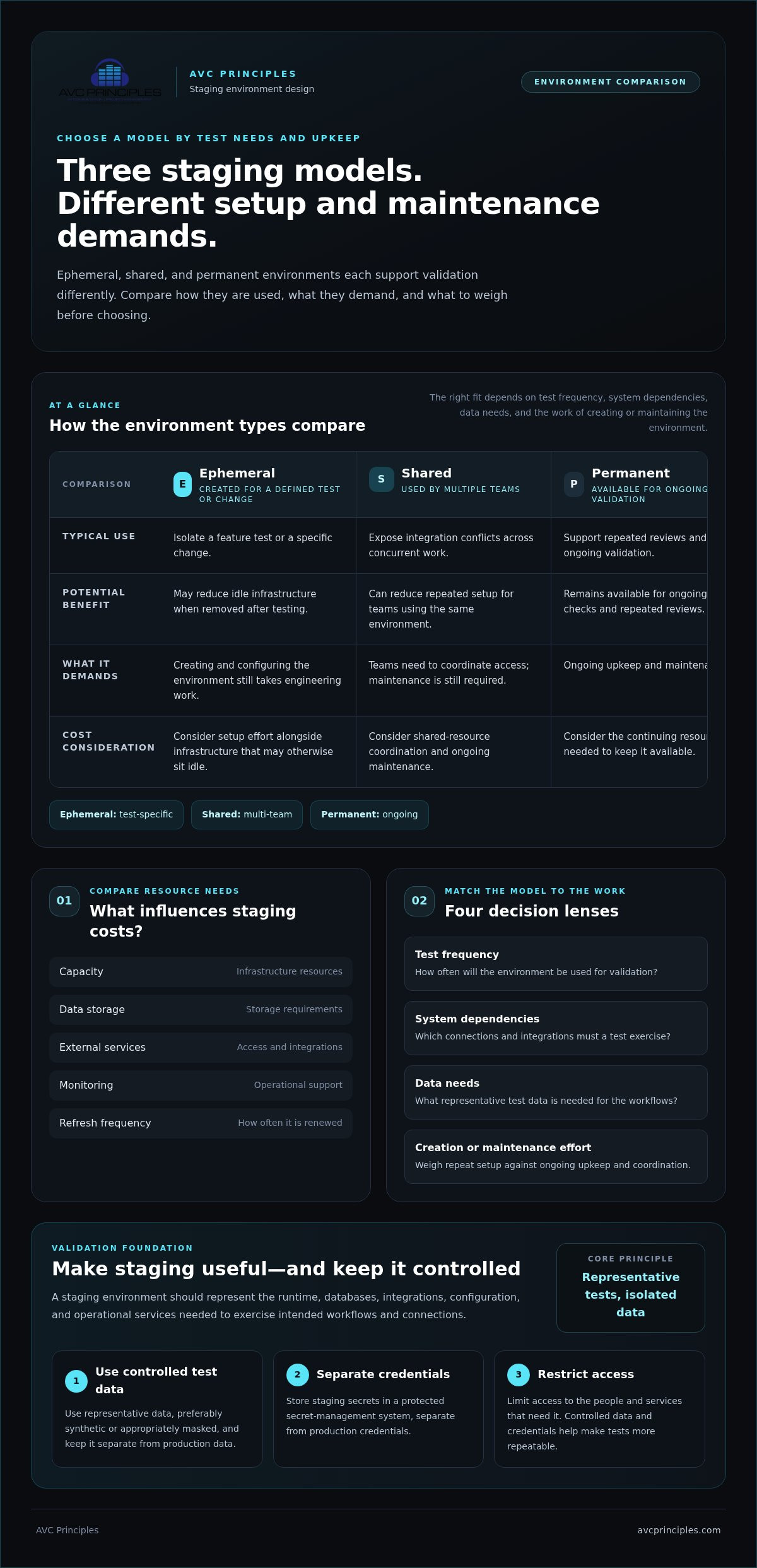
A staging environment should include the application runtime, required databases and integrations, configuration, and operational services needed to represent the intended system. Testing is useful only if the environment can exercise the workflows and connections the design must support.
Use representative test data, preferably synthetic or appropriately masked, and keep it separate from production data. Store staging secrets in a protected secret-management system, separate from production credentials, and restrict access to the people and services that need it. Controlled data and credentials make tests more repeatable without exposing live operational information.
Generating and assessing conceptual designs
Conceptual design turns project objectives into competing models that can be compared before detailed engineering commits to a direction.
Staging Environment Types
Ephemeral staging environments are created for a defined test or change. Shared environments support multiple teams, while permanent environments remain available for ongoing validation. The choice affects how closely tests represent the intended deployment and how teams coordinate access.
An ephemeral environment can isolate a feature test, while a shared environment can expose integration conflicts across concurrent work. A permanent environment supports repeated reviews but requires ongoing upkeep. Compare the options against test frequency, system dependencies, data needs, and the effort involved in creating or maintaining each environment.
Staging Environment Costs
Building and operating a staging environment requires resources for infrastructure, configuration, integrations, security controls, and maintenance. Its design affects both operating demands and how faithfully testing reflects the intended system.
Capacity, data storage, external service access, monitoring, and refresh frequency all influence resource use. Ephemeral environments may reduce idle infrastructure if removed after testing, but creating and configuring them still takes engineering work. Shared or permanent environments can reduce repeated setup, while increasing the need to coordinate access and provide ongoing maintenance.
Environment Architecture and Access Controls
Development, staging, and production are separate deployment environments, each with its own configuration, data handling, and access boundaries. Changes should be evaluated in staging before they reach production.
A typical pipeline promotes a build from development to staging, then to production after validation. Keep settings and credentials specific to each environment. Network segmentation can limit staging connections to required services, while role-based permissions restrict access to systems and data. For example, a test service can receive staging credentials without access to production credentials.
Set criteria before assessing concepts or selecting a preferred model. Compare proposals against objectives, feasibility, system interfaces, operational needs, and constraints. A layout sketch can show equipment relationships; a conceptual model can clarify how users, operators, and systems interact. Record assumptions for each concept so reviewers can see which decisions depend on unresolved requirements.
Risk assessment adds another basis for comparison. Identify failure scenarios, such as an unavailable integration or an unexpected configuration change, and evaluate their effects on testing and deployment. Map relevant regulatory and organizational requirements to design decisions and evidence. The resulting risk register can help set priorities without treating compliance as a final documentation exercise.
Lifecycle assessment brings environmental considerations into concept evaluation. Its goal and scope define the purpose, boundaries, level of detail, and functional unit. Inventory analysis gathers relevant inputs and outputs, including energy, materials, emissions, and waste. Impact assessment interprets those data as potential effects, such as global warming or acidification. The final interpretation uses the findings to inform decisions.
For a project comparing two infrastructure models, assess expected resource use, maintenance needs, and longevity alongside performance. Teams developing concepts that require coordinated audiovisual and network planning can explore staged environment design support.
Iterative design improvement
Design iteration uses evaluation feedback to refine a proposal until it meets project requirements. For a staged environment, each revision should address a defined constraint, test result, or operational need.
Iterative Refinement
Iterative refinement means repeatedly adjusting a preliminary design based on test findings and stakeholder feedback. It matters because examining how the parts work together can reveal constraints that were not apparent at first.
A review might show, for example, that equipment placement obstructs an operator’s view or complicates maintenance access. The team can revise the layout, update interface details, and assess the new design against the original objectives. Recording the reason for each change helps reviewers distinguish evidence-based improvements from preferences.
Refinement should also address sustainability and operational efficiency. If a design change affects energy use, material selection, or maintenance needs, record those effects alongside performance impacts. Life cycle assessment can connect resource inputs and outputs to potential environmental impacts, keeping those considerations within design evaluation rather than leaving them to a final review.
Design Iterations
A design iteration is a documented cycle of review, revision, and evaluation. Each cycle gives the team a controlled way to compare the current design with its requirements.
Start with a specific issue, such as a system interface that does not support a required workflow. Identify the relevant requirement, revise the affected part of the design, and assess whether the change resolves the issue without creating another conflict. Updated drawings and decision records help connected disciplines work from the same design state.
Not every finding calls for a small refinement. If an assumption proves invalid, the team may need iterative redesign: reconsidering the system architecture or selecting a different concept. For example, a proposed integration may not support the intended operating sequence. Reassessing alternatives against project constraints can prevent teams from extending a preliminary approach that no longer fits.
Set review criteria before each iteration. They may include functional performance, integration, maintainability, user feedback, and environmental considerations. Link the criteria to project requirements so the team can explain why a revision advances or rejects a proposal. A change log can record the issue, decision, affected documents, and evaluation outcome.
Iteration can continue after implementation. Quantitative performance data and qualitative feedback from users and stakeholders can reveal further opportunities for improvement. If actual operating conditions differ from the design assumptions, document the gap and assess targeted adjustments. This creates a traceable path from preliminary concepts through design changes and later operational learning.
Testing and validating prototypes and simulations
Prototype testing and simulation assess whether a proposed design meets its criteria and works as intended. For a staged environment, this means checking system behavior, integration, and operating conditions before implementation. A prototype can represent a physical component, a system arrangement, or a workflow. Simulation can examine interactions that are difficult to reproduce in a physical model.
Make staging resemble production in its architecture, service boundaries, and configuration patterns, while keeping the environments isolated. Use synthetic or appropriately masked data, separate credentials, and restricted network access instead of copying production data or secrets.
Start by translating design requirements into observable checks. For an audiovisual signal path, verify that the intended source reaches the correct display and that control actions produce the expected response. For a workflow simulation, define the inputs, expected outputs, and conditions that could interrupt the sequence. Each check should link to a documented design criterion.
Physical prototypes help teams assess form, fit, access, and interaction. They may use different materials from the final product and have a lower finish standard, yet still reveal practical challenges. A mock-up of an equipment position, for instance, can show whether an operator can reach controls or whether a component blocks sightlines. Record observations and ask reviewers to identify what works, what fails, and what needs improvement.
Simulation helps assess system behavior before a complete build exists. A model can represent connected components, operating sequences, or environmental conditions. Document its assumptions and limits, then compare its outputs with requirements. If a simulation assumes uninterrupted connectivity, its results do not show how the system responds to a connection failure. That requires a separate scenario or test.
Test the performance, reliability, and safety criteria relevant to the design. Vary inputs and operating conditions, then record results, defects, and required revisions. Quality control can combine performance tests with inspection for defects. If evaluation reveals a gap, revise the design and repeat the relevant check. This creates a traceable link between the issue, the engineering change, and the evidence supporting it.
Before manufacturing or implementation, consolidate test results in a review record. Include the prototype or model evaluated, test conditions, findings, feedback, and unresolved challenges. A presentation or report can communicate the results to stakeholders. After implementation, real-world performance and user feedback may reveal differences that prototypes and simulations did not capture, informing later design adjustments.
Before production, confirm that each prototype or model has been assessed against the criteria and objectives of the original challenge. Testing and evaluating prototypes helps identify where improvement is needed. Engineering design testing can use prototype tests and simulations to assess performance, safety, and reliability before production. Tests also assess whether prototypes and models meet criteria and function as intended, including whether they meet performance, safety, and regulatory requirements.
Communicate results and invite feedback on what works, what does not, and what could improve. Engineering quality control includes inspecting products for defects and testing their performance under different conditions. Use the findings to identify necessary improvements and determine whether the design meets its intended criteria.
Conceptual and preliminary design
Conceptual design establishes a system’s purpose, broad architecture, and possible approaches. Preliminary design develops a selected concept into coordinated layouts, equipment requirements, and interface assumptions. This distinction matters because early choices shape later engineering, while preliminary analysis tests whether those choices can support production and operation. Make the transition explicit in the staged environment technical design process so stakeholders understand what is established and what remains subject to refinement.
Start with a feasibility study that evaluates technical, economic, and environmental viability. For a staged environment, compare audience needs, venue conditions, operator workflows, and system integration requirements. A concept sketch might map the stage, control position, screens, and signal paths. These models clarify relationships without suggesting that every component or dimension is final.
Generate alternatives before settling on an arrangement. Compare equipment locations, control workflows, or system architectures against project objectives. A control position near the stage, for example, may support direct coordination, while a separate technical room changes sightline and communication requirements. Document each concept’s assumptions so reviewers can see what drives the proposed layout. This gives the team a basis for choosing a direction instead of defaulting to the first workable idea.
Preliminary design tests the strongest concept in greater detail. Develop layouts, define key interfaces, and identify dependencies between technical systems and the venue. A signal-flow diagram can show how a source connects to processing, distribution, and display, helping reviewers identify missing connections or operational constraints before detailed engineering advances. The staged environment technical design review should also assess how proposed interfaces affect operation and future changes.
Simulation can examine proposed workflows and system interactions before production or installation. A model might represent how content moves through a signal path or how an operator selects a source. Document the conditions represented, then compare the outputs with defined requirements. If the results expose a mismatch, revise the concept or test a different method.
Include environmental and lifecycle analysis in early design. Define assessment boundaries and a functional unit, then consider inputs and outputs such as energy, materials, emissions, and waste. These findings can inform decisions about equipment, materials, maintenance, and longevity. They complement performance analysis, rather than replacing it.
Advance a concept when its objectives, assumptions, interfaces, and feasibility are documented. That record gives detailed engineering a defensible starting point and makes later changes easier to assess. Discuss your preliminary design when you’re ready to develop the concept into coordinated technical planning.
Industrial engineering design commonly starts with a feasibility study to evaluate technical, economic, and environmental viability.
For projects involving nanomaterials, establish ventilation systems, storage, conditioning, and shipping areas during the design process.
AVC Principles: AV Systems Design
AVC Principles’ AV Systems Design translates staged environment requirements into coordinated audiovisual system plans. Turn to this service when concept development has established the intended experience but system architecture, signal paths, equipment relationships, and integration still need engineering definition.
For projects with network dependencies or operational control, ICT Infrastructure Design and Command and Control Center Design can address related planning needs. Staged Environment Engineering supports the technical coordination involved in concert and corporate event environments. The appropriate scope depends on project requirements and the systems involved.
Share your project objectives and current design stage with AVC Principles to discuss the next step. You can also visit avcprinciples.com.
Move from design intent to coordinated delivery
The next step is to identify which project decisions need engineering attention first. A clear scope for staged environment technical design aligns technical requirements with the intended experience, operational needs, and project constraints before downstream work advances.
AVC Principles offers AV Systems Design, ICT Infrastructure Design, and Staged Environment Engineering. These services support projects that need coordinated design for audiovisual systems, infrastructure, and staged applications. A project discussion can focus on the current design stage, key requirements, and interfaces that need resolution, establishing a practical basis for the next phase.
Bring the project’s objectives and current design materials into the conversation. Contact AVC Principles to discuss your project and identify a sound direction for its next design decisions. A disciplined next step can give your team a clearer path forward.
Frequently Asked Questions
What testing and monitoring should be performed in a staging environment?
Test deployment procedures, configuration changes, integration behavior, user permissions, and recovery paths in staging. For example, verify that a failed connection triggers a useful alert and that restoring a previous configuration returns the system to its expected state. Monitor application and infrastructure logs, service availability, resource use, and error events. Assign an owner and response action to each alert so monitoring leads to investigation rather than allowing issues to go unnoticed.
What are common risks and failure modes of staging environments?
Common failures include configuration drift from production, unavailable or unrealistic test data, broken integrations, stale dependencies, and overly broad access controls. These gaps can make successful staging tests poor evidence of production behavior. A service may, for example, pass testing with a staging-only setting but fail after deployment. Reduce this risk by tracking configuration changes, validating dependencies, limiting credentials, and documenting known differences before interpreting test results.


