

A command center's failure is never just a technical glitch. It represents a systemic collapse of operational oversight at the exact moment when clarity is most required. Most stakeholders agree that the risk of system downtime during a critical event is an unacceptable liability. You likely face the daily challenge of integrating legacy systems with new ICT infrastructure while trying to prevent operator fatigue. Effective command and control center system design must address these complexities through disciplined engineering rather than superficial hardware upgrades.
This analysis details the architectural and technical pillars required to design, engineer, and commission high-stakes environments. You'll gain a comprehensive understanding of how to build a resilient, 24/7 operational space that prioritizes seamless data visualization across multiple platforms. We'll examine the lifecycle of a project from initial technical documentation to final commissioning. This overview ensures your infrastructure remains future-proofed and capable of managing complex, multi-disciplinary challenges with clinical precision. Our focus remains on structural integrity and the methodical integration of mission-critical systems.
Key Takeaways
- Identify the specific operational requirements for NOC, SOC, and EOC environments to ensure 24/7/365 data synthesis and reliable decision-making.
- Evaluate visualization technologies and scalable AV-over-IP architectures based on specific duty cycles and mission-critical objectives.
- Apply ISO 11064 standards to control room layouts to optimize workstation ergonomics and manage operator cognitive load during high-pressure events.
- Execute a structured lifecycle for command and control center system design that moves methodically from initial discovery to technical commissioning.
- Utilize independent engineering oversight to maintain vendor neutrality and ensure the long-term reliability of mission-critical ICT infrastructure.
Defining the Command and Control Ecosystem
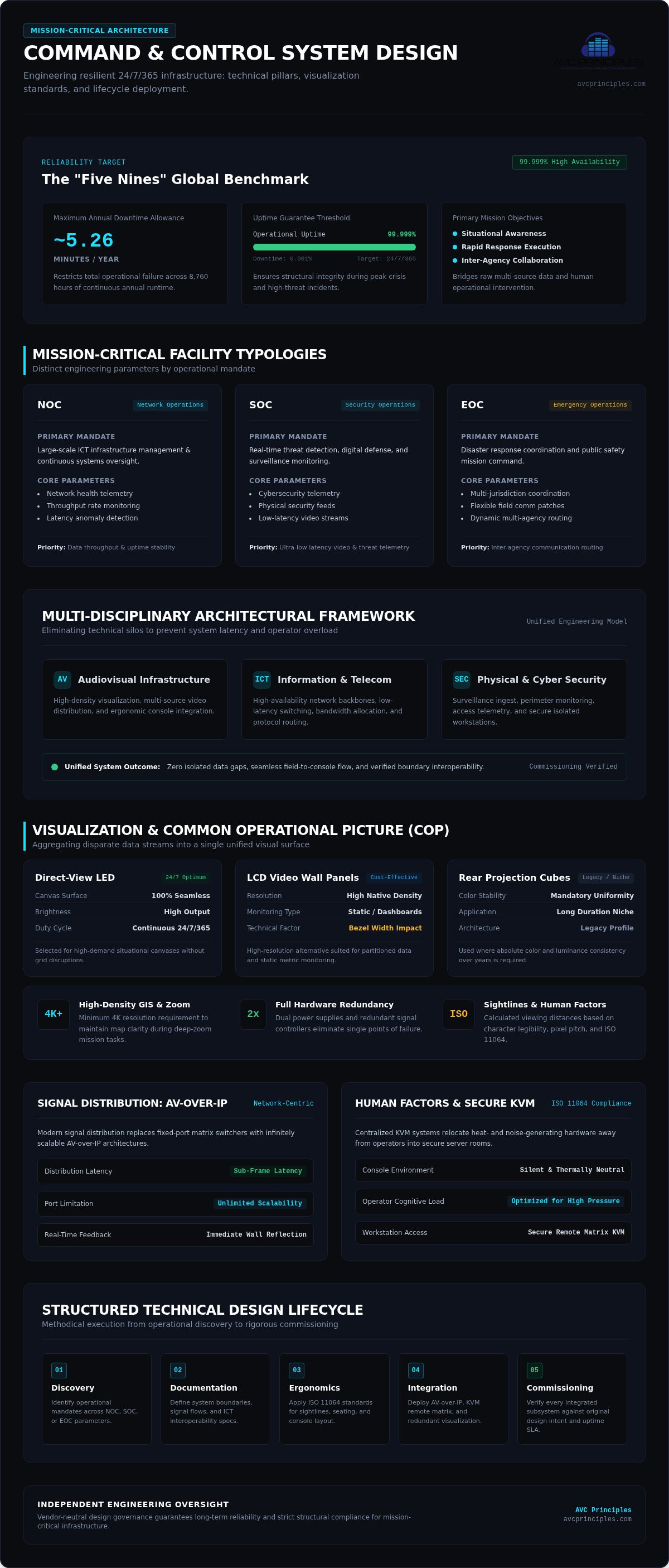
A command and control ecosystem is a mission-critical environment engineered for continuous data synthesis. It's not a standard office space. It's a high-stakes technical hub designed for 24/7/365 decision-making. High-stakes infrastructure requires high availability. We target 99.999% uptime. This "five nines" standard is the global benchmark for technical reliability. It restricts total annual downtime to approximately 5.26 minutes. Achieving this level of performance requires meticulous command and control center system design. The primary objectives are situational awareness, rapid response, and inter-agency collaboration. These goals depend on robust command and control systems that bridge the gap between raw data and human intervention.
Types of Mission-Critical Environments
Operational requirements differ based on the facility's specific mandate. Network Operations Centers (NOC) manage large-scale ICT infrastructure. Their focus is on network health, throughput, and latency. Emergency Operations Centers (EOC) facilitate disaster response. They coordinate public safety efforts across multiple jurisdictions. Security Operations Centers (SOC) provide real-time threat detection. They monitor cybersecurity telemetry and physical security feeds in tandem. Each environment necessitates distinct engineering parameters. A SOC requires low-latency video for surveillance. An EOC needs flexible communication patches for field units. Precision in these requirements prevents system collapse during peak demand.
The Multi-Disciplinary Design Approach
Modern engineering demands a unified system. We integrate AV, ICT, and physical security into a single architectural framework. Technical documentation plays a vital role. It defines system boundaries. It ensures interoperability between disparate hardware sets. Siloed design leads to catastrophic failure during critical events. When infrastructure is planned in isolation, technical gaps emerge. These gaps result in information overload or system latency when seconds matter. A holistic design methodology eliminates these vulnerabilities. It ensures data flows seamlessly from the field to the operator's console. We prioritize technical commissioning to verify that every integrated component meets the original design intent.
Visualization and Information Distribution Architecture
Visualization serves as the primary interface between raw data and actionable intelligence. In a mission-critical environment, the display system is the focal point of the Common Operational Picture (COP). This layer aggregates disparate data streams into a single, unified visualization layer. Effective command and control center system design requires selecting hardware based on the facility's specific duty cycle rather than aesthetic appeal. LED technology offers seamless canvases and high brightness for 24/7 environments. LCD panels provide cost-effective, high-resolution alternatives for static data monitoring, though bezel widths remain a technical consideration. Rear projection cubes, while legacy, still serve niche applications where absolute color consistency over long durations is mandatory.
Video Wall Engineering Parameters
Engineering sightlines requires adherence to established human factors design standards for control centers to prevent physical strain and cognitive fatigue. We calculate viewing distances based on the smallest legible character size and the total pixel pitch of the display. High-density data and GIS mapping demand 4K resolution or higher to maintain clarity during deep-zoom operations. Redundancy is not optional. Every visualization system must include dual power supplies and redundant signal controllers to eliminate single points of failure. This structural integrity ensures the display remains operational during peak crisis events.
Signal Processing and Distribution
Modern signal distribution has transitioned toward AV-over-IP architectures. This shift allows for unlimited scalability and breaks the physical port limitations of traditional matrix switchers. Real-time command and control requires sub-frame latency to ensure operator inputs reflect immediately on the video wall. KVM (Keyboard, Video, Mouse) systems are integrated to allow secure, remote access to workstations. This keeps heat-generating hardware in a controlled server room while providing the operator with a silent, ergonomic workspace. Our engineers specialize in AV systems design that prioritizes these low-latency, high-bandwidth requirements.
Security remains a primary constraint in multi-classification environments. Signal switching must maintain strict isolation between different security levels. ICT infrastructure serves as the backbone for these high-bandwidth video streams. We specify 10GbE networks to accommodate uncompressed or lightly compressed video without compromising signal integrity. Proper technical documentation during the design phase ensures that the network architecture can support the projected traffic loads without bottlenecks. This methodical approach to distribution ensures that critical information reaches the right person at the right time.
Human Factors and Ergonomics in System Design
Engineering a mission-critical environment requires more than hardware selection. The operator is the most vulnerable link in the technical chain. Command and control center system design must prioritize human factors to ensure reliable decision-making under pressure. This involves a rigorous application of ISO 11064 standards. These standards provide a framework for ergonomic design that minimizes physical strain and cognitive fatigue. By focusing on the human interface, we ensure that the technical infrastructure serves the operator's needs during high-stakes events.
ISO 11064 and Structural Compliance
Effective layout begins with functional grouping. We organize workstations based on frequency of interaction and shared data requirements. Circulation paths must remain clear to prevent operational bottlenecks. Workstation design focuses on adjustability and reach zones. Operators shouldn't overextend to access primary controls. Display angles are calculated to prevent neck strain and eye fatigue. Acoustic engineering is equally critical. We utilize sound-absorbing materials to maintain a low noise floor. This reduces operator stress and improves verbal communication clarity during critical operations. A controlled acoustic environment prevents the "cocktail party effect," where background noise interferes with vital information exchange.
Managing cognitive load is a core engineering requirement. Information hierarchy determines how data is presented. We design alarm management systems to prevent alarm fatigue, where critical alerts are buried in a sea of secondary notifications. By categorizing data by urgency, we ensure the operator focuses on the most vital information first. This methodical approach to data synthesis directly impacts situational awareness. Additionally, the physical layout dictates team communication dynamics. We engineer sightlines between supervisors and operators to facilitate non-verbal cues and rapid coordination.
Lighting and Circadian Rhythm
24/7 operations require dynamic lighting systems. These systems mirror natural circadian rhythms to maintain operator alertness across multiple shifts. We specify color-tunable LED fixtures that shift from cool white during daylight hours to warmer tones at night. Reducing glare is a technical priority. We coordinate lighting placement with video wall positions to eliminate reflections on visualization surfaces. Task lighting is provided at individual consoles for granular control. Proper environmental control ensures that the physical space supports the technical mission.
Environmental stability extends to HVAC and thermal management. Mission-critical hardware generates significant heat. We design airflow patterns to protect both the equipment and the operator. Draft-free ventilation is essential for long-term comfort. By integrating these environmental controls with the technical architecture, we create a resilient ecosystem. This holistic approach to command and control center system design ensures that the facility remains operational and the staff remains focused, regardless of the shift duration.
The Technical Design Lifecycle: From Concept to Commissioning
Engineering a mission-critical facility requires a disciplined, phased approach. It isn't a linear installation process. It's a technical lifecycle. A successful command and control center system design follows a rigid progression from initial theory to final execution. This lifecycle includes four primary phases:
- Phase 1: Discovery and Requirements Analysis. We define the operational mission. This involves identifying every data source, user persona, and security classification.
- Phase 2: Schematic Design and System Architecture Development. We establish the high-level distribution strategy. This includes the transition toward AV-over-IP for maximum scalability.
- Phase 3: Technical Documentation and Engineering Specifications. We produce the "contract documents." These are the granular blueprints used for procurement and construction.
- Phase 4: Independent Commissioning and Performance Testing. This final phase provides objective proof that the system meets its operational requirements.
Engineering Documentation Standards
Precision in documentation prevents catastrophic failure during maintenance. We produce detailed signal flow diagrams and rack elevations. Wiring schedules define every connection point within the facility. These documents serve as the blueprint for the build phase. We prioritize vendor-neutral specifications. This approach ensures competitive bidding and prevents proprietary lock-in. The final "As-Built" record is the most critical asset for long-term facility management. It documents the exact state of the infrastructure after commissioning. For expert guidance on these standards, explore our command and control center design services.
Technical Commissioning and Verification
Installation is not the final step. Commissioning is the final verification of reliability. Most competitors stop at the physical build. We don't. We perform final calibration of all audio-visual and broadcast control systems. Network reliability testing is mandatory. We stress-test the ICT infrastructure under peak loads. This identifies potential bottlenecks before they impact operations. System validation ensures every component functions according to the original engineering standards. This methodical verification process mitigates risk. It guarantees that the environment is ready for 24/7/365 service. We verify signal integrity, latency thresholds, and failover protocols. This level of oversight provides the steady hand required for high-stakes infrastructure management.
Independent Engineering Oversight for Mission-Critical Reliability
Reliability in high-stakes environments is not an accident of installation. It's the result of disciplined, independent oversight. Many organizations rely on design-build integrators who simultaneously act as equipment retailers. This creates an inherent conflict of interest. Effective command and control center system design requires a vendor-neutral lens to ensure the infrastructure meets rigorous engineering standards. Independent oversight provides the clinical precision needed to verify that every technical pillar supports the mission. We prioritize structural integrity over manufacturer preferences. This objective perspective is the only way to mitigate risk in mission-critical environments. It ensures that the final commissioned environment is a unified, mission-ready ecosystem.
The Value of Vendor-Neutrality
Open-standard architecture. Scalable distribution. Interoperability. These are the foundations of a resilient system. We avoid proprietary lock-in by specifying components that communicate across open platforms. This ensures the facility remains flexible as technology evolves. Equipment selection must be based on performance metrics and duty-cycle requirements. It shouldn't be driven by sales quotas or manufacturer rebates. Rigorous engineering analysis optimizes the project budget. We identify the most reliable solutions for the specific mission rather than the most convenient ones for an installer. This methodical approach ensures that every dollar spent contributes directly to system availability. It removes the ambiguity often found in general service contracts.
Ensuring Long-Term Operational Success
A command center is a multi-decade investment. Scalability planning is essential. We engineer the ICT backbone to accommodate future bandwidth requirements and emerging data visualization technologies. This future-proofing prevents premature obsolescence and costly mid-cycle refits. Long-term success also requires a structured lifecycle management framework. This includes defined technical support protocols and periodic system audits to ensure continued compliance with ISO 11064. Our role is to align technical infrastructure with long-term organizational goals through comprehensive system oversight.
We emphasize technical commissioning as the final verification of reliability. This isn't a cursory check. It's a rigorous validation against the original engineering specifications. Independent consultants don't have a vested interest in hiding installation errors. We identify and rectify them before they become operational liabilities. This level of oversight provides the steady hand required for high-stakes infrastructure management. It instills a sense of security in stakeholders. They know the system's been vetted by an expert who values the "how" of engineering as much as the "what." This disciplined approach ensures that the facility remains operational, regardless of the crisis level.
Engage AVC Principles for independent command center engineering.
Securing Mission-Critical Operational Integrity
Engineering a high-stakes environment requires a disciplined fusion of ICT infrastructure, AV distribution, and human factors. Success depends on moving beyond simple equipment installation toward a comprehensive technical lifecycle. By prioritizing ISO 11064 standards and sub-frame latency requirements, organizations can effectively mitigate the risk of system failure during peak demand. These technical pillars ensure that your facility isn't just a room with screens, but a resilient ecosystem built for 24/7/365 data synthesis.
Effective command and control center system design is an architectural discipline that demands independent oversight to ensure long-term reliability. A vendor-neutral approach eliminates conflicts of interest and aligns technical specifications with actual performance needs. This methodical progression from discovery to commissioning guarantees that your infrastructure remains resilient and scalable. As a national engineering consultancy specializing in mission-critical architecture, we provide the clinical precision required for complex systems.
Partner with AVC Principles for Expert Command Center Engineering to ensure your facility meets the highest standards of technical reliability. Your mission deserves the steady hand of a seasoned strategist.
Frequently Asked Questions
What is the difference between a NOC and a SOC in terms of design?
NOC design prioritizes network throughput and infrastructure health monitoring. SOC design focuses on real-time threat detection and security telemetry. A NOC requires high-density data dashboards for systemic overview. A SOC necessitates low-latency video distribution and strict signal isolation for surveillance. While both require 24/7 reliability, their visualization hierarchies differ. Successful command and control center system design acknowledges these distinct operational mandates to prevent information overload during critical events.
Why is ISO 11064 important for command and control center design?
ISO 11064 provides the international framework for the ergonomic design of control centers. It's critical because it establishes standards for layout, workstation adjustability, and environmental controls. Adherence to these principles reduces operator fatigue and physical strain. This directly impacts decision-making accuracy during high-pressure scenarios. We use these standards to calculate sightlines, display angles, and circulation paths. This ensures the physical environment supports the technical mission without compromise.
How do I ensure my command center system is future-proof?
Future-proofing requires a move toward AV-over-IP and open-standard architecture. Proprietary hardware limits scalability and leads to expensive mid-cycle refits. By engineering a high-bandwidth ICT backbone, you prepare the facility for emerging data visualization technologies. This includes specifying 10GbE networks and modular signal processing. A vendor-neutral design philosophy allows for the integration of new components as they become available. This preserves your capital investment over a multi-decade lifecycle.
What are the common mistakes in command center visualization design?
Common errors include ignoring sightlines and selecting hardware based on aesthetics rather than duty cycle. Many designs fail to account for the smallest legible character size on a video wall. This leads to operator eye strain and data misinterpretation. Another mistake is omitting power and signal redundancy. Without redundant controllers and dual power supplies, the visualization layer becomes a single point of failure. Proper engineering avoids these pitfalls through rigorous technical documentation and sightline analysis.
How much space is required for a mission-critical command center?
Space requirements are determined by the number of active workstations and the circulation paths required by ISO 11064. You must account for more than just desk space. A functional facility requires areas for supervisors, support staff, and dedicated server rooms for heat-generating hardware. We calculate the total footprint based on functional grouping and ergonomic reach zones. This prevents overcrowding and ensures that the environment remains operational during peak staffing periods.
What is the role of an AV consultant in command center engineering?
An AV consultant provides independent engineering oversight and technical documentation. Unlike an integrator, a consultant doesn't sell equipment. This ensures that system architecture is based on performance rather than sales quotas. The consultant manages the technical design lifecycle from initial discovery through to final commissioning. They verify that the installed systems meet the original design intent and engineering standards. This role is essential for maintaining vendor neutrality in complex projects.
Can legacy systems be integrated into a new command center design?
Legacy systems can be integrated through signal conversion and software-defined integration platforms. This process requires a methodical approach to bridge older hardware with modern command and control center system design. We identify technical gaps and implement gateways that allow legacy data to be synthesized into the Common Operational Picture. This prevents data silos and ensures that existing assets continue to provide value. Successful integration requires precise technical documentation and low-latency signal processing.
What are the redundancy requirements for 24/7 command center operations?
24/7 operations demand a "five nines" (99.999%) uptime standard. This necessitates full redundancy across the critical signal path. Every system must include dual power supplies, redundant network switches, and failover signal processors. We engineer these layers to ensure that a single component failure doesn't result in total system downtime. Technical commissioning verifies these failover protocols under stress-test conditions. This level of reliability is mandatory for mission-critical environments where data loss is unacceptable.


