
What if an event stage’s biggest technical risk isn’t a single piece of equipment, but the gaps between systems? Staged environment engineering for events coordinates audio, video, control, acoustics, and network requirements so the technical environment supports the creative intent. When event, venue, design, and integration teams work from different assumptions, those gaps can become costly coordination problems.
Reliable stages depend on more than capable equipment. They require clear responsibilities and technical decisions that connect design, programming, project management, and commissioning. An integrated engineering approach is particularly useful when a production involves complex systems, multiple stakeholders, or changes to an existing venue.
This guide explains what staged environment engineering covers and when it matters. You’ll compare equipment provision, production execution, and engineering; see how technical documentation turns creative requirements into a coordinated plan; and learn what information and services to consider before an engagement. AVC Principles provides staged environment engineering alongside AV systems design, connecting system requirements and project delivery from concept through commissioning.
Key Takeaways
- Staged environment engineering for events coordinates technical systems and stakeholder requirements, extending beyond equipment selection.
- Acoustics, audio coverage, displays, control, connectivity, and content workflows all shape an integrated stage environment.
- Equipment provision, production execution, and engineering have different scopes, documentation needs, coordination roles, and commissioning responsibilities.
- A practical process moves from event requirements through design and programming to testing and commissioning.
- Clear project inputs and partner responsibilities support better technical decisions as event and venue requirements evolve.
What staged environment engineering for events covers, and why it matters
Staged environment engineering for events is the coordinated planning and design of stage technology and supporting systems to meet defined creative, audience, venue, and operational requirements. Here, “staging” means creating a physical event environment, not a software testing environment used before a digital release.
Engineering defines how systems should function together. Equipment provision supplies specified hardware. Event production plans and delivers the show, while onsite operation runs systems during the event. These activities can overlap, but they have different responsibilities. A clear engineering scope aligns technical decisions before equipment is selected, installed, or operated.
The design must balance audience experience with technical performance and project constraints. A corporate presentation, for example, may prioritize intelligible speech, clear screen sightlines, and reliable content changes. Venue geometry, existing infrastructure, schedule, and budget can all affect the design. The aim is not to apply one standard system to every event, but to define requirements for the specific environment.
Which event environments benefit from engineering?
Concerts, corporate events, performance venues, broadcast settings, and sports environments can all involve coordinated stage technology. Their needs differ. Audience size and seating arrangement affect audio coverage and display placement. Content and show format influence signal routing and control. Venue conditions shape how systems can be integrated. The appropriate engineering scope depends on those project details, not simply the event category.
What does the engineering scope include?
Depending on the project, the scope can connect AV consulting, design engineering, programming, project management, and commissioning. The work coordinates audio, video, control, acoustics, and relevant ICT systems as a unified environment rather than a list of separate equipment. For example, show control systems can link the operation of multiple entertainment systems, making their interfaces and intended workflows important design considerations.
Engineering documentation turns requirements into a coordinated plan stakeholders can use to make and implement decisions. Revit BIM, AutoCAD, and Bluebeam Revu can support drawing and coordination workflows. Programming defines system behavior, while commissioning verifies that installed systems align with the design intent.
These deliverables are distinct from purchasing equipment and supplying event production labor. Engineering defines and coordinates the system; procurement and production address other parts of delivery. Clear boundaries help event, venue, design, and integration teams understand who is responsible for decisions, documentation, implementation, and operation.
How event AV systems are engineered to work as one environment
Integration starts with the event’s purpose, not a device list. The design team translates objectives into functional requirements, then uses them to develop system architecture and coordinated documentation. For a corporate event, that might mean defining how presenters share content, how remote material enters the room, what the audience needs to see and hear, and how operators manage transitions.
Translate event objectives into technical requirements
Requirements should capture the audience experience, event format, content types, presenter needs, and operational workflows. These decisions shape how audio, displays, control, and connectivity are arranged. They also help avoid assuming that every room needs the same configuration. Document design assumptions, system interfaces, and dependencies, such as how a presentation source connects to the display and audio systems it needs to reach.
Event readiness depends on defined system interfaces and coordinated decisions among the people responsible for design, construction, integration, and operation.
Coordinate AV, acoustics, control, and infrastructure
Systems affect one another. Room geometry and finishes influence acoustic design. Audio coverage must serve the audience and event format. Display positions need to support sightlines and content, while control workflows must account for how sources and systems interact. Network and ICT requirements also need coordination so supporting infrastructure aligns with the AV design.
Where acoustic analysis is relevant, EASE audio prediction software can inform design decisions. BIM coordination can help identify how AV requirements relate to architectural and construction design. Revit BIM, AutoCAD, and Bluebeam Revu support drawing and documentation workflows, helping architects, interior designers, contractors, consultants, and integrators work from coordinated project information. This makes interfaces and dependencies easier to identify while design decisions can still be aligned.
The result is a technical plan that connects creative intent to coordinated, buildable systems. Documented requirements give stakeholders a shared reference for resolving design questions and aligning implementation responsibilities.
For corporate projects where AV, acoustics, control, and infrastructure decisions intersect, AV systems design and coordination can establish a unified technical basis for the event environment.
Engineering-led design or equipment-led production: how to compare approaches
These approaches address different parts of event delivery. Equipment provision focuses on products. Production executes the event according to its assigned scope. Engineering defines how the technical environment should be designed and coordinated. A project may use one or several of these roles, with responsibilities set by the agreement and project requirements.
What changes between equipment, production, and engineering?
Equipment provision
Scope: Supplies equipment. Documentation: May include product or inventory information, but not necessarily an integrated system design. Integration and coordination: Depend on the wider project arrangement. Commissioning: Not inherent to equipment supply.
Production execution
Scope: Plans or delivers event operations, as assigned. Documentation: Focuses on production needs and show execution. Integration and coordination: Covers the systems and stakeholders included in the production scope. Commissioning: May be included when specified, but isn’t automatic.
Independent engineering consultancy
Scope: Develops technical requirements, system design, and coordination. Documentation: Defines systems and interfaces for project stakeholders. Integration and coordination: Addresses cross-system and project dependencies. Commissioning: Can be included in the engineering lifecycle.
The distinctions are functional, not absolute. An integrator-led approach may suit a project when the integrator’s scope includes system design, implementation coordination, and validation. Equipment and production teams also contribute essential expertise. Define who owns each design decision, interface, and delivery task rather than assuming role names determine responsibility.
When is independent engineering oversight useful?
Independent design expertise can add value when technical decisions span several stakeholders or disciplines. New construction and retrofit projects, for example, may require AV plans to align with architecture, interiors, existing infrastructure, and construction schedules. An engineering perspective can establish requirements and coordinated documentation before procurement or implementation decisions narrow the options.
This approach is especially relevant when audio performance, acoustics, control, and ICT requirements must be considered together while balancing technical intent with budget and schedule constraints. Staged environment engineering for events provides a defined design basis for production and integration teams to use within their respective scopes.
AVCPrinciples’ experience includes performing arts centers, sports arenas, broadcast studios, entertainment venues, and corporate campuses. This experience informs work across different environment types without assuming every project has identical requirements. Its consulting, design engineering, project management, programming, and commissioning services can support coordination across the project lifecycle. The right model is the one that makes scope, interfaces, and accountability clear for the specific event and venue.
A practical engineering sequence from event brief to technical commissioning
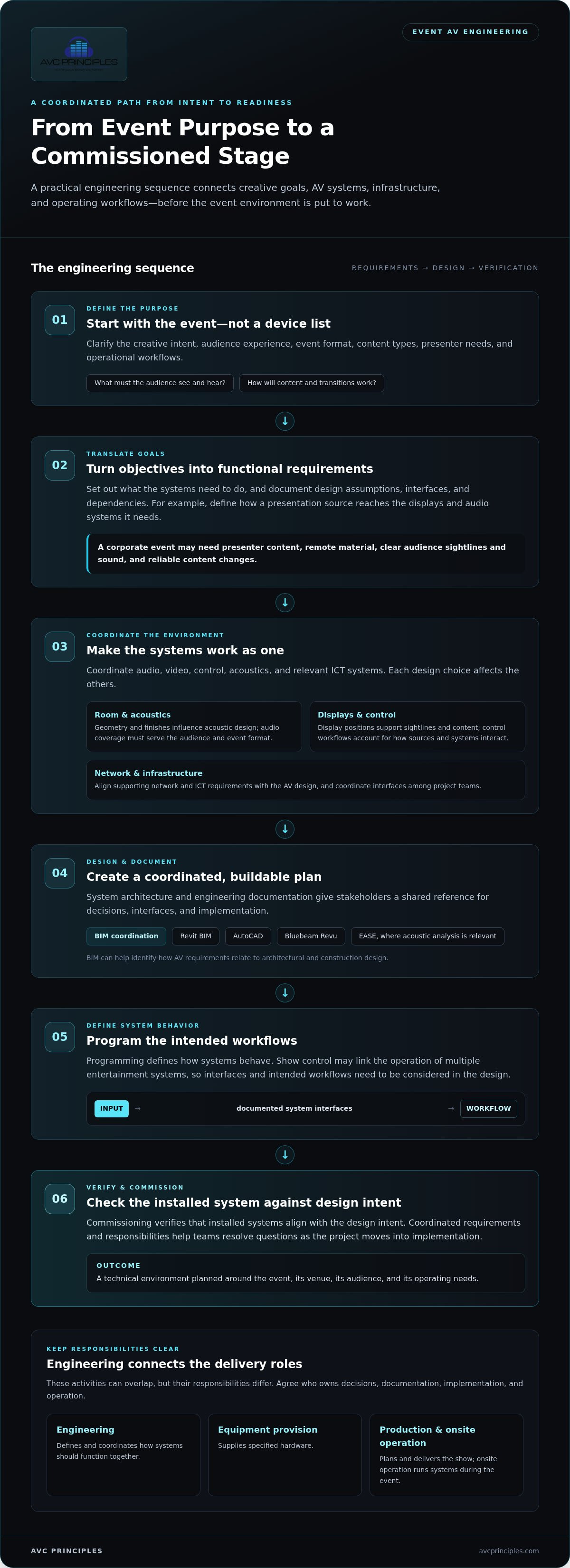
A reliable project sequence turns event objectives into decisions that can be designed, coordinated, implemented, and verified. Staged environment engineering for events follows an adaptable path: define requirements, develop the design, coordinate stakeholders, program systems, test, and commission. Phases may overlap, but clear records help the project team track decisions as venue or event needs change.
Prepare the project brief and design basis
Begin with the event purpose, format, audience, venue information, presenter and operator needs, and known project constraints. Useful inputs may include venue drawings, details about existing systems, stakeholder roles, and budget or construction schedule considerations. Record confirmed information separately from assumptions that need resolution. This design basis gives stakeholders a shared reference for scope, interfaces, and decisions as the design develops. For broader context on the planning and technical design process, see the AV design and engineering consulting guide.
Coordinate design, implementation, and commissioning
Design engineering develops the system approach and its documentation. BIM coordination aligns AV requirements with architectural and construction information. Project management supports communication across stakeholders and tracks decisions, dependencies, and changes. Programming defines system behavior in line with the design and operational needs.
As implementation proceeds, documented requirements guide testing and commissioning. Commissioning verifies installed systems against the project’s stated requirements. It is a verification activity, not a performance guarantee. If event or venue requirements change, assess the effect on system interfaces, documentation, programming, schedule, and responsibilities, then record agreed revisions.
For projects that include broadcast infrastructure, the broadcast infrastructure engineering guide provides additional context for that specialized scope.
- Define: Confirm event objectives, venue conditions, stakeholders, workflows, and constraints.
- Design: Translate requirements into system architecture and coordinated documentation.
- Coordinate: Align design information, dependencies, and responsibilities across project disciplines.
- Program and test: Configure system behavior and assess it against the documented design.
- Commission: Verify the installed systems against agreed project requirements.
AVCPrinciples provides staged environment engineering to develop a coordinated basis for an event’s technical environment.
Choosing an event engineering partner and defining the next step
The right engineering engagement begins with a clear definition of the work. Assess relevant venue experience, technical breadth, documentation practices, and the ability to coordinate stakeholders across design and delivery. These factors help determine whether a team can address the project’s system requirements rather than only one part of the event environment.
What should an engineering engagement clarify?
Set out the project objectives, scope boundaries, stakeholder interfaces, expected design deliverables, and lifecycle responsibilities. Clarify how event, venue, design, construction, and integration teams will share information and resolve technical decisions. Requirements, budget considerations, acoustics, and construction schedules should inform planning from the outset because each can affect design choices and coordination. Clear scope reduces ambiguity about who is responsible for decisions and how changes are recorded.
For staged environment engineering for events, useful partner evaluation questions include:
- Relevant experience: Has the team worked in venue types and environments related to the project?
- Technical breadth: Can its engineering address AV, control, acoustics, and related ICT considerations?
- Documentation: Are design intent, assumptions, system interfaces, and stakeholder dependencies made clear?
- Lifecycle coordination: Does the scope explain how design, programming, project management, and commissioning connect?
How AVCPrinciples supports complex event environments
AVCPrinciples connects audio visual consulting and design engineering with programming, project management, and commissioning. This lets the engineering scope support the project from requirements and system design through coordinated delivery and verification. AV and ICT design expertise can be applied to performance and entertainment environments, with project planning informed by technical requirements, acoustics, budgets, and construction schedules.
Experience includes performing arts centers, sports arenas, broadcast studios, entertainment venues, and corporate campuses. The principal holds CTS‑I, CTS‑D, and BICSI RCDD credentials.
Before defining the next step, assemble available venue information, event objectives, stakeholder contacts, operational needs, and known constraints. These inputs give the engineering discussion a practical basis and help identify key decisions and interfaces. Discuss your event engineering requirements with AVCPrinciples.
Set your event environment up for coordinated delivery
Reliable event stages depend on more than equipment choices. Staged environment engineering for events aligns technical requirements, system interfaces, venue conditions, and stakeholder responsibilities. Clear design documentation helps teams move from event objectives to coordinated implementation, while programming and commissioning connect design intent to system operation and verification.
The right project approach depends on the scope. Equipment provision, production execution, and engineering each serve distinct roles, and clearly defined responsibilities help prevent gaps between them. AVCPrinciples brings AV consulting, design engineering, programming, and project management to complex environments, with experience spanning performing arts centers, sports arenas, broadcast studios, and entertainment venues. The principal holds CTS‑I, CTS‑D, and BICSI RCDD credentials.
Start with the event brief, venue information, operational needs, and known constraints. These inputs create a practical foundation for discussing scope and coordination. Discuss your event engineering requirements with AVCPrinciples to plan an integrated technical environment for your event.
Frequently Asked Questions
What is staged environment engineering for events?
Staged environment engineering for events is the coordinated planning and design of event-stage technology and supporting systems. It translates event objectives and venue conditions into system requirements, architecture, and technical documentation. The work can coordinate audio, video, control, acoustics, and relevant ICT needs. Its scope varies by project: a corporate presentation in an existing room may call for a different engineering approach than a performance venue or a new construction project.
What systems are included in event stage engineering?
Depending on the event and venue, engineering may coordinate audio, video displays, control systems, acoustics, and supporting network or ICT infrastructure. It also considers how content moves through the system and how operators manage intended workflows. These elements are interdependent: display placement affects sightlines, room conditions inform acoustic design, and control depends on defined system interfaces. The design scope should reflect project requirements rather than assume every event needs the same systems.
How is event engineering different from AV equipment rental or production?
Equipment rental or provision concerns supplying equipment, while engineering defines how systems should be designed and coordinated to meet project requirements. Event production focuses on planning or executing show activities according to its assigned scope. These roles can complement one another, and some project scopes may overlap. Document who is responsible for system design, technical interfaces, implementation coordination, event operations, and commissioning.
When should an event team involve an AV engineering consultant?
Involve an AV engineering consultant while event requirements and venue decisions can still inform the design. Early input is useful when multiple stakeholders must coordinate, when AV intersects with architecture or construction, or when a project involves new construction, retrofit work, acoustics, or integrated technology. An engineer can help turn objectives into documented requirements and system interfaces. The exact scope depends on the project’s complexity, existing information, and delivery responsibilities.
Can staged environment engineering support both new construction and retrofit projects?
Yes. Staged environment engineering can support both new construction and retrofit projects. In new construction, AV and ICT requirements can be coordinated with architectural and construction information as the design develops. In a retrofit, the engineering process accounts for the existing environment and infrastructure alongside event requirements. In either case, scope, documentation, and coordination should reflect the conditions of that specific project.
How do engineers test and commission event AV systems?
Commissioning verifies installed systems against documented project requirements. The process can include checking that system functions and interfaces align with design intent, recording issues, and confirming their resolution within the agreed project scope. Testing provides a structured way to evaluate the installed work; it is not a guarantee of performance beyond the stated requirements. Applicable checks depend on the systems, documentation, and responsibilities established for the project.
What information should an event brief include before engineering begins?
An event brief should describe the event’s purpose, format, content, audience, venue, presenter needs, and operational workflows. Include available venue drawings or information about existing systems, identify key stakeholders, and record known budget or construction schedule constraints. Separate confirmed requirements from assumptions that need resolution. These inputs give the engineering team a basis for defining scope, documenting dependencies, and coordinating technical decisions as the project develops.


