
What has to work together for sound to remain clear and consistent from the front rows to the rear of a concert hall? Loudspeakers are only one part of the answer. Concert hall audio system design must account for room acoustics, audience coverage, control, and the infrastructure connecting each part of the system. If these decisions are made in isolation, even a carefully selected system may not perform as intended throughout the space.
It is understandable to focus first on loudspeaker placement, but room shape, volume, materials, and intended uses also shape system decisions. This guide explains the main elements of concert hall audio system design and how they interact, including what to resolve before construction and how engineering helps translate the intended listening experience into a coordinated plan.
We’ll examine acoustic coordination, system architecture, coverage, control, and technical infrastructure, then look at how design documentation and commissioning carry those decisions into operation. The goal is to align performance requirements with architecture, construction schedules, and project constraints from concept development through completion.
Key Takeaways
- Set the design brief around program types, stage use, audience areas, and operating modes before selecting system components.
- Understand how signal flow, loudspeaker directivity, and coverage zones inform concert hall audio system design.
- Compare the priorities of speech, amplified music, and multipurpose use to define the right balance of flexibility and operational control.
- Follow a coordinated engineering sequence from requirements and concept development through construction documentation and installation support.
- Use commissioning to verify system functions, signal paths, control behavior, and performance against documented design intent.
Concert Hall Audio System Design Starts With the Room and Its Use
Concert hall audio system design coordinates sound reinforcement, room acoustics, technical infrastructure, and operating requirements. It is not simply a matter of choosing loudspeakers or other equipment. The room and its intended use set the conditions the system must address, so design begins with the performance brief and architectural context.
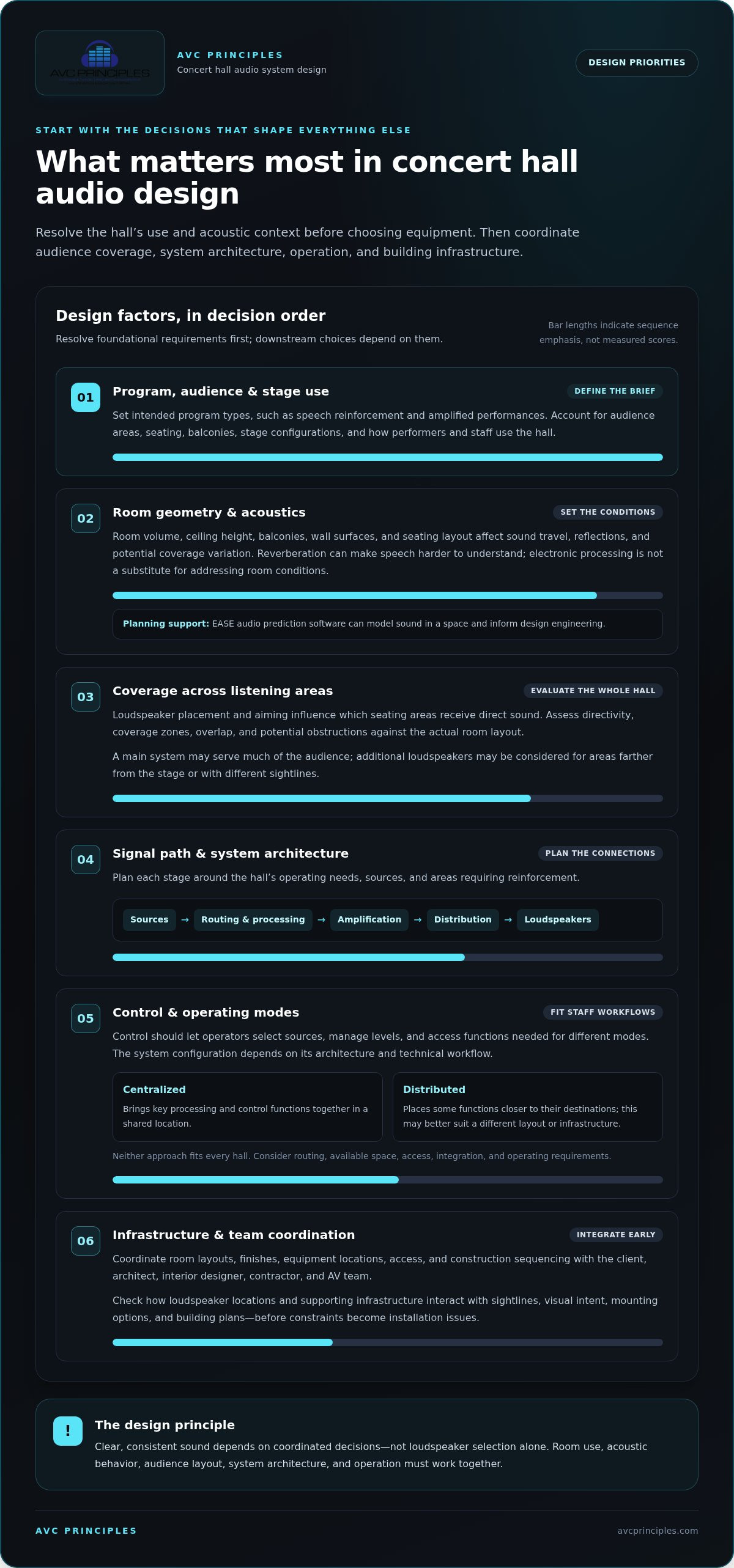
Geometry matters. Room volume, ceiling height, balcony positions, wall surfaces, and seating layout affect how sound travels and where listeners may experience strong reflections or uneven coverage. These factors inform the system approach, loudspeaker locations, and infrastructure before equipment is selected. Early coordination helps integrate audio into the building design instead of treating it as a late addition.
Which performance and audience needs shape the design brief?
Begin by listing the hall’s intended program types. Speech reinforcement, amplified performances, and other planned uses can have different priorities. A hall intended for varied events may need distinct operating modes. Seating areas, balcony and side sections, stage configurations, and the ways performers and staff use the space also shape the requirements.
Use the brief as a shared project reference. The client, architect, interior designer, contractor, and AV team need to coordinate on room layouts, finishes, equipment locations, and construction sequencing. Clear requirements help each discipline identify where decisions intersect, such as how a ceiling feature affects loudspeaker placement or how an equipment location affects access.
How do room acoustics affect concert hall sound?
Sound reflects from room surfaces. Some reflections contribute to a sense of space; others may arrive late or strongly enough to blur detail. Reverberation is the persistence of sound after its source stops. In a highly reverberant room, speech may be harder to understand. The electronic system also needs to be designed for its acoustic environment.
Architectural acoustics describes how a building’s design influences sound. In concert halls, geometry and finish materials shape the acoustic environment in which the audio system must operate. Acoustic assessment and system planning should therefore inform one another. Electronic processing should not be treated as a substitute for addressing room conditions.
EASE audio prediction software can support design engineering by modeling sound in a space. The model helps inform planning, while project requirements and coordination among the design team remain essential. Room use, acoustic behavior, and audience layout together establish the basis for system design.
How Loudspeaker Coverage and Audio Architecture Work Together
A loudspeaker layout is only one part of an audio system. The signal path starts with sources such as microphones or playback inputs, then runs through routing and processing, amplification, distribution, and loudspeakers. Plan each stage around the hall’s operating needs and the areas that require sound reinforcement.
Evaluate audience coverage across every intended listening area, because loudspeaker placement and system architecture determine how sound is distributed through the hall. Directivity describes how a loudspeaker projects sound in different directions. Coverage zones are the audience or performance areas served by particular loudspeakers. Design analysis considers how these zones relate, including where coverage overlaps and where architectural features may obstruct sound.
What does audience coverage mean in a concert hall?
Placement and aiming influence which seating areas receive direct sound and how evenly the system serves them. A main system may cover much of the audience, while additional loudspeakers may be considered for areas farther from the stage or with different sightlines. Evaluate these choices against the room layout rather than assuming one arrangement suits every hall.
Coverage objectives must also work with the architecture. Loudspeakers and their supporting infrastructure can affect sightlines, visual intent, access, and available mounting locations. Coordination during design helps identify constraints before they become installation issues. Consistency is an objective to evaluate across audience areas, not something equipment selection alone can guarantee.
How do audio processing and control support the system?
Processing routes and shapes signals for the intended use. Amplification drives the loudspeakers, while distribution connects system components and signal locations. Control gives operators a way to select sources, manage levels, and access the functions required for different operating modes. The configuration depends on the system architecture and technical workflow.
A centralized approach brings key processing and control functions together in a shared location, supporting coordinated management. A distributed approach places some functions closer to their destinations, which may better suit a different infrastructure or layout. Neither approach is right for every hall. Choose based on signal routing, available space, access, integration, and the project’s operating requirements.
Integrated AV and control systems can be planned for new construction or retrofit. In either case, the design needs to account for existing or planned infrastructure and how staff will operate the system. Concert hall audio system design connects coverage strategy with signal flow and control behavior. For a performance venue requiring coordinated planning, explore AV systems design as part of the broader project approach.
Concert Hall Audio Design Choices: Performance, Integration, and Flexibility
System priorities vary with the intended program. Speech reinforcement places particular emphasis on intelligibility and consistent vocal reproduction. Amplified music may call for a different balance of musical detail, impact, and control. A multipurpose hall needs to support its documented uses without assuming that one setup will suit every event.
There is no universal equipment recipe for concert hall audio system design. Decisions should follow the project brief, acoustic context, stage requirements, and operating workflows. For example, a hall hosting both spoken-word presentations and amplified performances may need clearly defined modes that let operators access the functions relevant to each event.
How should a design respond to different performance requirements?
Translate each intended use into system capabilities and operating modes. Identify who will operate the system, which sources are needed, and how the hall will transition between event types. Speech-focused use may prioritize vocal clarity, while music performance may place different demands on tonal character and system control. These priorities should be established for the specific venue rather than assumed to apply equally everywhere.
Balance flexibility with maintainability. A system with many options can be difficult to operate if workflows are unclear. Defined control interfaces, logical mode selection, accessible equipment locations, and organized system documentation help support practical operation and future service. For broader event-venue context, see this guide to staged environment engineering for events.
What should be coordinated with architecture and other AV systems?
System planning involves more than selecting equipment locations. Coordinate equipment spaces and mounting positions with architectural layouts, as well as pathways, power, network interfaces, maintenance access, and visual integration. These decisions affect adjacent building systems and the venue’s appearance. Resolving interfaces during design helps teams address conflicts as drawings and construction plans develop.
Revit BIM and AutoCAD can support design coordination by helping teams work with building information and technical layouts. The appropriate coordination approach depends on project requirements. Audio and control decisions may also connect with other AV functions, so consider interfaces and operator workflows as part of the wider system plan. For a broader view of coordinated system planning, read the guide to AV design and engineering consulting.
The result is a framework tailored to the venue: defined use cases, coordinated infrastructure, maintainable systems, and control workflows aligned with how the hall operates.
From Design Brief to Construction: A Practical Engineering Sequence
A concert hall audio system moves from requirements to operation through a coordinated engineering sequence. Each phase makes decisions clear enough for stakeholders and project teams to review before they affect later design or construction work. The sequence typically includes:
- Requirements: Document venue uses, stakeholder needs, operating modes, and project constraints.
- Concept: Establish a system approach in response to the brief and room conditions.
- System design: Develop signal architecture, equipment locations, infrastructure needs, and control functions.
- Coordination and documentation: Align the design with building plans and record interfaces for the project team.
- Delivery and verification: Support installation and use commissioning to check the completed system against documented design intent.
This sequence gives concert hall audio system design a practical framework: requirements guide the concept, and coordinated documentation carries decisions into construction. Reviews at key stages give the client, design team, and construction stakeholders an opportunity to address conflicts and assess alternatives. Construction schedules matter too. Resolve equipment locations, pathways, and technical interfaces in step with architectural and engineering work, before the relevant spaces are finalized.
What happens during requirements definition and system design?
Requirements definition captures intended venue use, stakeholder priorities, operating modes, and project constraints. The design team translates that brief into a system architecture and documentation describing how components, spaces, and interfaces relate. Acoustic analysis can inform room and sound-system decisions. EASE audio prediction software is one tool used in this work, interpreted in the context of the project’s requirements.
Technical documents do more than identify equipment. They communicate locations, pathways, connectivity, control relationships, and coordination requirements. This gives architects, consultants, contractors, and AV integrators a shared reference for resolving interfaces and planning the work.
How does AV coordination support construction and retrofit projects?
For new construction, coordination aligns the AV design with developing architectural, interior, structural, electrical, and network plans. BIM coordination helps teams review spatial relationships and identify potential conflicts. Project management supports communication between stakeholders and connects design decisions with delivery needs.
Retrofits start from a different set of conditions. Existing layouts, available pathways, room access, and retained infrastructure can constrain design choices. The team needs to account for these conditions when defining the proposed system and its interfaces. AVC Principles provides design engineering, programming, and project management for performance environments. Plan a coordinated AV design process from early requirements through construction and commissioning.
Commissioning Makes Concert Hall Audio Design Verifiable
Commissioning checks whether the installed audio system operates in line with its documented design intent. It connects engineering decisions made during concert hall audio system design to the system’s actual functions, signal paths, and operating modes. It also provides a structured way to identify issues that need to be addressed before project completion.
Verification is measured against the project’s approved documentation and acceptance criteria. Generic thresholds cannot replace criteria defined for the specific venue and its intended uses. Testing should be relevant to the design brief, not based on assumptions that may not suit the hall.
What should be verified during audio system commissioning?
Commissioning can include functional checks of routing, control behavior, and intended operating modes. The team verifies that sources reach their assigned destinations and that control functions support the documented workflows. Audio and acoustic performance testing can also assess system behavior in the venue, using project-defined methods and criteria.
Record findings and compare them with the relevant design documents. If a test identifies a discrepancy, the project team can document the issue, assign follow-up, and verify the resolution through established project processes. This record supports handover and gives the venue team a reference for system operation.
When should a venue engage an engineering consultant?
Engineering input is useful at concept development, while room and system requirements are being established. It also supports new construction, retrofit planning, and system renewal, where existing conditions or schedules influence design decisions. Early involvement connects technical requirements with architectural coordination. Continued involvement through commissioning helps carry design intent into verification.
AVCPrinciples provides audiovisual consulting, design engineering, programming, project management, and commissioning for performance environments. Coordinating these phases helps align system requirements, technical documentation, construction interfaces, and final verification. The scope is shaped around the project’s needs.
For coordinated concert hall audio system design and commissioning support, contact AVCPrinciples at (562) 343-6014 or (562) 714-4151, or email [email protected].
Plan a Coordinated Path From Design to Performance
Concert hall audio system design is strongest when room acoustics, audience coverage, system architecture, and operating requirements inform one another from the outset. Equipment choices matter, as do clear design documentation, coordination with architecture and construction, and commissioning that verifies the installed system against project intent.
Every venue has distinct performance needs. A coordinated engineering process translates those needs into practical system decisions, aligns work across project teams, and carries design intent through delivery. AVCPrinciples brings experience with performing arts centers and entertainment venues, with expertise spanning acoustics, BIM coordination, and integrated technology strategies. Its services include design engineering, programming, project management, and commissioning.
Planning a new concert hall, retrofit, or system renewal? Discuss concert hall audio system design with AVCPrinciples and take the next step toward a coordinated project plan.
Frequently Asked Questions
What is concert hall audio system design?
Concert hall audio system design is the planning and engineering of sound systems in relation to a venue’s acoustics, intended performances, audience areas, and operating requirements. It involves more than choosing loudspeakers. The work can include system architecture, coverage planning, control, infrastructure coordination, and technical documentation. Commissioning then helps verify that the installed system functions in line with the project’s documented requirements.
How do acoustics affect a concert hall sound system?
Room shape, surfaces, and other acoustic conditions influence how sound travels and is heard. These factors inform loudspeaker placement, coverage planning, and system decisions. Room acoustics and electronic audio design are related but distinct disciplines: a sound system does not replace acoustic planning, and acoustic planning does not replace system engineering. Project-specific analysis helps the design team consider both in relation to the hall’s intended uses.
Are loudspeakers the most important part of concert hall audio design?
Loudspeakers are important, but they are only one part of a concert hall audio system. A complete design also considers the room, audience areas, audio sources, processing, amplification, control, infrastructure, and operating needs. Selecting products before defining those requirements can leave integration and coverage questions unresolved. Establishing what the venue must support first gives the design team a basis for evaluating system architecture and equipment choices.
How is sound coverage planned in a concert hall?
Coverage planning evaluates where sound needs to reach and how room conditions, architecture, and venue use shape the design. Designers consider loudspeaker locations and orientation alongside the intended audience areas and system architecture. Project requirements and documented analysis guide the evaluation. Generic targets may not suit a particular venue, so define coverage expectations for the project rather than assuming a universal rule.
What is the role of EASE audio prediction software in venue design?
EASE audio prediction software supports audio design analysis. It can help assess proposed system arrangements in relation to a modeled space when the model and project information are appropriate to the analysis. Software is one part of the engineering process. It does not replace project-specific requirements, professional judgment, or commissioning. Its use alone does not establish predicted results or prove system performance.
When should concert hall audio system design begin?
Concert hall audio system design should begin early enough to inform the project brief and coordinate with architectural and construction decisions. Early planning gives the team an opportunity to address system requirements, equipment locations, pathways, interfaces, and operating needs as the project develops. Retrofit planning should also account for existing conditions and the intended scope of change. These inputs help frame decisions before they become difficult to integrate.
What does commissioning verify in a concert hall audio system?
Commissioning verifies whether an installed system operates in accordance with its approved design and project documentation. Depending on the documented scope, checks may include signal routing, control functions, operating modes, and audio performance. Project-specific acceptance criteria should guide testing rather than generic thresholds. Recording findings creates a structured basis for resolving issues and handing system information over to the venue team.


